
Defensive specialist in volleyball: DS vs libero, role and rules
The short answer
A defensive specialist in volleyball is a regular substitute you bring in to pass and play defense, usually for three rotations in the back row. Unlike the libero, a DS may serve and attack, but every substitution counts toward your six per set.
A defensive specialist in volleyball, or DS, is not a position in the rulebook but a coaching choice. Here you read what a DS may and may not do, what they cost you in substitutions and how they fit next to one or two liberos.
What is a defensive specialist in volleyball?
A defensive specialist is a player you bring off the bench to pass and dig. They usually come in for an attacker who is in the back row, play a few rotations there and come off as soon as that spot rotates to the front again. The term is common mainly in American volleyball, where teams have far more than six substitutions. In NCAA women's volleyball, the US college game, teams have so far been allowed up to 15 substitutions per set; in Divisions II and III that becomes 18 (NCAA, February 2026). With that many substitutions, the defensive specialist is a fixed role on many teams there.
The FIVB rulebook has no such role. In fact, that rulebook uses almost the same words for the liberos: it calls them "specialist defensive players" (Rule 19.1.1 of the Official Volleyball Rules 2025-2028). The difference is fundamental, though. The libero is a separate player with their own rules and a jersey in a different color. The defensive specialist is a regular player you bring in with a regular substitution, in the same jersey as the rest of the team.
Defensive specialist vs libero: what is the difference?
Because the defensive specialist is a regular player, the rules of the spot they occupy in the rotation apply to them. That makes a DS more useful than a libero on a few points, and more expensive on one.
| What | Defensive specialist | Libero |
|---|---|---|
| Jersey | Same as the team | A contrasting color |
| Serving | Yes, when in position 1 | No |
| Attacking from behind the attack line | Yes, at any height | Only if the ball is partly below the top of the net |
| Blocking | Only when in the front row | No |
| Counts as a substitution | Yes, in and out | No, Libero replacements are separate |
| How often per set | Once in and once out | Unlimited, with a completed rally in between |
A back-row player may attack at any height, as long as they do not touch or cross the attack line at take-off (Rule 13.2.2). In the front zone they may only attack if the ball is partly below the top of the net at contact (Rule 13.2.3). If your defensive specialist stays on court when their spot rotates to the front, they are simply a front-row player who may block and attack from anywhere. The libero may not serve, block or attempt to block (Rule 19.3.1.3); the rest of the libero rules, such as setting with the fingers in the front zone, are in the libero: rules and role.
What the substitution rules mean for your defensive specialist
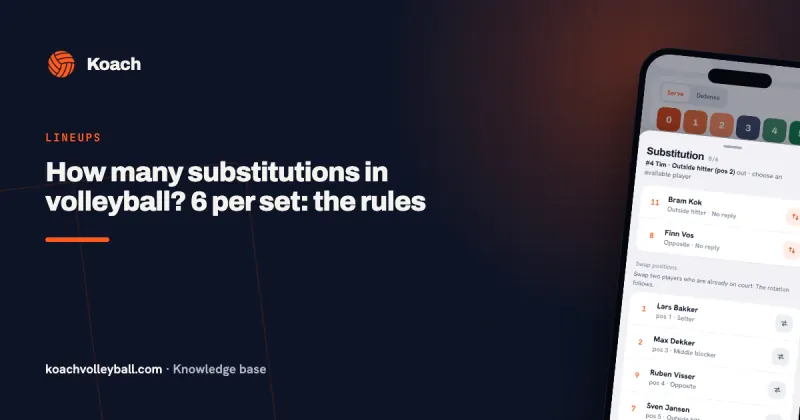
This is where the real limit is. You make no more than six substitutions per set (Rule 15.1). A starting player may leave the game once per set and come back once, and only to their own position in the lineup (Rule 15.6.1). A substitute may enter the game once per set to replace a starting player, and can only be replaced by that same starting player (Rule 15.6.2). The substitute takes over the starting player's position in the lineup (Rule 15.5.1), and with it their turn to serve.
Say your outside hitter #12 attacks well but passes shakily. This is what one cycle with a defensive specialist looks like:
- Your team wins the serve back and #12 rotates to position 1. Before the whistle for the serve you substitute: the defensive specialist comes in. That is substitution 1.
- The DS serves and plays three rotations in the back row, in positions 1, 6 and 5, in serve receive and defense.
- When their spot rotates to the front, to position 4, you bring #12 back. That is substitution 2.
After that the pair is done for this set: #12 has been off once and back once, and the defensive specialist has entered once. So one cycle costs you two substitutions. Do it for two players and you have two left for an injury or a tactical change at the end of the set. Also, between two separate substitution requests from the same team there has to be a completed rally (Rule 15.2.3); if you want to change several players at once, ask for them in one request. The full rules, including what happens with an injury when your substitutions are used up, are in how many substitutions you get in volleyball. If you play in a league with its own substitution rules, for example in youth volleyball, your federation's rules apply.
How does a defensive specialist fit next to one or two liberos?
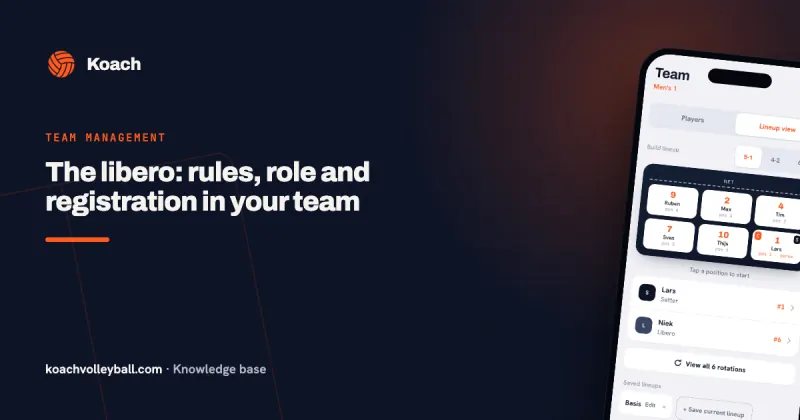
On most teams the libero comes in for the middle blockers when they are in the back row. Next to the libero there are then two more players in the back row, usually an outside hitter and the setter or the opposite. If one of those two is your weak spot in serve receive or defense, that is the spot for a defensive specialist. With a libero and a DS you have two players in the back row in those rotations whose main job is the first ball.
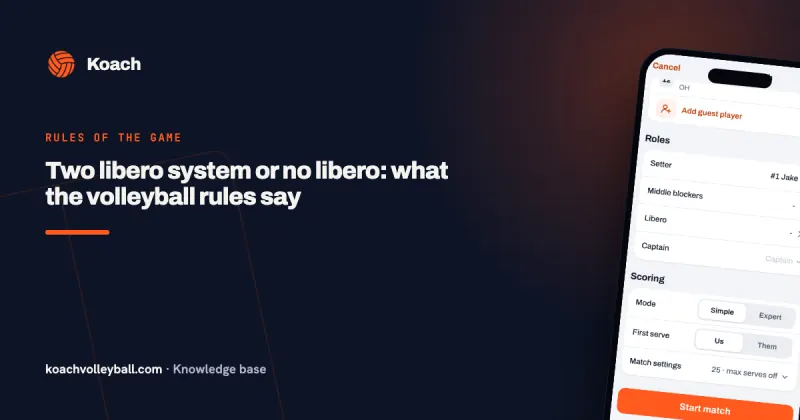
Two liberos do not solve that. You may designate two, but only one of them is on court at any time (Rule 19.1). How teams work with two liberos is in volleyball without a libero or with two. If you want two specialists in the back row at the same time, you need a libero and a defensive specialist.
There is one more difference that counts in the choice: the libero does not serve. If you have a good passer who also has a tough serve, you would rather make them a defensive specialist than a libero. As a libero they may not serve; as a DS they take over the service turn of the player they replace, and then stay in the back row.
When do you use a defensive specialist?
- For an attacker who passes poorly. You keep their attack in the front row and take their passing out of the back row. What you give up is their attack from behind the attack line. If your team runs a lot of back-row attacks, the substitution costs you firepower.
- Against a team that serves hard. If a lot of jump serves are coming at you, you want players in serve receive who train for exactly that every week.
- At the end of a set. A defensive specialist with a good serve is a substitution that works twice in a tight finish: first a serve with pressure, then an extra defender. Keep substitutions in reserve for it.
- As playing time for a developing player. A player who does not yet attack well enough but passes well gets real match minutes in a spot where they already add something.
When better not: if you go to a match with seven or eight players, you need your substitutions for fatigue and injuries. And with young players it is better that everyone learns everything, including passing and defense; a fixed specialist role comes later.
What a good defensive specialist needs to be able to do
The role asks for more than good passing. A DS comes in cold off the bench, often at a tense moment, and has to play the first ball well right away. Look for four things when you choose one: a stable pass on the serve, also on a hard ball; defending by reading the hitter; a serve that reliably goes in, because serving is often their first action; and talking with the libero, so they do not both go for the ball, or neither of them does. Train a DS in the same drills as your libero, for example from volleyball digging drills.
Keep them warm and tell them in advance when they go in. According to the FIVB rules, players who are not on court may warm up without balls in the warm-up area during play, if the gym has one. Agree before the match at which rotation or score they come in, so they are ready instead of hearing it only when the whistle blows.
Tracking a defensive specialist in Koach
Koach has no separate position for a defensive specialist. In the player's profile you give them their main position, for example Outside hitter, and if you like a Second position; you assign the libero under Roles. During live scoring the Sub button shows how many substitutions you have used in this set, and Libero replacements do not count toward it. If you try a substitution that goes against the rules, for example with a substitute who has already been in and out, the app first asks Is this substitution allowed?
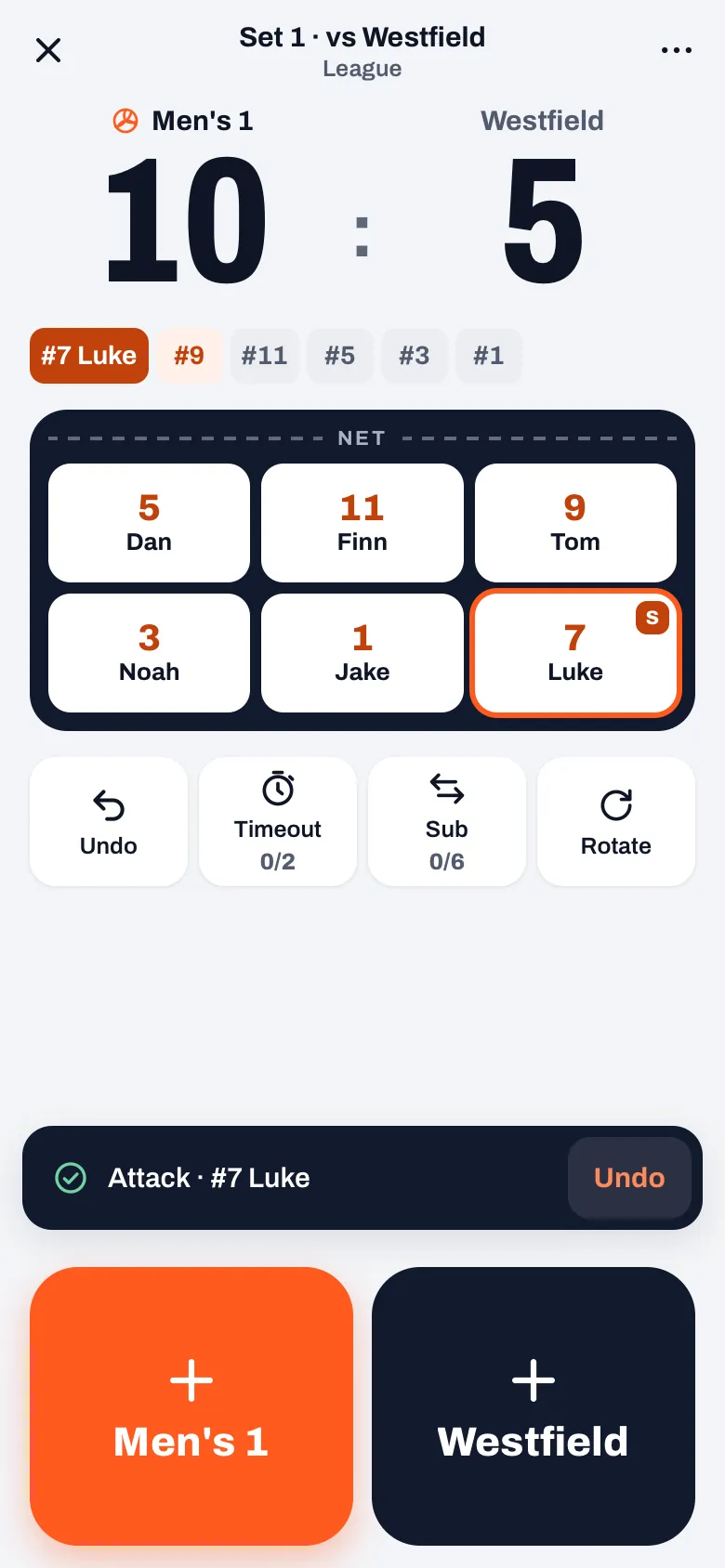
After a match you scored live, you see under Players how many rallies each player was on court for and their plus/minus: rallies won minus rallies lost while they were playing. That shows you whether the rotations with your defensive specialist paid off. How to read that number is in plus-minus in volleyball, and how to keep your roster, roles and positions in one place in managing a volleyball team.
14 days free, no credit card. Score your next match live and see what your substitutions brought you.
Try Koach with your teamWhat Koach costs after the trial is on the pricing page.
Frequently asked questions
What is the difference between a libero and a defensive specialist?
The libero is a separate player with their own rules: they wear a contrasting jersey, may not serve, block or attack when the ball is entirely above the top of the net, and their replacements do not count as substitutions. The defensive specialist is a regular substitute in the team jersey. A DS may serve and attack and rotates normally, but every time they go in or out costs you one of your six substitutions per set.
Can a defensive specialist serve?
Yes. A DS takes over the position of the player they replace, including that player's turn to serve. That is why many coaches bring the DS in when the player they replace rotates to position 1: the defensive specialist then serves and plays three rotations in the back row after that.
Does a defensive specialist count as a substitution?
Yes. Going in is one substitution and bringing the starting player back is another. Under the FIVB rules a starting player may leave once per set and come back once, and a substitute may enter once per set, only for that one starting player. So one cycle with a defensive specialist costs two of your six substitutions, and you can only do it once per set with the same pair.
Can a defensive specialist attack?
Yes. In the back row a DS may attack at any height as long as they do not touch or cross the attack line at take-off. In the front zone they may only attack if the ball is partly below the top of the net. If they stay on court when they rotate to the front, they are a regular front-row player who may block and attack.
Do you need a defensive specialist if you have two liberos?
It can still be useful. Of two liberos, only one is ever on court at a time. If you want two strong passers side by side in the back row in some rotations, you need a defensive specialist next to the libero. With few players or few substitutions, it is often better to save your substitutions.
Track your substitutions per set
14 days free, no credit card. After one match you see what your defensive specialist brought.
Get started with KoachOr read first what the volleyball coaching app does.