
Plus-minus in volleyball: what a player and a substitution add
The short answer
Volleyball plus-minus is the number of rallies your team won minus the number it lost while a player was on court. If a player is on court for 100 rallies and the team wins 56 of them, their plus-minus is +12. In Koach you see it per player after every live-scored match.
Plus-minus in volleyball measures what happens to the score while a player is on court. It shows something that points and errors miss: how the team plays with that player in it. Here is how to work it out, how to read it without falling into the traps, and how to measure whether a substitution worked.
What is plus-minus in volleyball?
Plus-minus counts every rally in which a player was on court. If your team wins the rally, it is a plus; if it loses, a minus. Who scored the point or made the error doesn't matter: the passer who puts the ball perfectly on the setter gets the same plus as the attacker who finishes it. That is why plus-minus measures something different from a points tally. Not what a player scores themselves, but how the team does with them on court.
The sum is short: plus-minus = rallies won minus rallies lost, counted only while the player was on court. Someone who plays every rally always has the team's balance. The number only gets interesting when you compare players who played part of the match, or the same player across several matches.
Worked example: two players in one spot
A three-set match has 130 rallies. Your team wins 68 and loses 62, a balance of +6.
- Emma is on court for 100 rallies. The team wins 56 and loses 44. Her plus-minus is 56 minus 44 = +12.
- Mia comes on for her and plays the other 30 rallies: 12 won, 18 lost. Her plus-minus is 12 minus 18 = minus 6.
- Your setter plays all 130 rallies and stands at 68 minus 62 = +6, exactly the team balance.
Emma and Mia filled one spot on court between them: their +12 and minus 6 add up to the team's +6. Emma seems to be doing much better. But Mia's minus 6 comes from only 30 rallies: had the team won three more of them, she would be at 15 against 15, so at zero. Three rallies is one good service run by the opponent.
Where plus-minus fools you
- Few rallies. As with Mia: a sub with twenty or thirty rallies can end up deep in the minus after one run by the opponent. Only compare after a few matches.
- The rotation someone plays in. Most teams win fewer rallies on their own serve than on the opponent's serve, except in the youngest age groups, where the serve often decides the point. A player who only comes on for a service turn only plays those harder rallies and quickly ends up in the minus, even when serving well. The difference between those two kinds of rallies is in side-out and break point by rotation.
- The moment and the opponent. Someone who plays when the set is already decided, or exactly in the rotation where the opponent has their best server, gets a different number than their play deserves.
- Libero and middles. The libero plays at the back in place of a middle, and the middle plays at the front. So their plus-minus mostly says something about the team in that half of the rotations.
So read plus-minus as a question, not a verdict: why does the team win less with this player on court? The answer may lie with the player, but just as well with the rotation or the moment you bring them in. Which players work well together is a separate question, covered in player combinations.
Plus-minus in Koach: Playing time in the Players segment
If you score a match live, in Simple mode or in Expert, Koach works out for each player, when you finish the match, how many rallies they were on court and how many of those the team won. You don't tap anything extra for it. Open the played match and choose the Players segment. Under Player performance you find the Playing time block: per player the number of rallies and the +/- column, with at the top who played least and the best plus/minus of the match.
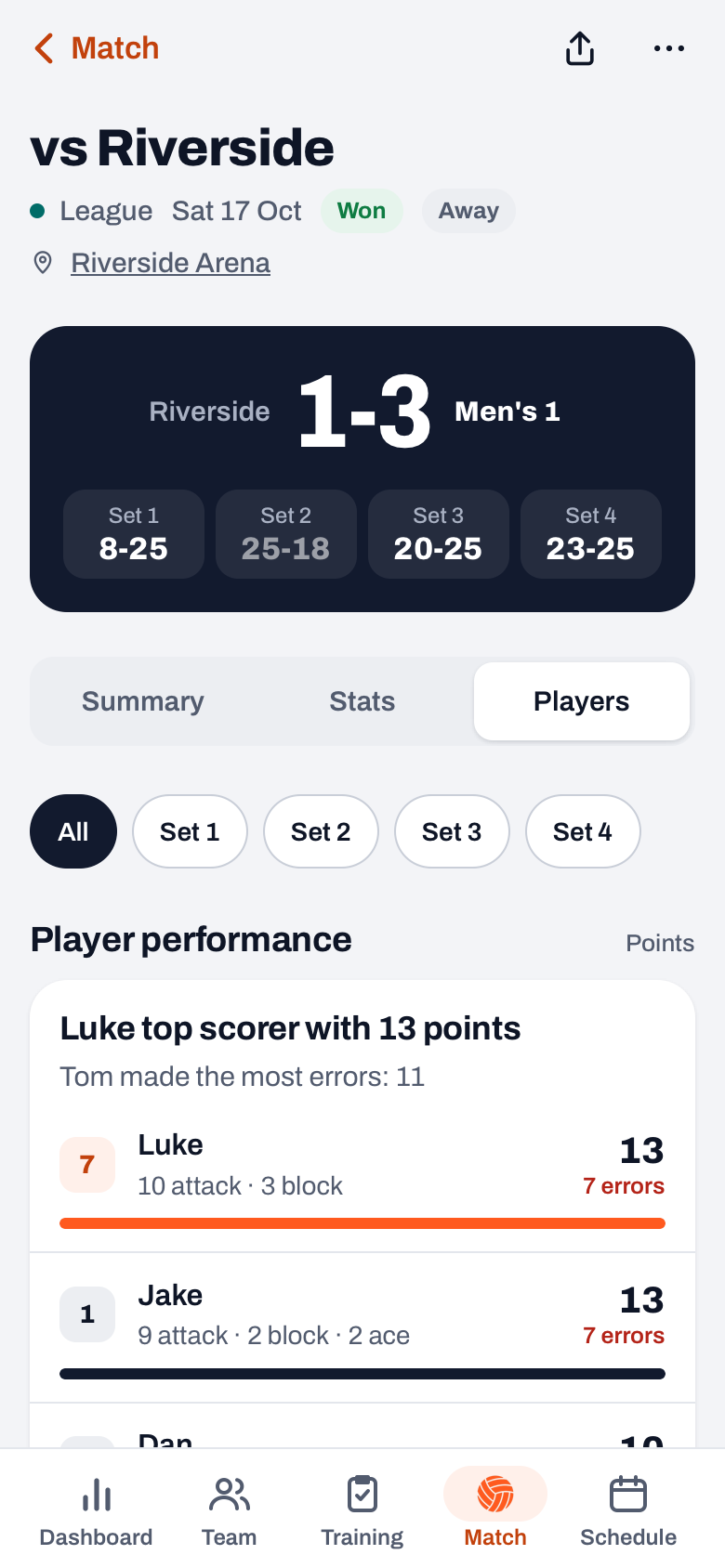
14 days free, no credit card. Score Saturday's match live and see each player's rallies and plus/minus afterwards.
Try Koach with your teamOver the season you see it in the player profile under Stats. Under Per match, choose the Plus/minus chip and you see it match by match as a line, with the season average as a dashed line; a match only counts if the player played at least ten rallies. The Rotations and positions block shows the total over all live matches, and per rotation what share of the rallies the team won with that player on court.
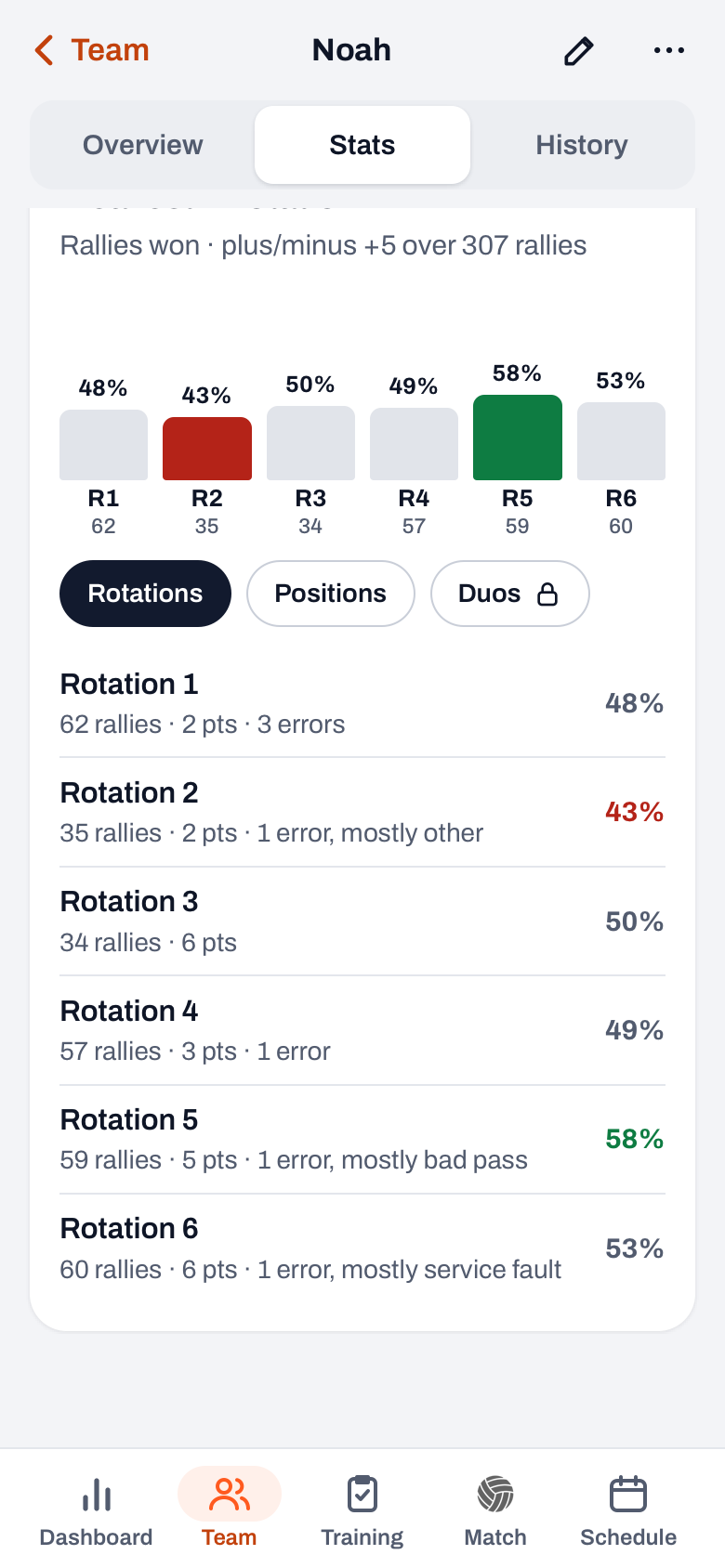
Players see their own plus/minus in their own match screen, not that of their teammates. The number only exists for matches you scored live with the current version of the app. A result you enter afterwards, or a match finished by a score keeper, has no plus/minus.
Did the substitution work? Measuring the effect of a sub
A substitution is a question: does the team play better with the new player in? Two numbers help you answer it.
- The sub's plus-minus, next to that of the player who came off. Preferably over a few matches, for the reason above.
- The rallies right after the substitution. In Koach, under Stats, the Momentum block has the row After a substitution (5 rallies): how many of the five rallies after each substitution you won (For) and lost (Against), added up over the match. A libero replacement doesn't count, and if another substitution follows within five rallies, the count starts again. The row only appears if you made substitutions in that match.
Worked example: four substitutions
You make four substitutions in a match. The five rallies after each one end 3-2, 1-4, 4-1 and 2-3. After a substitution then shows For 10, Against 10 (3 + 1 + 4 + 2 against 2 + 4 + 1 + 3). Neutral, then, even though one substitution worked straight away (4-1) and another cost points straight away (1-4). The total says little here; which substitution produced which run, you see in the score progression of the set.
Five rallies is short. It measures whether a substitution turned the game around immediately, not whether the sub played well; for that, their plus-minus over the whole time on court is the better number. When to substitute and why is in match coaching: time-outs and substitutions. How to find the turning point of a set is in the momentum line.
What do you do with plus-minus?
Use it to ask questions about your substitution policy and your lineup, not as a ranking. If a player is in the minus match after match, first look at which rotations and which moments they play in. If a sub always comes on at the same difficult moment, change the moment before you judge the player. And put it next to playing time: someone who gets few rallies also has little chance to post a good number. How to share playing time fairly is in tracking playing time; how plus-minus fits in with the other team stats is in understanding volleyball statistics.
Plus/minus, Playing time and the substitution effect are part of every live-scored match. You can try Koach free for 14 days; what it costs after that is on the pricing page.
Compare a player with themselves. The plus-minus of two players in different rotations says little. The same player over five matches says a lot: if their line under Per match rises, the team plays better with them in it.
Frequently asked questions
What is a good plus-minus in volleyball?
There is no fixed standard, because the number depends on how good your team is and how much a player plays. A positive number means the team won more rallies than it lost with that player on court. So compare it with your team's balance in the same match, and with the player's own earlier matches. Only after a few matches with enough rallies does it really tell you something.
Why is my sub in the minus when they played well?
Often because of the moment or the rotation. A sub plays few rallies, so one run by the opponent weighs heavily. If they only come on for a service turn, they only play rallies on your own serve, and most teams win those less often. So look at several matches and at the rotations they played in before you draw conclusions.
Does a libero replacement count in the effect of a substitution?
No. In Koach the After a substitution (5 rallies) row only counts regular substitutions; the libero going in and out does not count, just as under the rules it is not one of the six substitutions per set. The libero's plus-minus is tracked as normal, though: every rally in which the libero is on court counts.
Do I need to track anything extra for plus-minus?
No. When you score the match live in Koach, in Simple or Expert, the app knows for every rally who was on court and who won it. When you finish, it calculates the plus/minus for each player. You can try Koach free for 14 days, no credit card needed; the prices after that are on the pricing page.



Measure what your subs add on Saturday
14 days free, no credit card. After the match you'll see each player's plus/minus.
Get started with KoachOr read first what the volleyball coaching app does.