
Volleyball player combinations: which pairs win the most rallies
The short answer
You measure volleyball player combinations by the share of rallies your team wins while two players stand next to each other, over enough rallies. In Koach you find this per player under Stats, at Duos: the percentage of rallies won with each teammate, from 20 rallies together and for coaches only.
Volleyball player combinations are usually picked on feel: those two click, those two don't. Sometimes that feeling is right, sometimes it is the memory of one good night. Here you'll read how to measure pairs, what the number does and does not tell you, and where to find it in Koach.
Which player combinations matter in volleyball?
Volleyball is a game of handoffs. Almost every rally runs through two or three players who have to be able to count on each other, and some pairs you see in action together dozens of times every match:
- Setter and middle. A quick set only works when timing and height are right. Two players who read each other turn even a decent pass into an attack.
- The serve receive line. Passers who stand side by side split the court between them. Who takes the ball that comes right between them? A pair that sorts that out without talking lets fewer aces through.
- The block. The middle and the outside close the block together. If the middle is late, the outside is on their own.
- The back-row defenders. The libero and the back-row players cover each other's space, especially on tips and balls coming off the block.
Those are the places where a good or bad combination shows up first. They are also the places where your lineup gives you a choice: who do you put next to your best passer, and which outside next to your strongest middle?
How do you measure whether a pair works?
The simplest measure is also the fairest: count the rallies in which two players stood next to each other on court, and look at what share of those your team won. You don't need to know who touched the ball. The question is whether the team plays better when those two are on court together.
A worked example. Emma and Grace stand next to each other for 60 rallies over five matches, and your team wins 36 of them. Emma and Chloe stand next to each other for 45 rallies, and you win 22 of those. So the first pair wins three out of five rallies, the second just under half. That difference may mean something, but with so few rallies it can also be chance. That's why you stick to two rules:
- Enough rallies. A pair with ten rallies together tells you nothing: one good set then decides the whole picture. It only gets interesting after a few matches together.
- Compare within one player. Look at Emma: next to whom does the team win most, and next to whom least? Those pairs mostly played in the same matches against the same opponents, so the comparison is fairer than putting two random pairs side by side.
Duos in Koach: where to find them
Koach works out the pairs by itself when you score live. You don't tap anything extra for it: as long as you track a match live, in Simple or in Expert, the app knows who stood where in every rally.
- Open Team and tap a player.
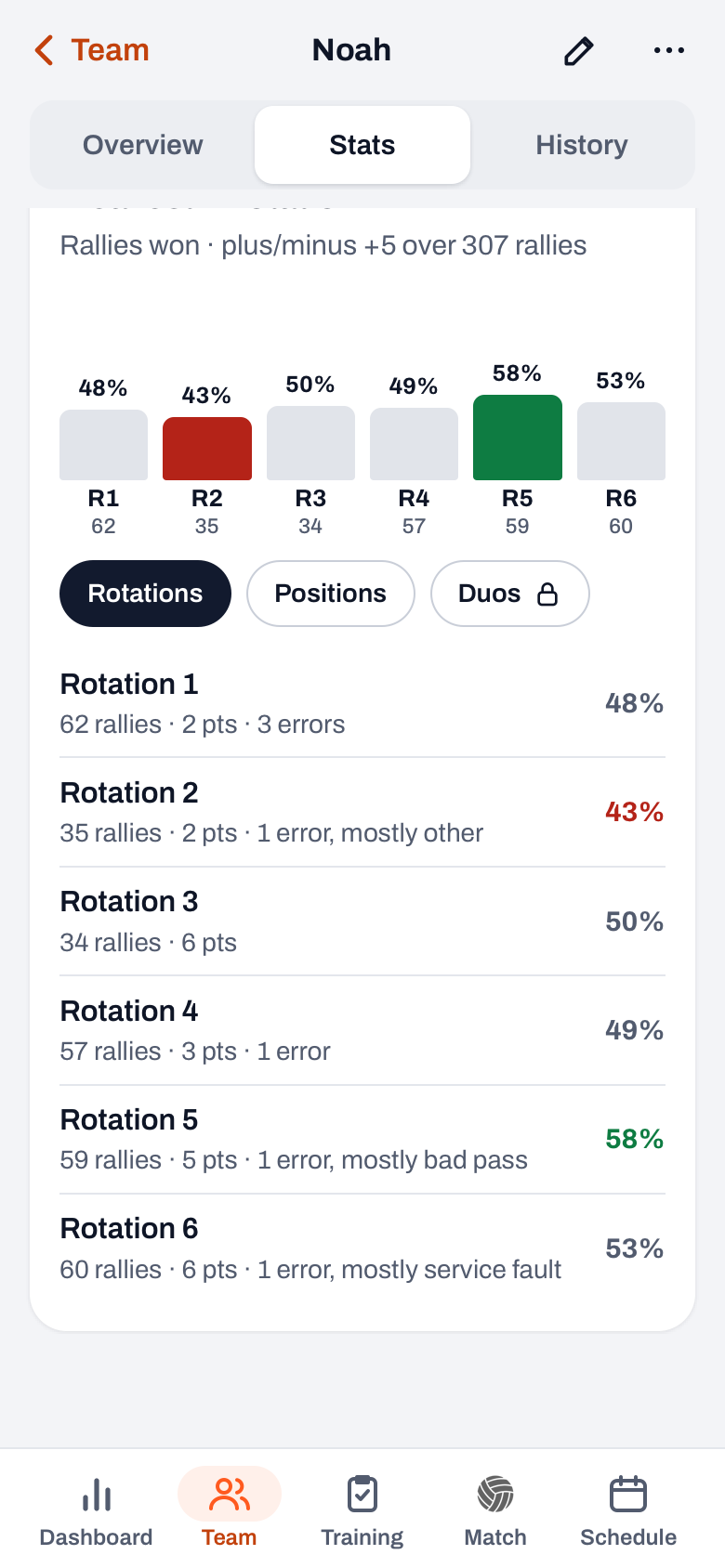
- In the profile, choose the Stats tab and scroll to the Rotations and positions block.
- Tap the Duos chip. The padlock next to it means only coaches can see it.
For each teammate you then see how many rallies they stood together, for example 48 rallies together, and on the right the percentage of those rallies your team won. The pair that wins most is at the top. What else you need to know:
- Next to each other means neighbours on the court: side by side in the front row or the back row, or directly in front of each other (positions 4 and 5, 3 and 6, 2 and 1). Two players standing diagonally from each other don't count as a pair.
- Only from 20 rallies together does a pair appear in the list, and you see six at most. If you don't see the chip yet, no pair has stood next to each other for 20 rallies so far.
- The season adds up. The pairs come from all live-tracked matches of the selected season. A match where you only entered the result doesn't count, and neither does a match finished by an authorised score keeper.
- Players don't see the chip. In their own profile a player does see Rotations and Positions, but not next to whom the team wins most. There's something to be said for that: a ranking of pairs quickly sets two teammates against each other.
14 days free, no credit card. Score a few matches live and then see which pairs make the difference on your team.
Try Koach with your teamWhat a pair's percentage does not tell you
A pair's percentage shows that two things go together, not why. Four things can colour the picture:
- The rest of the court. Two starters are often on court together with the other strong players. The pair then also wins because the other four are good.
- The rotation. A pair that only stands side by side in your best rotations inherits that advantage. So also look at the Rotations chip in the same block.
- The opponents. A pair that mostly played together against the bottom teams of the league looks better than it is.
- The moment. Players you bring in together for the end of a set stand next to each other in exactly the tensest rallies.
So treat the number as a question, not an answer. If a pair stands out, watch those two closely in the next match, or put them together in serve receive a few times at practice. How to follow a player's progress with numbers like these is covered in tracking player development in volleyball.
How to use player combinations for your lineup and subs
- As a tiebreaker, not as the decision. Torn between two outsides of the same level? Look at which one your best passer wins most next to. If the numbers are equal, what you see at practice decides.
- When moving players to another position. Put a player in their second position and they get different neighbours. What's involved is explained in flexible lineups with players in two positions.
- With two setters. In a 4-2 or 6-2, each setter stands next to different attackers in different rotations. How to set that up in the app is in two setters in a 4-2 or 6-2.
- For subs. Duos are about two players together; for one player you look at plus-minus: how many more rallies the team wins than it loses while that player is on court. See plus-minus in volleyball.
Duos and the rest of the rally analysis are included in both plans. What Koach costs after the free trial is on the pricing page.
Start with your regular starters. Your setter and your regular starters spend the most time on court, so they are the first to reach 20 rallies per pair. After three or four live matches, open their profiles and see which neighbours are at the top.
Frequently asked questions
How many rallies before a player combination tells you something?
A pair with a handful of rallies together tells you nothing, because one good or bad set then decides the whole picture. That's why Koach only shows a pair from 20 rallies side by side, and it gets more reliable as the number grows. Preferably compare the pairs of one player with each other, because those played mostly in the same matches.
Can players see who they play best with?
No. The Duos chip in the player profile has a padlock and is only visible to coaches. In their own profile a player does see how many rallies the team won per rotation and per position, but not next to which teammate the team wins most or least.
Does a match count if I only enter the result?
No. Duos come from the rallies of matches you track live in the app, in Simple or in Expert. If you only enter the result and the points afterwards, or an authorised score keeper finishes the match, the app doesn't know who stood where in each rally, and that match doesn't count towards the pairs.
How much does Koach cost?
You can try Koach free for 14 days, with no credit card and every feature, including Duos and the rest of the rally analysis. After that, choose Coach for €2.99 per month (one team, two coaches) or Club for €9.99 per month (unlimited teams). With a yearly plan you pay less per month.


Find the pairs that win for you
14 days free, no credit card. After a few live matches you'll see your first pairs.
Get started with KoachOr read first what the volleyball coaching app does.