
Elbow pads for volleyball: who wears them and what to look for
The short answer
Elbow pads for volleyball are not mandatory, and most players don't need them. Players who dive and roll a lot, such as the libero and defenders, do benefit: they protect against floor burns and impacts on the tip of the elbow. Choose a pad that covers your elbow and leaves your forearms free.
You see elbow pads in volleyball less often than knee pads, and that makes sense: most players can do without them. Players who go to the floor a lot can't always. Here you read who they are useful for, what they don't do, how to choose thickness and fit and how to look after them.
Do you need elbow pads for volleyball?
Your knees already touch the floor with a low pass on one knee. Your elbows only do when you dive, roll or slide across the floor after a save. That is why far from everyone needs elbow pads. You get the most out of them if you:
- are a libero or defender and go to the floor a lot at every practice;
- are learning to dive and roll. Beginners often land on their elbows in the first weeks, and a pad makes the floor less scary;
- already have a sensitive spot on the tip of your elbow, for example after an earlier fall;
- often slide across the floor with bare arms after a save and end up with floor burns.
A middle blocker who rarely dives, or a recreational player who mostly plays on their feet, usually doesn't need them. They are not mandatory anywhere; what your child really needs for the first practices is covered in what your child needs for volleyball.
What elbow pads do and don't do
They do two things. They prevent scrapes and floor burns when your arm slides across the floor, and they cushion an impact on the tip of your elbow. That second one is more than comfort. Over the tip of the elbow lies a bursa, and according to the American Academy of Orthopaedic Surgeons a hard blow there can make the bursa produce extra fluid and swell (OrthoInfo, Elbow (Olecranon) Bursitis). The same source names a scrape on the tip of the elbow as one of the ways bacteria can get into that bursa. So a floor burn is not just annoying.
What they don't do:
- They don't protect the joint. If your elbow twists or overextends when you fall on an outstretched arm, a pad won't absorb that.
- They don't replace diving technique. In a good dive you catch yourself with your hands and slide out on your chest and stomach, or you roll over your shoulder and back; the elbow then barely touches the floor. How that works is covered in defense and diving in volleyball.
- They don't make your pass softer. Red marks on your forearms come from passing, not from the floor. An elbow pad doesn't help with that.
Sleeve, thin pad or thick pad?
| Type | What it does | Suits |
|---|---|---|
| Arm sleeve without a pad | Protects against scrapes; no cushioning on impact | Players who slide across the floor now and then |
| Sleeve with a thin pad | Protects against scrapes and light impacts, barely noticeable | Defenders and young players learning to dive |
| Sleeve with a thick pad | More cushioning, also when you land sideways | Libero and players with a sensitive elbow |
Why players wear arm sleeves, even without a pad, is explained in why volleyball players do what they do. Don't choose a pad with a hard plastic shell. The rules forbid objects that may cause injury (rule 4.5.1), and the FIVB Casebook 2025 draws the line between hard parts that can injure someone else and soft, supportive materials (case 1.1). In volleyball, two or three players regularly go for the same ball at once.
Fit: the pad on your elbow, not on your platform
With elbow pads, position matters. Your forearms are the platform you pass with, and a pad or seam there changes how the ball comes off your arms. So check three things:
- The pad sits on the tip of your elbow when your arm is bent, as in a dive or roll. Check it in that position, not with a straight arm.
- Your platform stays free. Do ten forearm passes against the wall. If the ball touches the pad or the edge of the sleeve, it sits too low or the model is too long for you.
- It stays in place without pinching. Bend and straighten your arm ten times and swing it as in a spike. If it slides, it is too big; tingling fingers or a red mark at your biceps mean too tight.
Measure according to the size chart for that model, because brands measure in different places. Don't buy children a size to grow into: a sleeve that is too loose slides down to the wrist on the first dive.
One or two? Wear two if you wear them for diving. In a dive or roll you don't choose which elbow hits the floor, and a ball to your left or right decides which way you go. If you wear one only for a sensitive spot on one elbow, one is enough.
Try them with a ball, not in front of the mirror. Put them on in the gym, do ten passes against the wall and two rolls on a mat. If the ball feels different or the pad slides away, it is not the right model for you.
Can you wear elbow pads in a match?
Yes. The FIVB rules don't mention elbow pads by name, but they allow compression pads (padded protection devices) to be worn for protection or support (rule 4.5.3 of the Official Volleyball Rules 2025-2028). In official FIVB senior competitions a color rule applies, and it can differ by country or competition; the details are in volleyball uniform rules.
Care, and when to see a doctor
An elbow pad sits tight on a sweaty arm, so take it out of your bag after practice and let it air-dry. Wash it according to the label and don't put it on a radiator to dry. Replace it when the pad has gone flat, when it keeps slipping even though the size is right, or when the seam comes loose.
If you get a soft, swollen lump on the tip of your elbow after a fall, show it to a family doctor or sports physician, especially if it hurts or doesn't go down within a few weeks. If the skin over it turns red and warm, go soon: according to OrthoInfo that can point to an infected bursa, and that needs to be treated in time.
Let your team know there will be diving
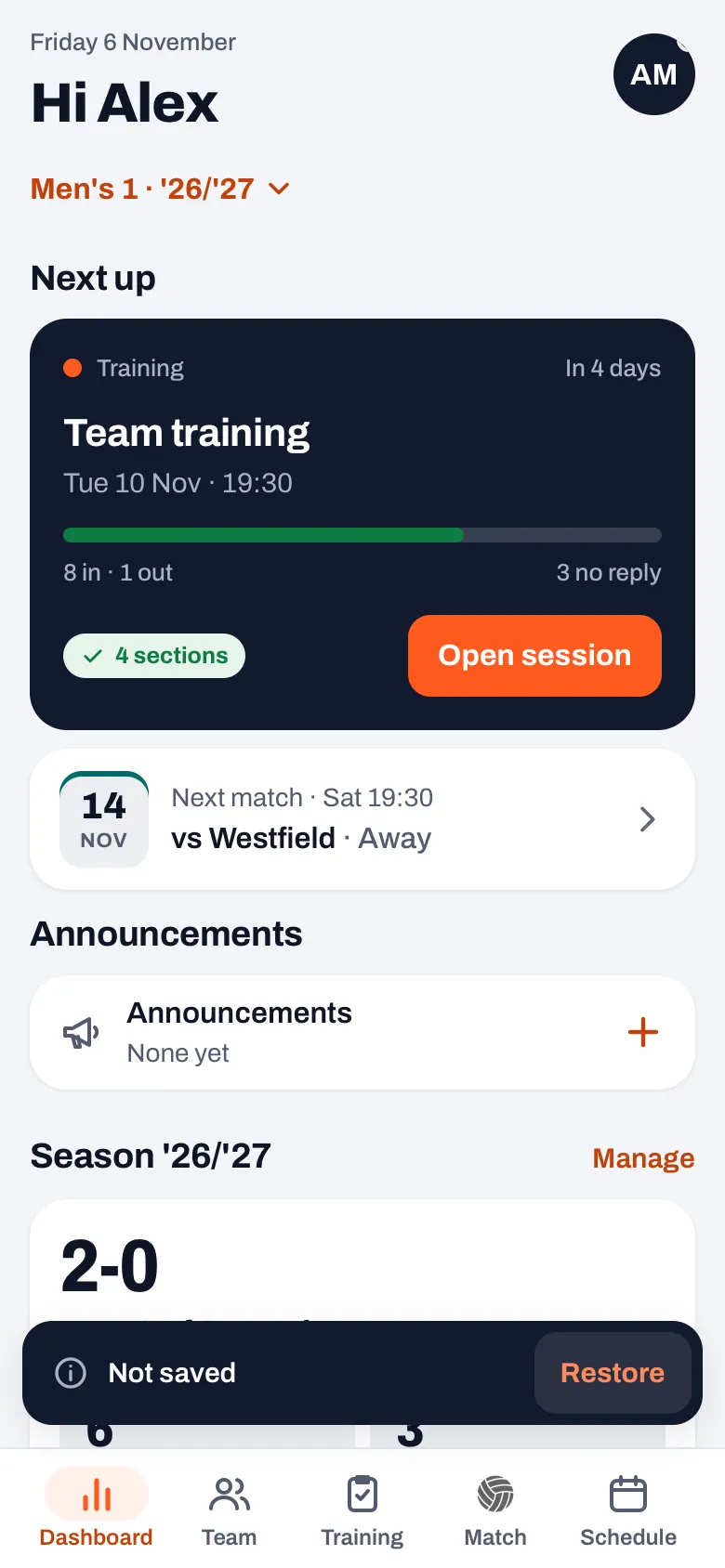
If you plan a practice with diving and rolling, say so beforehand, so players bring their pads. In Koach you build that practice with Add drill; for falling and diving, the library includes Mat dive drill and Roll and sprawl technique, with a diagram per phase of who stands where. On the dashboard you post a message under Announcements such as "Thursday we dive: bring knee and elbow pads". Players and parents see that announcement on their own dashboard. If the sheet closes before you tapped Post, since version 3.1 you can get the text back with Restore.
Which knee pads to choose alongside your elbow pads is covered in volleyball knee pads. If you are new to coaching, starting as a volleyball coach covers what to arrange from the first week. What Koach costs after the trial is on the pricing page.
14 days free, no credit card. Set up your next defense practice and let your team know today what to bring.
Try Koach with your teamFrequently asked questions
Who wears elbow pads in volleyball?
Mostly players who go to the floor a lot: the libero, defenders and young players learning to dive and roll. Players with a sensitive spot on the tip of the elbow, for example after an earlier fall, often wear them too. Middle blockers and recreational players who rarely dive usually don't need them. They are not mandatory.
How should elbow pads fit?
The pad should sit on the tip of your elbow when your arm is bent, as in a dive or roll. Your forearms must stay free, because that is what you pass with. Test it with ten passes against the wall: if the ball touches the pad or the edge of the sleeve, it sits too low or the model is too long.
Are arm sleeves the same as elbow pads?
No. An arm sleeve is a tight sleeve without a pad: it protects against scrapes when your arm slides across the floor, but it doesn't cushion an impact. An elbow pad has a cushion over the tip of the elbow. If you dive a lot or already have a sensitive elbow, choose a sleeve with a pad.
What should you do about a swollen elbow after a fall?
A soft, swollen lump on the tip of your elbow can be an irritated bursa. Show it to a family doctor or sports physician, especially if it hurts or hasn't gone down after a few weeks. If the skin over it turns red and warm, go soon, because the bursa may be infected.

Set up your next defense practice
14 days free, no credit card. Your team knows beforehand what to bring.
Get started with KoachOr read first what the volleyball coaching app does.