
How long does a volleyball match last? Plan your day
The fixture list gives you one time, and that is precisely the time that helps you least. A parent wants to know when to pick up. A coach wants to know how much hall time to book. A new player wants to know whether they can still make plans that evening. This article works the match day through from arrival to departure — not just the minutes in which volleyball is actually played.
The short answer: ninety minutes of play, two and a half hours away
An ordinary senior match at club level lasts ninety minutes to two hours of playing time, counted from the first whistle to the last point. But nobody plans their Saturday on playing time. Door to door, a home match costs you two and a half to three hours, and for an away match the travel time comes on top of that twice.
That difference of an hour is where parents miscalculate and where hall managers pull coaches up. The match is only one block of a match day made up of eight blocks, and the other seven are written down nowhere. Below they are, with minutes attached, so you can count from door lock to door lock instead of from whistle to whistle.
The eight blocks of a match day
This is the shape of a home match at an average club. If you are playing away, add the travel time before block 1 and after block 8.
- Arrival and changing — 10 minutes. Many teams use a meeting time of forty-five minutes before the start. For the first team of the day that is an hour, because that team sets the hall up.
- Setting up the hall — 15 to 20 minutes. Tensioning the net, putting up the posts, the referee's stand, the benches, the score sheet and the ball cart. Only for the first team of the match day; after that every following team inherits a ready court.
- Warm-up off court — 15 minutes. Jogging, mobilising, pepper along the side. How to fill those fifteen minutes without wasting them is in building the warm-up.
- Warm-up and hitting on court — 6 to 10 minutes. The international rules give the teams six minutes together at the net, or twice three minutes separately. If neither team had a court available beforehand, that becomes ten minutes. In practice this is the block that overruns most often.
- Toss, lineup and first serve — 5 minutes. Tossing for serve and side, lineup sheet to the scorer, players in position, first whistle.
- Playing — 1 hour 10 to 2 hours. Depending on the number of sets. See the arithmetic below.
- Wrapping up — 5 to 15 minutes. Shaking hands, checking and signing the match sheet, and for the last team of the day: taking the hall down again.
- Showering and chatting — 15 minutes to open-ended. The only block you fully control yourself, and the block where most time leaks away at an away match.
Add blocks 1, 3, 4 and 5 together and you are at 35 to 40 minutes of hall time before the first whistle — and at 50 to 60 minutes if your team also sets the hall up. Blocks 7 and 8 together are 20 to 30 minutes after the last point. Those two figures are the core of this article: reckon on three quarters of an hour before and half an hour after as standard, and adjust the playing time inside that to your format.
The set format in three lines
Officially a match is played to three sets won: sets to 25 points, a deciding fifth set to 15, always with two points' difference and with no points ceiling. Some federations play a fixed number of sets in their regional or recreational leagues — always four, for example, even at 3-0 — so that every match takes the same time. What applies where you play is in your competition rulebook; the full story about sets, points and extended sets is in how many sets a volleyball match has.
The arithmetic: sets times 22, plus three minutes' break
At virtually every level a set takes 20 to 25 minutes. In youth and recreational volleyball the points fall faster because more is given away; higher up the rallies last longer but less is thrown away. Net, it comes to the same thing. So count on 22 minutes per set, 13 minutes for a deciding set to 15, and three minutes' break between every two sets — that last one is a rule of the game and not a hall custom, as explained in the break between two sets.
- Three-setter (3-0): 3 × 22 + 2 × 3 = 72 minutes, so a good hour and ten.
- Four-setter (3-1 or a fixed four-set format): 4 × 22 + 3 × 3 = 97 minutes, so an hour and forty.
- Five-setter (3-2): 4 × 22 + 13 + 4 × 3 = 113 minutes, so almost two hours.
The difference between the shortest and the longest outcome is well over forty minutes. That is the only real uncertainty in your planning, and it is exactly why a format with a fixed number of sets is so convenient for hall bookings and lift rotas: you know in advance when you will be finished.
Rules of thumb per format, from mini morning to beach
Not every volleyball match is a senior match on a full court. These are the formats that come up most in practice, with the playing time and the hall slot you should reserve for them. All the figures are rules of thumb — the exact format and duration differ by federation and by competition.
- Seniors, best of five: 1 hour 10 to 2 hours of play. Reserve a hall slot of 2 hours 30.
- Seniors, fixed number of sets (four): consistently around 1 hour 40. Hall slot of 2 hours 15, and you know in advance when it finishes.
- Youth on the full court: comparable to seniors, but with shorter rallies and more service errors: often 1 hour 15 to 1 hour 30. Hall slot of 2 hours.
- Youth 4 against 4 on a small court: 1 hour to 1 hour 15 for a full match. Hall slot of 1 hour 45. Two matches are often played back to back on the same court.
- Mini volleyball morning: not a match but a tournament. One group plays four to six short games, often timed. Reckon on 2 hours 30 to 3 hours from arrival to departure, with a meeting time of half an hour. The court sizes, net heights and scoring rules per level are in the mini volleyball rules.
- Recreational, best of three: 1 hour 10 to 1 hour 20. Many recreational leagues schedule two matches on one evening, so you still lose a block of 2 hours 30.
- Beach volleyball, best of three to 21: 40 to 60 minutes per match. Shorter sets, shorter breaks, no hall to set up — see also the differences between indoor and beach.
- Tournaments and cup rounds: nearly always a shortened format, from sets to 15 to timed matches. No rule of thumb helps here: the tournament regulations decide, and they differ per organiser.
For parents: what time will my child be home?
Use this formula and you will rarely be more than a quarter of an hour out:
Home = start time + playing time + 30 minutes + travel time.
An example. Your daughter has an away match starting at 12:00, the sports hall is a forty-minute drive and it is a youth team playing four sets. That gives: 12:00 + 1 hour 40 of play + 30 minutes wrapping up and changing + 40 minutes travel = 14:50. Not half past one, which is what most parents aim for. You work out the departure from home the other way round: start time minus 45 minutes in the hall, minus the travel time, minus ten minutes of margin. For the same match that means leaving at 10:25.
Three things disturb this sum, and they are worth asking about beforehand. One: if the team plays best of five, the playing time can run over forty minutes longer. Two: is your car also driving back, or are the children staying to watch the team playing after them? Three: at a mini morning the formula doesn't apply at all — there the tournament's finish time is the only number that counts. Who drives out and who drives back is best agreed once for the whole season, as described in the lift rota for away matches.
For coaches: how much hall time should you book?
A hall slot consists of three parts: warm-up, play and overrun. For one senior match in a best-of-five format that is 20 minutes of warm-up, a maximum of 2 hours of play and 10 minutes of overrun — 2 hours 30 in total. Book tighter and the first five-setter catches you out.
If you are scheduling two matches back to back on the same court, the trap is to put them two hours apart because most matches are done in two hours. Don't: leave 2 hours 30 between them. Otherwise the second team is warming up on half a court while the fifth set of the first match is still running, and that delay pushes through the rest of the day. If you play a format with a fixed number of sets you may schedule on 2 hours 15, because then the outlier doesn't exist.
Two more things to fix when you rent the hall: who puts the court up and who takes it down (that costs a quarter of an hour at each end that nobody counts), and until what time the hall is actually open. A slot until 22:00 with a caretaker who locks the door at 22:00 is in practice a slot until 21:45.
What makes a match overrun — and what doesn't
There is one factor that genuinely matters, and that is the number of sets. The rest is noise, but noise that accumulates:
- Extended sets above 25. A set ending 30-28 costs about five extra minutes. Two of those in a match and you are a quarter of an hour further on.
- A scorer or referee who doesn't turn up. The most expensive delay of all: 10 to 20 minutes, and it always hits the first match of the day, so everything after it shifts.
- An injury. Play stops and the rules allow a recovery time of three minutes if substitution isn't possible. With anything more serious, every plan is off the table.
- Warm-up that overruns. Six official minutes effortlessly become twelve when both teams are late.
What does not matter, counter to intuition: the interruptions during play. Two time-outs of thirty seconds per set cost one minute per set between them. Even a competition still playing technical time-outs comes to at most three minutes a set. So you are never home late because of your coach's time-outs — you are home late because it went to 2-2.
Key point: never count on the start time alone. Three quarters of an hour before, the playing time of your own format, half an hour after and twice the travel time — that is the match day. For an average home match that comes to two and a half to three hours, and for an away match to half a Saturday.
Put two times in the calendar, not one
Most of the confusion on a match day doesn't come from people misjudging the duration, but from only one time being communicated. The federation publishes the start time; the team needs a meeting time. If only the first one is in the group chat, every player works out their own margin and half the team arrives ten minutes before the toss.
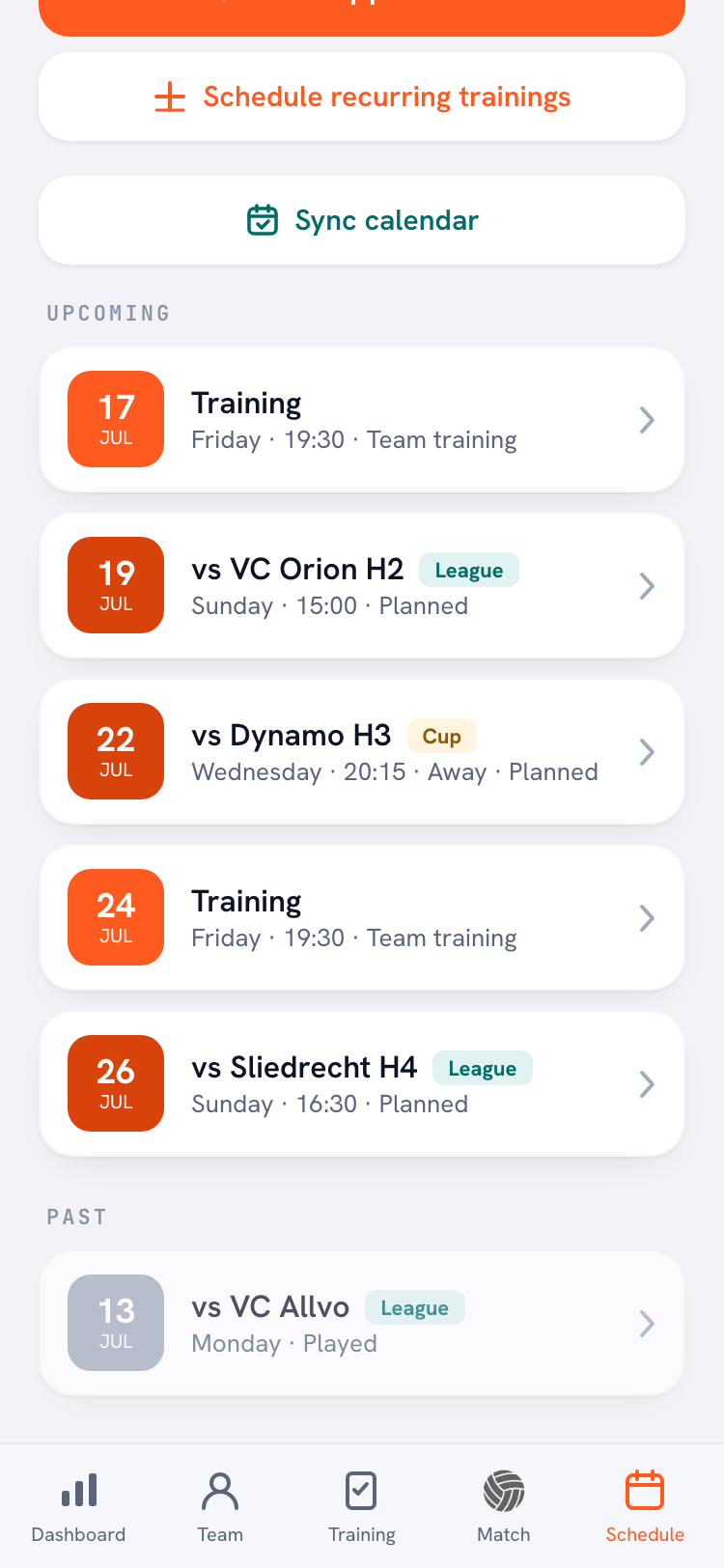
So put both times in the team calendar for every match as standard, plus the address and whether it is home or away. In Koach those fields are fixed per match and players and parents see in the same calendar when they are expected — which saves the weekly round of messages. If you work without an app, agree one fixed rule for the whole season ("home 45 minutes before the start, away 60 minutes before the start at the sports hall"), because a rule that is the same every week doesn't have to be repeated every week. How to set up such a calendar and sync it with your players' phones is in setting up the team calendar.
For the parents, add one sentence you only have to send once a season: how long a match at this team usually takes and when it overruns. That is the answer to virtually every message you get on a Saturday morning.
Frequently asked questions
How long does a volleyball match last on average?
The playing time is ninety minutes to two hours: a three-setter takes a good hour and ten minutes, a five-setter almost two hours. Door to door, a home match costs you two and a half to three hours, because there are three quarters of an hour of warming up and changing before it and half an hour of wrapping up after.
How long does one set of volleyball take?
At virtually every level, 20 to 25 minutes. A deciding set only goes to 15 points and therefore takes around 13 minutes. There is a three-minute break between every two sets, so four sets including breaks come to about an hour and forty.
What time do I have to be there for a volleyball match?
The usual meeting time is 45 minutes before the start, and an hour if your team has to set the hall up. For an away match, add the travel time and ten minutes of margin to work out when to leave home.
How much hall time should I book for a match?
For one senior match in a best-of-five format, 2 hours 30: twenty minutes of warm-up, a maximum of two hours of play and ten minutes of overrun. If your league plays a fixed number of sets, 2 hours 15 will do. Never schedule two matches back to back less than 2 hours 30 apart.
How long does a mini volleyball morning last?
Reckon on two and a half to three hours from arrival to departure. It is a tournament and not a match: one group plays four to six short games back to back, often timed rather than to a points total. The finish time given by the organising club is what counts.
How long does a beach volleyball match last?
Forty to sixty minutes. Beach is played to two sets won to 21 points with a third set to 15, and there are shorter breaks and fewer interruptions than indoors. On a tournament day you play several back to back, with waiting time in between.