How Many Times a Week Should a 12-Year-Old Play Volleyball?
Two practices, a match, and then an extra squad session on Wednesday — with a driven kid the week fills up without anyone noticing. The line between enough and too much is not drawn at a number of practices, but at total hours and total jumps. Here are the guidelines and the warning signs.
Count hours, not practices
The most usable rule of thumb from sports medicine research into youth sport: the number of hours of organised sport per week should not exceed the child's age in years. So a twelve-year-old sits at their ceiling at around twelve hours a week — and that is everything added together: volleyball, PE lessons counting in part, and definitely the soccer practice on Sunday.
Just as important is the ratio between organised and free play. Kids who spend far more hours in structured sport than they do playing outside on their own run a demonstrably higher risk of both overuse injuries and dropping out. Two practices a week plus a lot of outdoor play is a better programme for an eleven-year-old than four practices and nothing else.
What is realistic by age
| Age | Volleyball per week | Length per session | Watch out for |
|---|---|---|---|
| 6-9 | Once, possibly plus a play morning | 45-60 min | Mostly movement and ball familiarity; a second sport alongside is fine |
| 10-12 | 1-2 times plus a match | 60-75 min | Best age for technique; quality over volume |
| 12-14 | 2-3 times plus a match | 75-90 min | Growth spurt: keep an eye on jump load |
Three conditions that count just as hard as the table: at least one full rest day per week, at least one day per week with no organised sport at all, and a period of two to three months per year in which this child does no volleyball. That last one is the most ignored and the most effective.
Jumps are the real load
An hour of ball-control work and an hour of hitting both go into the calendar as "an hour", but they do completely different things to a growing body. The load that matters in volleyball is the number of maximal jumps and landings: that is what hammers patellar tendons, heels and lower backs. An intensive hitting session can easily contain two hundred jumps.
In practice that means counting jump days as well as practices. Do not schedule two heavy jumping sessions on consecutive days, and in a match weekend move the jumping work to the start of the week. In the months when a player is growing fast, this is the first thing you cut — the background is in what a growth spurt does to a young player.
The signs that it is becoming too much
- Pain that keeps coming back in the same spot: below the kneecap, in the heel, in the hitting shoulder or in the lower back. Recurring pain with no clear injury moment is almost always overuse.
- Getting worse while training more. The most underrated signal: a player doing more and performing less is not recovering.
- Losing interest in a sport the child was mad about six months ago.
- Poor sleep, a short fuse, waking up tired. This shows up at home before it shows up in the gym, so ask the parents.
- Skipping sessions. Kids rarely say it is too much; they just miss practice more and more often.
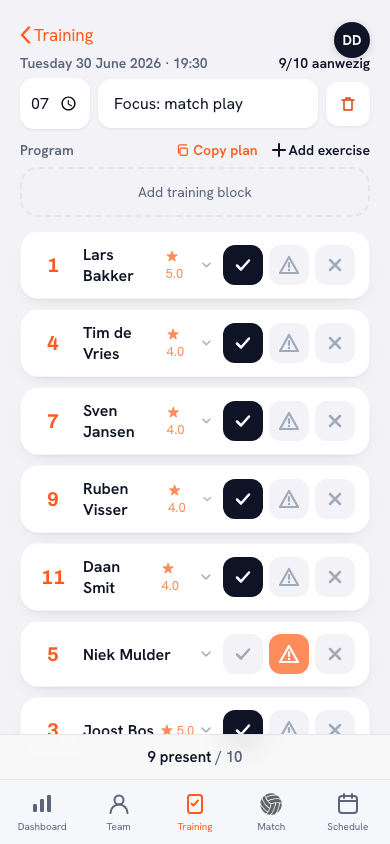
That last one is also the measurable one. Attendance tracking in Koach shows at a glance which kids are in the gym four times a week and which ones have started skipping. What to do with that pattern is in improving practice attendance.
The conversation with a driven kid and driven parents
The tricky part is that the pressure rarely comes from one direction. There is a club practice, a regional squad session, maybe a second team asking for a fill-in, and a kid who says yes to all of it. As a coach you only see part of that week. So at the start of the season, ask concretely what else a child is doing, and get in touch with the other coaches if the sum comes out above the guideline — it is nobody's fault and easily sorted between three adults. With parents, the main thing to explain is that applying the brakes is not curbing ambition: the players still playing at eighteen are rarely the ones who trained the most at twelve. That long-term story is worked out in long-term player development.
Multiple sports is not wasted time
A twelve-year-old who does gymnastics, swimming or soccer alongside volleyball builds movement experience you cannot train in the gym: balance, different jumping patterns, different running forms, different muscle groups. That lowers injury risk and gives an advantage as soon as the child does focus on volleyball later. So do not fight that battle — rather choose to make the volleyball part of those weeks a little lighter.
Frequently asked questions
Is three times a week too much for a twelve-year-old?
Not by definition, provided total organised sport stays under twelve hours a week, there is a genuine rest day in it, and not every session is jump-intensive. If volleyball becomes the only sport and the only movement, three times quickly becomes too much.
How much rest does a youth player need per week?
At least one day with no organised sport at all, and preferably a second day with only light movement. On top of that, two to three months a year without volleyball — which can perfectly well be filled with another sport.
My child wants to train more. Should I slow them down?
Do not slow the motivation, steer the load. Offer extra sessions that cost few jumps, such as ball control, serving or game reading, and keep the number of heavy jumping sessions the same. That way the child gets more without the risk going up.