
How many times does a volleyball player jump in a game?
The short answer
How many times a volleyball player jumps in a game depends on their position and on the player. In a study of a Portuguese top-division team, the setter jumped about 32 times per set, the middles 21 times and the outside hitters 13 times. A libero jumps the least, because they do not block or attack above the top of the net.
How many times does a volleyball player jump in a game, and at practice? There are a few good measurements, and what they mostly show is how big the differences are: between positions, but even more between players. Here are the numbers with their sources, and what you do with them as a coach when you plan.
How many jumps does a volleyball player make per match?
In research, jumps are counted with video or with a small motion sensor on a belt at the hip. Numbers per position from official matches come from, among others, Lima, Palao and Clemente (Journal of Human Kinetics, 2019). They followed seven players from a Portuguese men's team in the top division, three middles, one setter and three outside hitters, with such a sensor during five official matches. This is what they found:
| Position | Jumps per set | Jumps per hour of play |
|---|---|---|
| Setter | 31.7 | 76.8 |
| Middle blocker | 20.7 | 50.2 |
| Outside hitter | 13.3 | 32.3 |
If you work that out yourself for a four-set match, you get about 127 jumps for the setter, about 83 for a middle and about 53 for an outside hitter. That is our own example based on one team with one setter, not a standard. Opposites and liberos were not part of this measurement. A libero jumps the least in any case: they may not block and may not attack when the ball is entirely above the top of the net.
A larger measurement with young players comes from Bahr and Bahr (British Journal of Sports Medicine, 2014). They filmed 26 boys and 18 girls aged 16 to 18 from a Norwegian elite sports high school for volleyball, for a week of training and ten matches, and counted 11,943 jumps. In matches the boys jumped on average 62.2 times per hour and the girls 41.9 times. A striking finding: the differences between players were much larger than the differences between positions. Added up over the filmed matches, the number of jumps per player ranged from 1 to 339 for the boys and from 0 to 379 for the girls.
Which position jumps the most?
A review by Rebelo and colleagues (Journal of Sports Sciences, 2026) brought together 28 studies on what a volleyball match demands from players. In it, setters made the most jumps, while middle blockers and outside and opposite hitters made the most high jumps, above 50 centimeters. That difference matters:
- The setter jumps often, but usually not at maximum. They play a lot of balls in the air and block when in the front row. In the Portuguese measurement the setter jumped lower on average than the middles. Because most of their jumps are not attacks, you do not see them in regular stats.
- The middle blocker jumps into the block on almost every opponent attack and attacks quickly themselves. In an analysis of sixteen men's international matches, middles made both the most block jumps and the most attack jumps (Sheppard and colleagues, 2009).
- The outside hitter and the opposite jump less often, but higher. Over a season with a professional team, the opposites made the most high-intensity jumps, measured against their own maximum jump (Skazalski, Whiteley and Bahr, 2018).
- The libero hardly jumps, because of the libero rules.
Do women jump more or less than men? The studies do not agree. Among the Norwegian youth players the girls jumped less often per hour than the boys; in the Rebelo review, women actually made more jumps, but lower ones. So it depends on the level, the age and the style of play of the team. How high volleyball players jump is a separate question, covered in how high volleyball players jump.
How many jumps per practice?
In the Norwegian study, players jumped less per hour at practice than in matches, but there were more training hours. At practice the boys jumped on average 35.7 times per hour and the girls 13.7 times. Per week, the number of training jumps per player ranged from 50 to 666 for the boys and from 11 to 251 for the girls (Bahr and Bahr, 2014).
With professionals it can be a lot more. Skazalski and colleagues followed fourteen professional players for a whole season and counted 129,173 jumps in 142 sessions: 108 practices, 27 matches and 7 scrimmages. The setters made the most jumps, on average 121 per practice. More striking was how much the weeks differed. In 18 of the 28 weeks there was at least one player who jumped twice as much as the week before, or who came back after a week without jumps.
How much your players jump depends mostly on what you have them do. Say you run a twelve-minute attacking drill in which each hitter gets a turn every 40 seconds: then each hitter makes 18 maximal jumps in that drill, not counting the block on the other side. That is how you add up a whole practice.
What do you do with these numbers as a coach?
The numbers from research are a direction, not a standard for your team. They do help you with five decisions:
- Count once yourself. Have a substitute or a parent tally the jumps at one practice and one match, per position. After that you know where your team stands and you can estimate. How to turn such a count into a jump budget per player is in knee pain in volleyball and jumper's knee.
- Watch your setter. They often jump the most and show up in no attack count at all. In a technique drill for your hitters, do not have the setter jump-set every ball if the drill does not need it.
- Plan by position. A blocking drill at the net is heavy jump training for your middles, not for your libero. Give the middles a rest in another drill the same evening.
- Watch out for the doubling. A week with twice as many jumps happens easily: the first week after a break, or a week with an extra tournament or a rescheduled match. Build up after a break, and how to make the practices in one week fit together is in planning a training week.
- Think about every landing. Every jump is also a landing, and the way a player lands decides what that jump costs. How to teach it is in learning to land safely.
With youth players who are still growing this counts even more; how to build up their week is in how often youth players should train. If a player has pain in the knee, the heel or the lower back that persists or gets worse, have them see a doctor, a sports physician or a physical therapist.
Tally the setter separately. Anyone counting jumps for the first time watches the hitters. For your first count, have someone follow only the setter. In most measurements the setter jumps the most often of anyone, even if lower, and that can explain why they are as tired as your middles after a busy week.
Estimating your team's load in Koach
Koach does not count jumps. What you do see after every match you score live, under Players, is how many rallies each player was on court for and how many sets they played, with their points from attack, ace and block. Put that next to the per-set numbers from the research and you have a rough estimate of who spent the most time on court this week, not a count of their jumps. If you score in Expert mode, the app also counts the attack attempts per hitter, which gives you an idea of their attack jumps.
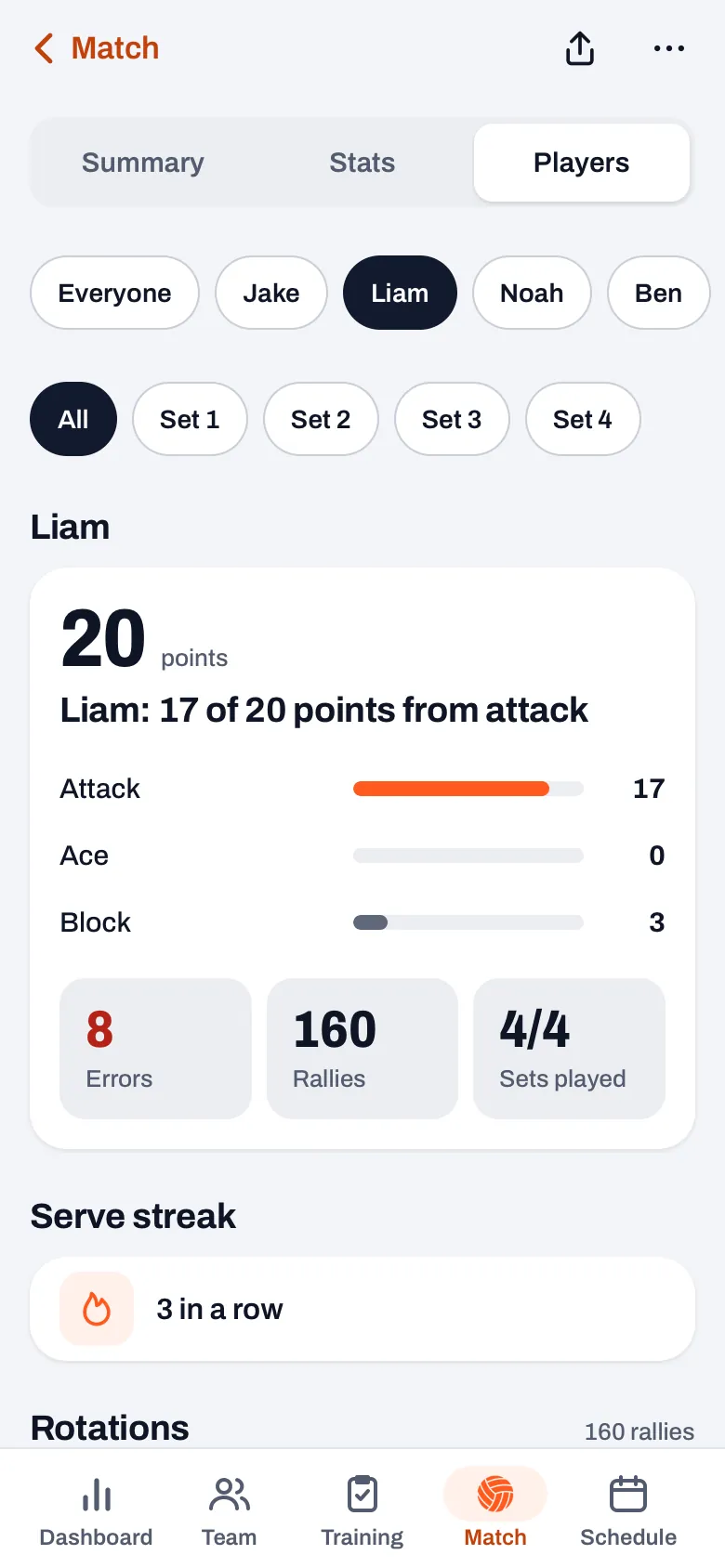
For practice, the plan shows which sections are on the schedule for the evening and for how long, and attendance shows who was there. If you write down a count, put it in the Player notes for that practice, so you can find it again in a few weeks. What else to set up in your first season is in starting as a volleyball coach.
14 days free, no credit card. Score your next match live and see how many rallies and sets each player played.
Try Koach with your teamWhat Koach costs after the trial is on the pricing page.
Frequently asked questions
How many times does a volleyball player jump per game?
That depends on the position, the number of sets and the player. In a study of a Portuguese top-division team (Lima and colleagues, 2019), the setter jumped about 32 times per set, the middles 21 times and the outside hitters 13 times. For a four-set match that comes to about 127 jumps for the setter. Among young Norwegian elite players it was on average 62 jumps per hour of match play for the boys and 42 for the girls.
Which volleyball position jumps the most?
In most measurements the setter makes the most jumps, because they play a lot of balls in the air and block in the front row. The middle blocker and the outside and opposite hitters make the most high jumps. The libero jumps the least: they may not block and may not attack when the ball is entirely above the top of the net.
Do women jump less often than men in volleyball?
The studies do not agree. Among Norwegian youth players aged 16 to 18, the girls jumped less often per hour than the boys. In a review of 28 studies, women actually made more jumps, but lower ones. So it varies with the level, the age and the style of play.
How do you count how much your volleyball players jump?
Have someone on the sideline make a tally mark per player for every jump: attack, block, jump serve and a jump set. Do it for one practice and one match, at least one player per position, and count the warm-up separately. In research it is done with video or with a small sensor on a belt at the hip. After that one count you can estimate the rest of the season.



See who played the heaviest load
14 days free, no credit card. After one match you see each player's rallies and sets.
Get started with KoachOr read first what the volleyball coaching app does.