
Volleyball weekly training plan: how your practices connect
The short answer
A volleyball weekly training plan starts from the match: count back and give each practice a job. The practice furthest from the match teaches and loads the most, the practice just before it applies the theme in game formats. Keep one theme all week and start each practice where the last one ended.
A volleyball weekly training plan is more than putting two good practices back to back. Two practices that tackle the same topic from two sides get you more than two separate evenings. Here you read how to split the jobs over the week, with sample weeks for two and three practices.
What makes a training week different from separate practices
A player does not learn a skill in one evening. They have to see it, repeat it, perform it under pressure and then dare to use it in a match. A week with two or three practices and a match is exactly long enough for that sequence, if the practices connect. If they stand on their own, your team starts from zero at every practice.
Which theme comes up in which week follows from your season plan. How hard each day of the week is, is explained in volleyball periodization; in that theory such a week is called a microcycle. This article makes the week itself practical: which practice gets which job, what goes into it and how to keep the thread from one practice to the next.
Count back from the match
Weekdays say little. One team plays on Saturday evening, another on Sunday morning, a third on Friday. So name your practices after their distance to the match: two days before, four days before. That is also how you plan them.
- The practice furthest from the match gets the new work and the most jumps. There is time to recover.
- The practice closest to the match is shorter, sharper and has few jumps. No new material comes in here.
- A practice the day after a match you keep light: lots of ball contact at a low pace, little jumping.
- Two practices on consecutive days are not both hard. Put the jumps on the day furthest from the match.
Three jobs to spread over the week
Every practice in the week has a main job. There are three, and they come in this order:
| Job | What goes into it | Jumps |
|---|---|---|
| Learn | Teaching or refining the theme of the week: technique drills with lots of repetition, explanation and correction, little pressure | Medium |
| Pressure | The same theme with a count, a time limit or an opponent: game formats with lots of balls per minute | Many |
| Apply | The theme in the game format, the lineup and the serving targets for the match; short and sharp | Few |
With two practices, the first one does both learning and pressure: start with the technique drill and finish with the same skill under pressure. The second one applies. With three practices, each job gets an evening of its own. If you only practice once a week, all three go into the same practice, in that order, and a theme lasts two weeks.
Sample week: two practices and a match
Say your team plays on Saturday and practices on Tuesday and Thursday. The theme of the week is serve receive against a float serve.
Tuesday, four days before the match: learn and pressure (90 minutes).
- 15 minutes of warm-up with the ball.
- 25 minutes of serve receive technique: floats over a short distance in threes, with correction on the platform and the feet.
- 20 minutes of serve receive under pressure: Servers vs passers, in which a good pass earns a point and an ace costs one.
- 20 minutes of six against six with a bonus point for a side-out after your own serve receive.
- 10 minutes of serving at zones.
Thursday, two days before the match: apply (75 minutes). After the warm-up you start with Tuesday's last drill, Servers vs passers, now without explanation. Then the evening is about Saturday: serve receive and side-out per rotation with your starting lineup, short sets from 20-20 and a serving target per player. That way the theme of the week comes back in the form in which it counts on Saturday. How to build that practice and what to leave out of it is in the volleyball practice before a game.
A weekly plan with three practices
With a third practice the week gets roomier, but also heavier. A setup for a Saturday match with practices on Monday, Wednesday and Friday:
- Monday: learn. The new theme, lots of repetition, room for explanation. Two days after the match there is energy for technique again.
- Wednesday: pressure. The hardest practice of the week: the same theme in drills with a count, lots of balls per minute, the most jumps.
- Friday: apply. An hour, few jumps, lineup and serving targets.
If the schedule falls differently, for example Tuesday, Wednesday and Thursday, the order stays the same. Only the Wednesday gets a bit lighter, because there is no rest day between the practices.
The common thread: how the practices connect
- One theme, three formats. Every practice is about the same topic, but in a different format: technique, pressure, match. A second theme in the same week dilutes both.
- Start where you ended last time. The first drill after the warm-up is the last format of the previous practice. Players recognize it, you have nothing to explain, and you see right away what stuck.
- One count that runs all week. Use the same measure in every practice, for example the pass rating from 0 to 3 or the number of good passes out of ten. That way you see on Thursday whether it is going better than on Tuesday.
- After every practice, write one sentence for the next one. What went wrong, what do you start with next time? That sentence decides more than the plan you made on Sunday.
- Plan for whoever was missing. Not everyone is at every practice. Build the second practice so that a player who missed the first can still join in: repeat the key point once in the warm-up and do not let the rest depend on Tuesday's explanation.
The match itself produces work for the next week. Take one observation to the next learning practice, and otherwise stick to your plan. How to prepare, run and evaluate an evening is covered in running a volleyball practice.
Plan the week in one go. On Sunday or Monday, write down three things per practice: the job, the theme and the main drill. Then you only fill in the details per practice, and you see right away whether the week has a line through it.
The week in Koach: plan, drills and report
In Koach every practice has its own plan with blocks and minutes. Three things help to tie the week together.
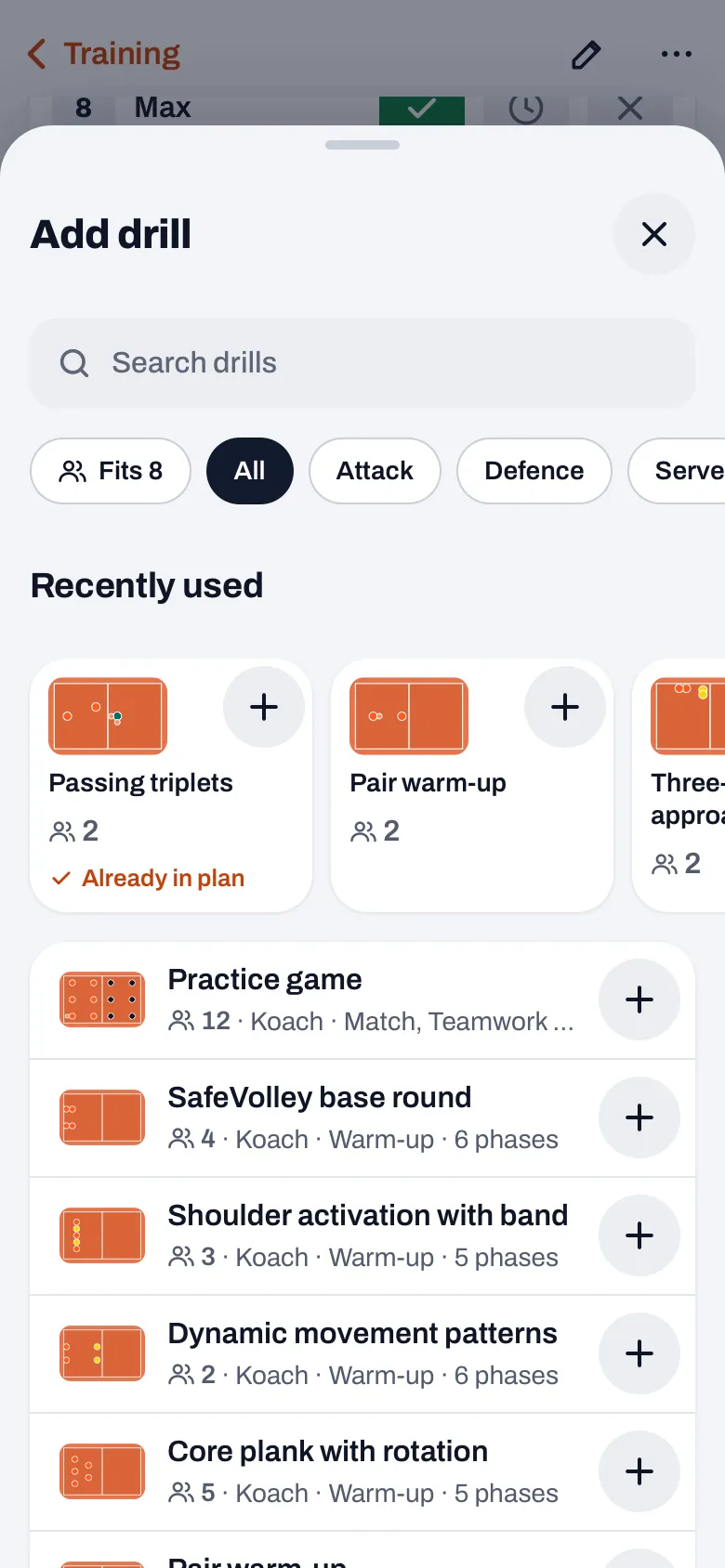
Copy plan. Start Thursday's plan with Tuesday's: tap Copy plan and pick Tuesday under Earlier trainings. The blocks go into your plan, and you remove what belonged to the learning part. Recently used. When you add a drill with + Add drill, the top row is Recently used: at most eight drills from your practices with the latest date, and practices you have already planned ahead count too. If you plan week by week, Tuesday's drill is therefore there, and if you have already put it in the plan, it says Already in plan.
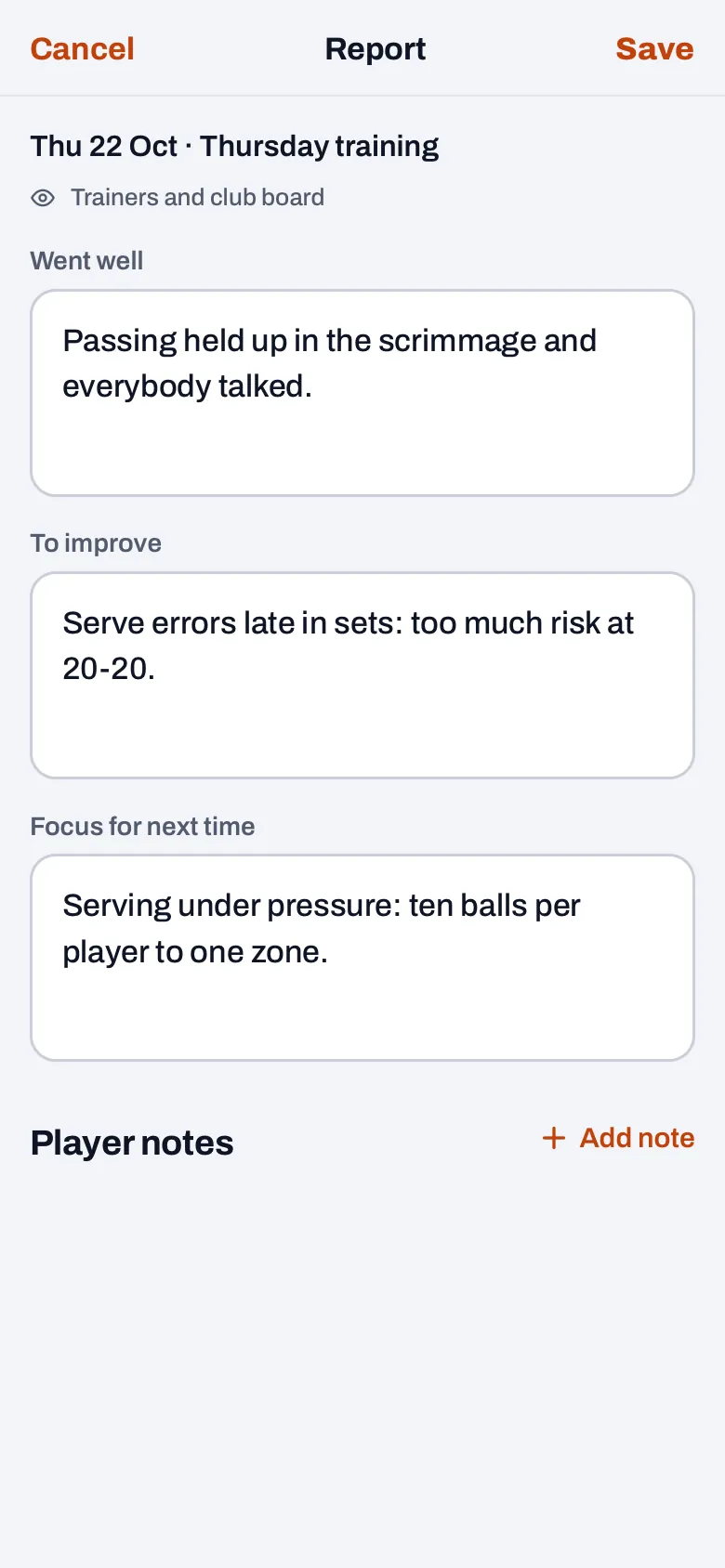
Focus for next time. After practice you write under Report what went well, what can be better and the focus for next time. When you open the next practice, that focus sits above the plan under Focus, with the date and who wrote it. That is the sentence from point 4 above, right where you need it. How the report works beyond that is in the practice report.
In the gym you open a drill from the plan with a tap on the small court, and with Next you move on to the next drill in your plan. What Koach costs after the 14 free days is on the pricing page.
14 days free, no credit card. Plan your next week in Koach and copy Tuesday to Thursday with one tap.
Plan your training week in KoachFrequently asked questions
How many practices a week does a volleyball team need?
That depends on the level, the age and the gym time available. Many amateur teams practice once or twice a week, higher-level teams and older youth teams often three times. More practices only help if they have different jobs and if there is recovery in between. Two practices that connect often get you more than three separate ones.
How do you plan if you only practice once a week?
Put all three jobs in the same practice, in a fixed order: first the technique drill, then the same skill under pressure, and finally a game format. Let a theme run for two weeks instead of one, so there is enough repetition. Start the second week with the format you finished the first one with.
Can you practice the day before a match?
Yes, if you keep the practice short and light. Play game formats at speed, run through the lineup and give everyone a serving target, but avoid heavy jumping blocks and new drills. What players learn that evening will not show the next day yet; the fatigue they pick up will.
How do you plan a week with two matches?
Drop the learning practice and keep the one that applies. The theme of the week then moves up a week. If there is only one practice between the matches, keep it light: recovery, ball contact and the agreements for the second match.
Plan your next training week
14 days free, no credit card. After one week you will see whether your practices connect.
Get started with KoachOr read first what the volleyball coaching app does.