
Volleyball periodization: macro, meso and micro cycles
The short answer
Volleyball periodization means dividing the season into cycles in which load and recovery deliberately alternate. The macrocycle is the season, a mesocycle a block of a few weeks with one goal, and a microcycle the week around the match. That way you build up, maintain and are sharp when it counts.
Volleyball periodization sounds like something for pro teams with a strength coach, but the idea is simple: you don't plan every week at the same load. This article explains the three cycles, the principle of load and recovery, and how to apply it to an amateur team with two practices and a match a week.
What is periodization?
Periodization means you divide the season into periods, each with its own goal and its own load. Hard and easy weeks deliberately alternate, so players get stronger without wearing out, and are in shape at the moments that count. The classic model is more than half a century old and assumed one peak per season, such as a championship at the end. In his 2010 review, Issurin names exactly that as the weak spot of the traditional model: it cannot deliver peak form at several moments in a season. And that is exactly what a volleyball league with a match every week asks for.
Periodization is about load: how hard, how long and when to rest. Which technical or tactical theme is on the menu in which week is a different question; that is worked out in the season plan in 34 weeks. And organizing the whole year, from tryouts to evaluation, is covered in organizing the volleyball season. This article is the layer underneath.
Three cycles: macro, meso and micro
| Cycle | How long | For an amateur team |
|---|---|---|
| Macrocycle | a season, sometimes half a season | preseason, competition and a rest period after the last match |
| Mesocycle | usually three to six weeks | one goal, a few harder weeks and then an easier week |
| Microcycle | a week | two practices and a match, the hardest practice furthest from the match |
An example. The macrocycle runs from the first practice in August to the last match in spring. Inside it are mesocycles: a block of strength and jump build-up in preseason, a block centered on the serve, a block around the winter break. And every week is a microcycle with a fixed rhythm around the match. How to count the weeks if your league starts at a different time is in the season plan; the principle is the same.
Load and recovery: the principle underneath
A practice is a stimulus. The body adapts in the hours and days afterwards, during recovery, not during the practice itself. That is why a team often performs worse right after a hard week and better a week later: the fatigue briefly hides what was gained. If you train at exactly the same load every week, after a while you no longer give a new stimulus. If you train harder every week without an easier week, you pile up fatigue and invite injuries and dropouts.
Load is made up of two things: how much (minutes, reps, jumps) and how hard. In volleyball the jumps count most; an attacking practice loads knees and tendons differently from an hour of passing. A simple way to measure load is the session RPE that Foster and colleagues tested in 2001, in basketball among other sports. After practice every player rates how hard the whole session was on a scale of 0 to 10, and you multiply that number by the number of minutes. Say a 90-minute practice gets an average of 6: then the load is 540. Add up the practices and the match of a week, and you see which weeks were hard and where the load suddenly jumped.
Ask for one number after practice. Have players say how hard the practice was, from 0 to 10, on their way out. After four weeks you see which practices turn out harder than you intended, and which player is always higher than the rest.
The season in phases: build up, maintain, peak, rest
Preseason: from general to specific
In the first weeks after the summer the emphasis is on volume: strength, a gradual jump build-up, lots of reps of the basic technique. Start lower than where you stopped in spring, because after a few weeks of rest part of the fitness is gone. Toward the first match the emphasis shifts to intensity: shorter, faster game-like drills, more jumps at match tempo and scrimmages against other teams. How to build the physical side over the year is covered in conditioning for volleyball players.
Competition: maintain and wave
With a match every week there is no room for one big peak. The goal is to maintain the level, with a short strength and jump stimulus each week. Within the competition you work in mesocycles: two or three normal weeks, then an easier week with fewer jumps and shorter practices. A holiday week or the winter break is often that easier week by itself; put it in on purpose instead of seeing it as lost time.
Peaking for the match that counts
A few matches per season weigh more: a cup match, a promotion or relegation match, a final tournament. For those you taper. A meta-analysis by Bosquet and colleagues (2007) of 27 studies in competitive athletes found the largest effect with a two-week taper in which training volume dropped by 41 to 60 percent, while intensity and the number of sessions stayed the same. Those numbers are not specific to volleyball, so for a team they are a direction, not a recipe. For a volleyball team it means: the same practice days, but shorter, with fewer jumps and without heavy strength blocks, and with sharp, fast game-like drills. What you don't do is train extra hard in the week before that match.
Rest after the season
After the last match comes a period without structured volleyball, with other kinds of movement. Players then come back fresh and motivated. For youth players the bar is higher: a longer break from volleyball belongs in every year, see how often young players can train.
The week around the match: a microcycle
A common amateur rhythm is practice on Tuesday and Thursday and a match on Saturday. This is how you spread the physical load over that week:
| Day | Load | What goes in |
|---|---|---|
| Sunday and Monday | rest | recovering from the match, sleep, light movement if anything |
| Tuesday | hard | the strength or jump block, the most volume, new material |
| Wednesday | rest | no volleyball |
| Thursday | light to moderate | shorter, few jumps, game-like drills at tempo |
| Friday | rest | nothing hard |
| Saturday | match | the heaviest load of the week |
The season plan uses the same rhythm for the learning load: a learning day far from the match and a sharpening day shortly before it. The two line up, and that is handy. If you have a week with two matches, the hard block drops out. If you have a week without a match, Tuesday can be harder and Thursday too.
Four mistakes when periodizing an amateur team
- Every week the same. Without easier weeks and without harder blocks there is no new stimulus and no real recovery.
- Copying a pro program. Amateurs work, study and have exam weeks. That load counts too, even though it isn't in your plan.
- Training hard just before the match that counts. The coach's nerves are not a training stimulus.
- Measuring nothing. Without session RPE or without knowing who was there, you can't see afterwards whether your plan turned out hard or light.
Putting your cycles in the schedule
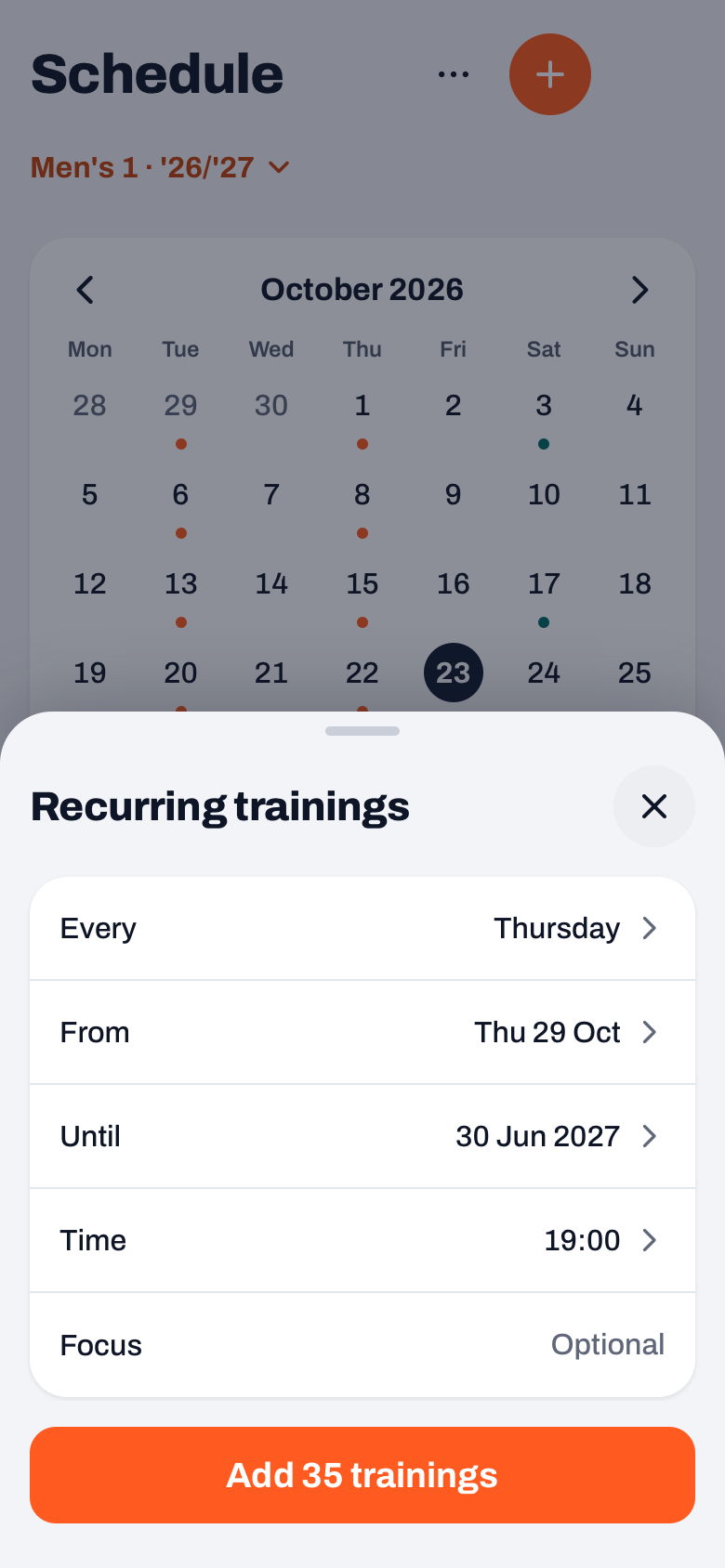
A mesocycle only becomes real once it is in the schedule. In Koach you put practices in the schedule in one go with Recurring trainings: you choose the day, From and Until, the time and a Focus. Make a separate series for each block, for example every Tuesday of the six weeks of your serving block with the focus "Serve pressure block", and that focus appears on every practice of that block. If your team has templates, you pick a Template too, so the structure of the hard Tuesday is already there. Days that already have a practice are skipped by the app. How that works step by step is covered in scheduling recurring practices.
Koach does not measure training load: you keep track of session RPE yourself, on paper or in a spreadsheet. What Koach does show is who was at which practice, and so whether a player really did the hard block. What Koach costs after the 14 free days is on the pricing page.
14 days free, no credit card. Put your first block in the schedule as a series with a focus and check after six weeks whether the plan held.
Plan your season in KoachFrequently asked questions
What is the difference between periodization and a season plan?
A season plan says which theme is on the menu in which week, for example three weeks of serve receive and then three weeks of serving. Periodization is about the load underneath: which weeks are hard, which are light, when you build up and when you taper for an important match. In practice you lay them on top of each other: the hardest physical blocks in the weeks with no match or one match.
How long is a mesocycle?
Usually three to six weeks. Shorter gives players too little repetition to adapt, longer makes the block monotonous and lets fatigue build up. For an amateur team a block of two or three normal weeks followed by an easier week works well, or a block that ends at a natural break such as a holiday.
How do you peak for an important volleyball match?
Taper over roughly the last two weeks: the same practice days, but shorter, with fewer jumps and without heavy strength blocks. Keep the intensity high with short, fast game-like drills. Research on tapering in competitive athletes found the largest effect when volume drops sharply and intensity and the number of sessions stay the same.
Does periodization make sense with two practices a week?
Yes, perhaps even more so. With two practices and a match there is little room, so it matters a lot which practice is hard and which is light. Plan the hard practice furthest from the match, a lighter one shortly before it, and keep an easier week after every few weeks. That costs no extra time, just a deliberate choice.


Put your first block in the schedule tonight
14 days free, no credit card. After six weeks you see whether the plan held.
Get started with KoachOr read first what the volleyball coaching app does.