
Volleyball practice before a game: what to do and what to skip
The short answer
The volleyball practice before a game is shorter and sharper than a normal practice: game formats at speed, the lineup through all six rotations, a serving target per player and few jumps. You teach nothing new and you finish on a successful action, so your team goes into the match fresh and confident.
The volleyball practice before a game does not make your team better than it is, but it does decide how it walks into the gym: fresh or tired, confident or doubting. Here you read what belongs in it, what should stay out, a 75-minute plan and the version for youth and recreational teams.
What should the last practice before a game deliver?
Fitness and technique do not change in a day or two anymore. What your players gain in strength or new technique in this practice will not show in the match yet. What they pick up in fatigue or doubt will. That is why the last practice has four goals:
- Fresh legs. Shorter than usual and with few jumps.
- Sharpness. A high tempo, decisions under pressure, the ball in game situations.
- Clarity. Everyone knows where they stand, in which rotation, what their role is and where they serve.
- Confidence. Players go home feeling that it works.
In the weekly plan this is the practice that applies; how it fits with the practice earlier in the week is in the volleyball weekly training plan. The warm-up on match day itself is a different story, with its own routine: see warming up for a volleyball match. If the last practice falls on the day before the match, make it a bit shorter still than the plan below.
Shorter and sharper: a 75-minute plan
A normal practice of 90 minutes becomes one of 75. The time that comes off is taken from the technical work and the repetitions, not from the game formats.
| Block | Min. | What you do |
|---|---|---|
| Warm-up as on match day | 15 | The same order as at the match, so it becomes a routine |
| Quick technique touch | 10 | A familiar drill with lots of ball contact at speed, without explanation |
| Side-out per rotation | 20 | The starting lineup through all six rotations, with serves from the other side |
| Game format with scores | 15 | Short sets that start at 20-20 or 22-22 |
| Serving targets | 10 | Every server works on their own target for the match |
| Finisher | 5 | A short drill that succeeds, then one or two agreements |
The rallies can be intense, the blocks are short. Keep the breaks short too: a quick drink and on you go. A practice that is long and hard makes players tired; a practice that is short and fast makes them sharp. How a normal practice is built is in running a volleyball practice; here everything is one size smaller.
For the game format, 22 all works well: both teams start at 22 and the rally is played out completely. Players practice exactly the scores at which they get tense in a match.
Running through the lineup and rotations
The most important block is running through your lineup. Not as theory on a whiteboard, but on the court, with a ball and a server on the other side. In Side-out per rotation the other side serves on rotation 1, your team plays the side-out all the way out and then rotates on to rotation 2. In each rotation, watch four things:
- Who receives the serve, and who stays out of the receiving pattern.
- Where the setter comes from and how quickly they get to the net.
- Which hitters are in the front row and which attack the setter picks first.
- When the libero comes in and for whom.
Start with the rotation in which you begin the match. Give the most time to the rotation that cost you the most points in the last match. And play a few minutes with the substitution you are likely to make in the match, so that player knows where to stand when they come in.
If you have too few players for six against six, run through the rotations without an opponent: the coach serves or tosses the ball in, and the team plays the ball out to an attack on a target on the other side.
Serving targets for the match
Give each server one target for the match, and train that target. A zone, a type of serve or a spot between two passers: one thing per player, not three. Have them serve after a short sprint or straight after a rally, because in a match you do not serve rested either. Count ten serves per player: how many landed in the target zone, and how many were in overall?
Also agree as a team when you take risks. For example: after a service error of our own, the next player serves safely in. Agreements like that only work if they already apply in practice.
Stop a drill at the moment it works. End the game format after a successful rally, not when the clock hits zero. If the last drill goes badly, add two minutes of something your team can definitely do. Players take the last image of practice with them into the match.
What you skip in the last practice
- Teaching anything new. No new system, no new attack combination, no new drill with its own rules. Only an injury or a player dropping out is a reason to change things around.
- Heavy jumping or strength blocks. No block jumps in series, no conditioning. Those belong earlier in the week.
- Punishment. Running or push-ups after losing a drill make players tired and do nothing for the match.
- A scrimmage without an end. A long free scrimmage drags on, often ends in grumbling and costs the legs you need in the match.
- A long talk. One or two agreements at the end is enough. What you say just before the match is in the team talk before the match.
Youth and recreational teams: the variation
Youth. The principle stays the same: short, nothing new and finishing on success. But keep the tactics small. One agreement is enough, for example that every serve has to go in. Do run through the rotation order in a playful way, so everyone knows where they stand and when they rotate. End the practice with a game they enjoy, with a clear winner.
Recreational teams. If you practice once a week, the last practice is also the only one. Then some technique can go in, but keep the second half for the game format and the lineup. If you play the next day, leave out the jumps and keep it to an hour.
The last practice in Koach
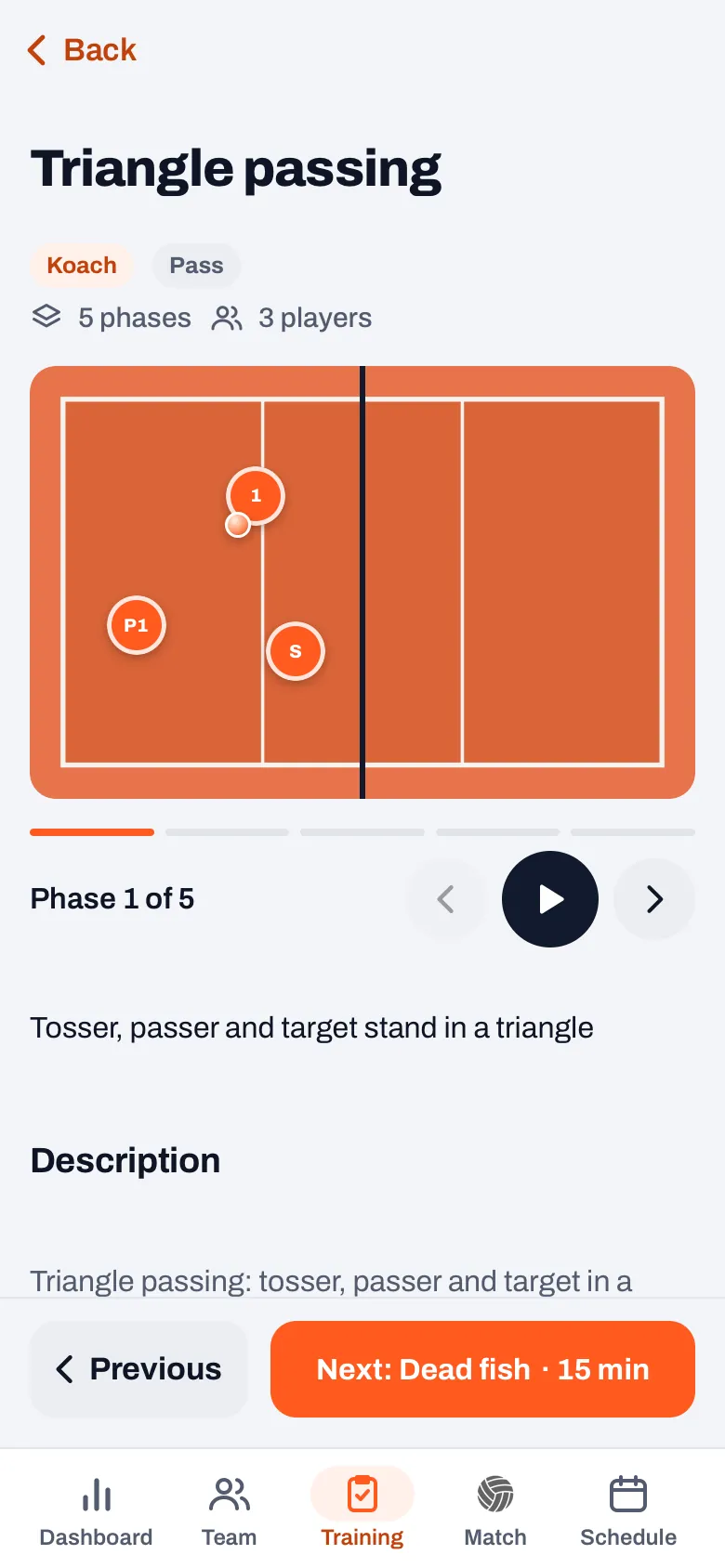
In Koach you put the blocks with their minutes in the plan of the practice. In the gym you tap the small court of a plan row to open the drill. Since version 3.1 the bottom shows Previous and Next, with the name and the minutes of the next block, so you go from drill to drill without searching; a block without a drill, such as a separate warm-up, is skipped by Next. Each drill then starts at phase 1, and with Back you are at the same spot in your plan again.
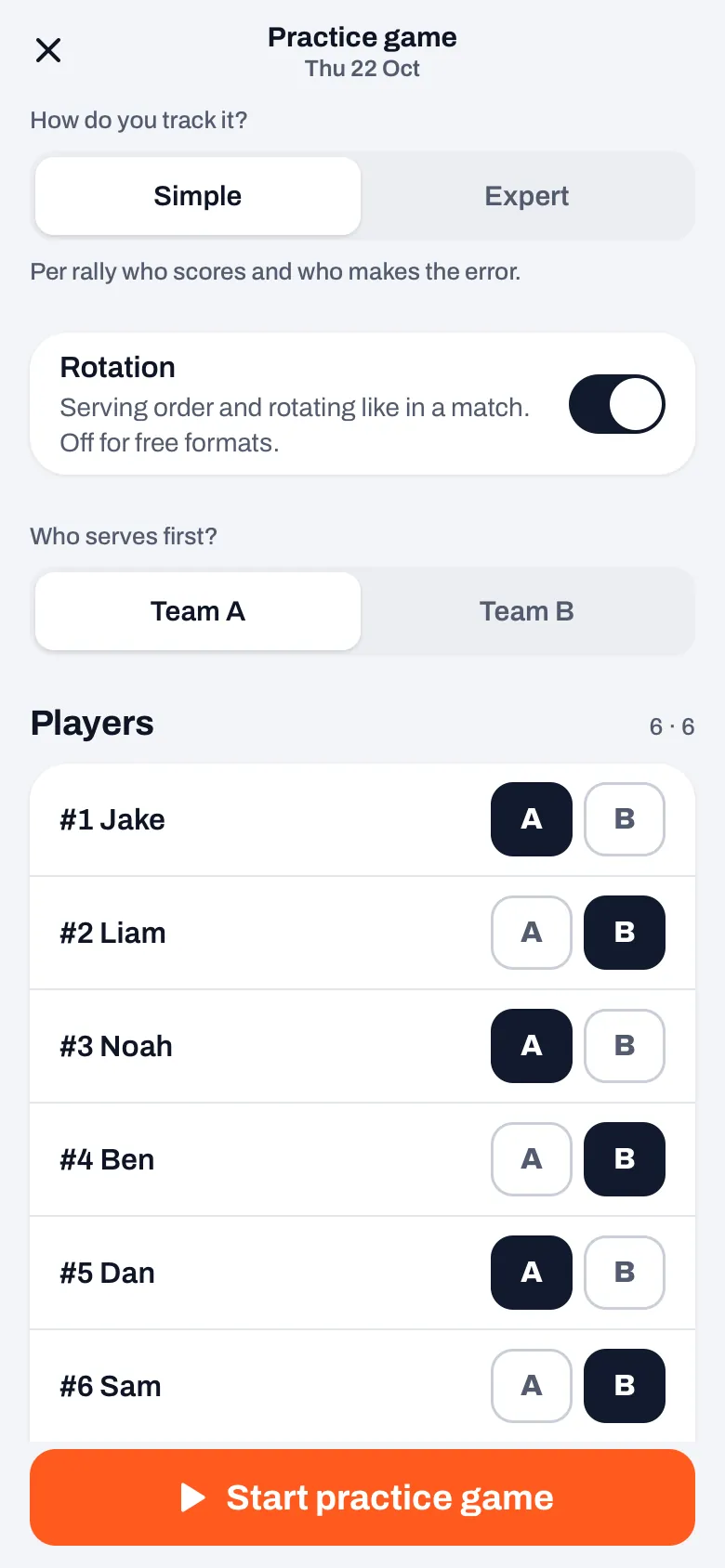
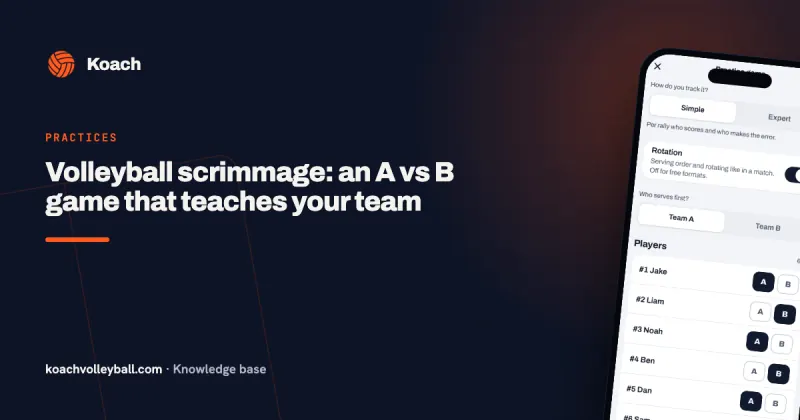
You can track a scrimmage with your own players as a practice game; you start it from the plan of the practice. Turn on the Rotation switch, and the serving order and rotating apply as in a match. You split your players over Team A and Team B and choose who serves first. In Simple mode you track per rally who scores and who makes the error. More about that format is in the volleyball scrimmage.
What Koach costs after the 14 free days is on the pricing page. If you are on an older version, update the app through the App Store or Google Play.
14 days free, no credit card. Put your last practice before the next match in the plan and work through it in the gym with Next.
Plan your last practice in KoachFrequently asked questions
How long should the last practice before a game be?
Shorter than a normal practice. A plan of 60 to 75 minutes is enough for most teams, with short blocks and little rest. If the practice falls on the day before the match, keep it to an hour and leave out the jumping drills. The time that comes off is taken from the technical work, not from the game formats.
Can you still do a new drill in the last practice?
Better not. A new drill takes explanation and attention, and the first time a new format almost always goes messily. Pick drills your team knows, so the tempo is high right away and players have their heads in the match. New material fits better in the practice furthest from the match.
What do you do if players are missing from the last practice?
Run through the rotations with whoever is there and fill the open spots with a substitute or the coach. Tell a starter who was not there what the agreements are separately, for example when they arrive at the gym. If many players are missing, choose smaller game formats and leave the six-against-six work to the match.
What does the last practice look like for a youth team?
The same principle as for adults, with less tactics. Short games, one simple agreement such as every serve in, and running through the rotation order playfully so everyone knows where they stand. End with a game they enjoy and that they win or nearly win, so they look forward to the match.
Set up your last practice
14 days free, no credit card. In the gym you go to the next block with one tap.
Get started with KoachOr read first what the volleyball coaching app does.