
How to Hit a Back-Row Attack in Volleyball: The Pipe
A back-row attack looks complicated, but technically it is the same movement as up front. What differs is where you start, when you leave and how flat you swing. Get those three right and you hand your team a fourth attacking option that most opponents never cover.
Where your approach starts
The biggest mistake is starting too close to the three-meter line. You need room for a full three- or four-step approach and you have to take off well behind the line. In practice that means: start your approach six to seven meters from the net, so just in front of the end line.
From there you make the same three-step rhythm as up front, only with longer steps. Many hitters use a four-step approach in the back row: one extra step to build speed, followed by the familiar long-fast and short-explosive finish.
The take-off point: half a meter of margin
The rule is clear: on a ball entirely above the height of the net, a back-row player has to take off behind the three-meter line, and the line itself belongs to the front zone. Taking off on the line is a fault. Landing in the front zone afterward is completely fine - the referee only watches the take-off. The full rule is in may a back-row player attack.
The practical agreement to make with your hitters: take off about half a meter behind the line. That costs you virtually no attacking power and removes the doubt from the situation. Hitters who hunt for the line start looking down during their approach, and anyone looking at the floor is not looking at the ball.
Timing: leave earlier than in the front row
This is the real difference. On an outside attack you leave as the set reaches its peak. On a back-row attack the ball has to travel several meters further and you have more ground to cover yourself, so you leave clearly earlier. For a pipe at normal tempo the rule of thumb is: you are already moving at the moment the setter touches the ball.
Leave too late and you arrive at the ball still running and have to check up - the classic back-row attack where the hitter jumps half beside the ball. Leave too early and you stand waiting and jump from a standstill. This needs repetition with the same setter, because every setter has their own arc. Count on a few weeks of fixed pairs before it clicks.
The set that goes with it
A back-row attack lives or dies on the ball it gets. For a pipe (the attack through the middle from position 6) the guideline is roughly one to one and a half meters above the band and two to three meters off the net. That last part is crucial: a pipe sitting against the net cannot be hit without ending up in it, and the block is right on top of it.
For the attack from position 1 (often called the D-ball) the same principle applies with a slightly longer path to the right side. Which tempos fit with these is in attack tempo and first tempo.
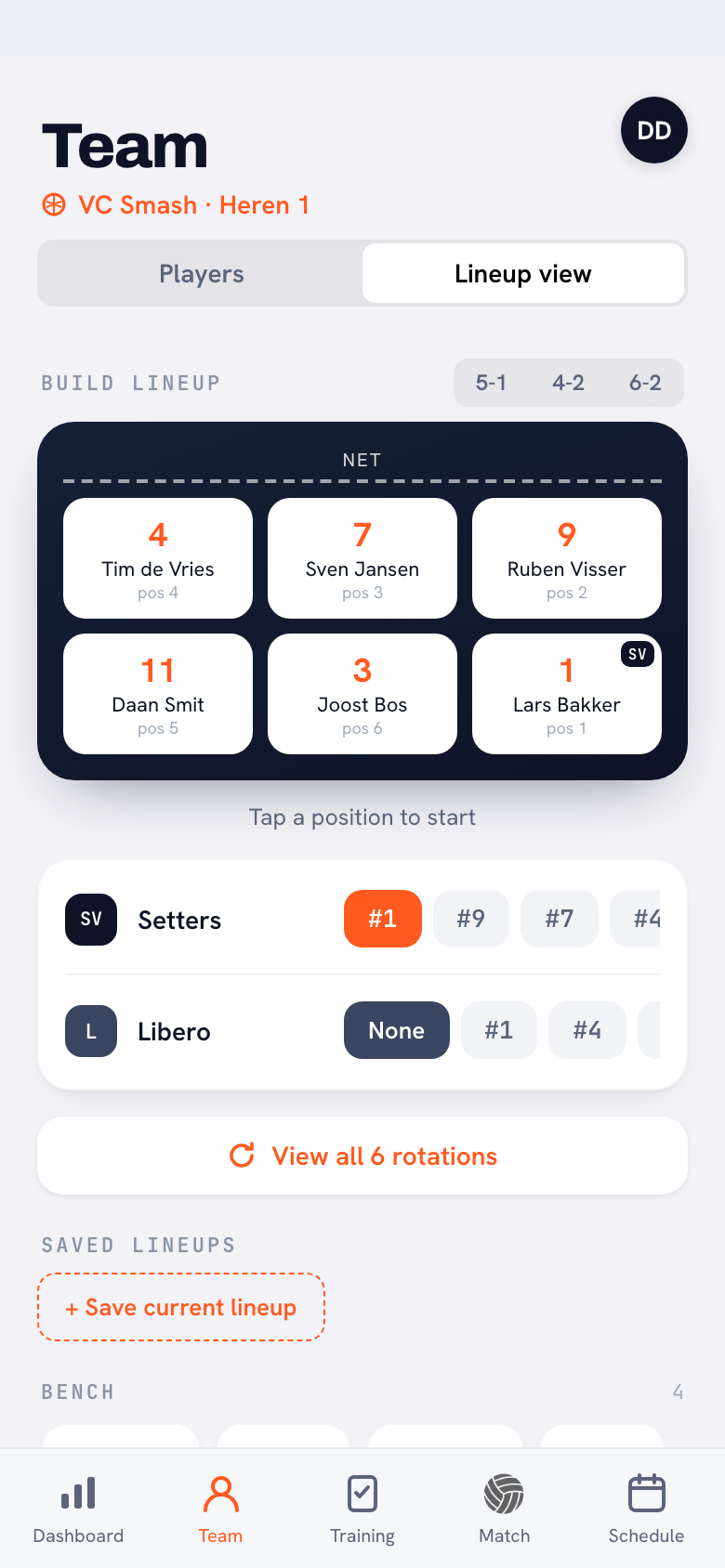
Think through in advance in which rotations you can actually use it: your best back-row attacker is only in the back row in three of the six rotations. In Koach you can save the lineup that gets your best back-row attacker into the right spot and check it rotation by rotation before the match - exactly the kind of preparation opponents do not expect.
The contact: hit flatter, not steeper
From three meters behind the line you cannot hit the ball steeply down - the angle simply does not exist. Try it anyway and the ball goes into the net or lands just behind it where it is easily dug. Instead, swing flat through the ball with plenty of topspin, aimed at the back three meters of the court. The rotation makes the ball dive after all.
The contact point stays the same as up front: highest point, in front of the hitting shoulder, hand on the top-middle of the ball with an active wrist. So nothing changes about your arm swing, only about where you aim. If you lose the feel, go back to the basics of spiking.
Call it, then get back
Two practical things. First: call your attack. A setter who does not know you are coming will give the ball to somebody else, and a pipe nobody announced ends in a collision with the middle. Call early, during the pass.
Second: you are a back-row player, so after your attack you are in defense. Land on two feet, get straight back toward your defensive position and expect the block deflection. Back-row hitters who stand and admire their swing let exactly the balls drop that the block puts back.
How to build it in practice
- Approach without a ball: from the end line, take off half a meter behind the three-meter line, ten times until it feels right.
- Tossed ball at a fixed height: coach tosses two meters off the net, hitter times their start.
- Off the set: with a fixed setter, high first, then faster.
- Off the pass: pass-set-pipe in the order it happens in a match, which is the only way to really learn the timing.
Save the lineup that puts that hitter in the right place so you do not have to work it out again every week - see saving and reusing lineups.
Frequently asked questions
Where do you have to take off on a back-row attack?
Behind the three-meter line, and the line itself belongs to the front zone - stepping on it is a fault. In practice, agree on half a meter of margin. Landing in the front zone afterward is fine; the referee only judges the take-off.
When do you start your approach on a pipe?
Earlier than on an outside attack: on a pipe at normal tempo you are already moving when the setter contacts the ball. Both the ball and you have more ground to cover, so waiting for the peak of the set is too late.
How far off the net should a pipe be?
Two to three meters off the net, about one to one and a half meters above the band. A pipe against the net cannot be hit without ending up in it, and the block is right on top of it.
Why do I keep hitting my back-row attack out?
Usually because you contact too flat without topspin, or because you leave late and end up swinging behind the ball. Swing flat through the ball with an active wrist and aim at the back three meters - the rotation makes it dive.


