
Types of volleyball hits: spike, tip, roll shot and more
The short answer
Types of volleyball hits differ in three ways: how you contact the ball (spike, tip, poke, roll shot, block wipe), where you attack from (outside, middle, right side or the back row) and how fast the set comes. A good hitter only picks the shot once in the air.
Types of volleyball hits are about more than hard or soft. This overview puts every form of attack side by side: the shots, the attacking spots at the net and in the back row, and the tempos, with when each one works and what the rules say about it.
What counts as an attack?
The FIVB rules are broader than many players think. Every action that directs the ball toward the opponent, except the serve and the block, is an attack hit (Rule 13.1.1). So a hard spike, but also a tip, a ball you play over on the second contact and a free ball you send back overhead. A tip is allowed as long as you hit the ball cleanly and do not catch or throw it (Rule 13.1.2). The attack hit is completed the moment the ball completely crosses the vertical plane of the net or is touched by an opponent.
That broad definition has consequences. The restrictions for back-row players and the libero apply to every attack, including a soft one. A back-row player who, from the front zone, attacks a ball that is entirely above the top of the net commits a fault (Rule 13.3.3), and nobody may attack the opponent's serve when that ball is in the front zone and entirely above the top of the net (Rule 13.2.4).
The shots: how you contact the ball
| Shot | What you do | When it works |
|---|---|---|
| Cross-court spike | Full arm swing, torso rotates through, ball to the long diagonal | Good set, block covers the line |
| Line shot | Less torso rotation, the hand steers the ball along the sideline | Block covers the angle, defender is inside |
| Sharp angle | Arm and wrist turn in, ball lands short near the sideline | Block takes away the deep angle |
| Tip | Fingertips of an extended hand, short contact over or past the block | Defense is deep, the spot behind the block is empty |
| Poke | Knuckles of a half fist, short and firm | Set tight to the net, awkward ball |
| Roll shot | Half speed with topspin, over the block | Big block, defense deep |
| Block wipe | Ball off the outside of the blocker's hand, out of bounds | Tight set near the antenna, block is closed |
| Down ball | From a standing position or a small jump, with topspin deep into the court | Set too far from the net or too low to jump |
| Free ball | Controlled over the net, overhead or with the forearms | No attack possible, keep the ball in play |
The hard spike is the foundation; how to learn it is covered under the basic volleyball skills. But a hitter with only that shot gets read within a set. The soft shots work because they look like a spike until the last moment: the same approach, the same arm swing, and only at contact does the hand slow down. How to play the tip, poke and roll shot is in poke, tip and roll shot; the block wipe has its own guide in wiping the block.
The down ball is often forgotten. When the set comes a few meters off the net, or so low that jumping gains you nothing, you hit it from a standing position with plenty of topspin deep into a corner. The team on the other side gets a ball it has to defend instead of a gift, and your own team gets time to recover.
Where you attack: from the outside to the back row
- Outside, in position 4. The left-front hitter gets the most sets, including the high ball after a bad pass. They need every shot in the table, because the block knows they are coming.
- Right side, in position 2. The opposite hits from the right. For a right-hander the ball comes across the body from the left; a left-hander has the natural contact point here.
- Middle, in position 3. The middle hitter takes the quick set, in front of or behind the setter. Even without getting the ball, their approach holds the opposing middle blocker.
- The slide. The middle hitter runs behind the setter and takes off from one foot; see the slide attack.
- The back row. The pipe through position 6 and the attack from position 1. The back-row player takes off behind the attack line and may land in the front zone (Rule 13.2.2); takeoff, timing and set are in hitting a back-row attack.
- The second ball. The setter attacks instead of setting. If the setter is in the back row and plays the ball from the front zone, that is only allowed if part of the ball is below the top of the net (Rule 13.2.3).
Put those spots together in one attack, with hitters crossing each other's approach paths or arriving just after each other, and you have a combination play. The cross, the tandem and the double quick are in attack combinations.
How fast: three tempos
The third way to classify attacks is the time between set and hit. On the high ball, the third tempo, the hitter only starts the approach once the set is on its way. On second tempo they approach while the setter plays the ball, and on first tempo they are already in the air when the set arrives. The faster the tempo, the less time the block has, and the better the pass needs to be. When to build in which tempo is in attack tempos.
Which attack do you choose when?
- Perfect pass, block not yet formed: fast and hard, through the gap in the block.
- Good set, double block up: hard to the side the block leaves open, or the block wipe at the antenna.
- Set tight to the net: poke, tip or block wipe. A forced spike ends up in the net or in the block.
- Set far off the net: roll shot or down ball deep into the corner. Surviving the point comes before forcing it.
- Defense creeping forward because you just tipped twice: now go hard, or hit the roll shot deep.
- After a bad pass: the high ball to the outside, and then an attack that keeps the rally alive.
The choice is made in the air. A hitter who has decided during the approach no longer looks at the block; a hitter who only looks at the jump sees the open spot.
Give every hitter one second shot. One hard shot plus one soft shot that comes from exactly the same approach is enough to make a defense hesitate. Have the coach call out at takeoff which one it will be, so the choice is made late. A third shot only comes once the second one works in matches.
Seeing which attack works
Whether your hitters choose well only shows in the outcome. In Koach, after a point, you tap Attack in the How did we score? drawer and then the player. If you track the match in Expert, you give every attack a rating from 0 to 5: Error, Free ball, Easy dig, Covered, Tough or Kill. Afterwards the Expert figures show, per hitter, the number of attempts, the efficiency and how often they scored after a good or a poor pass, and below that the difference between the attack on the first ball after reception and the attack in transition.
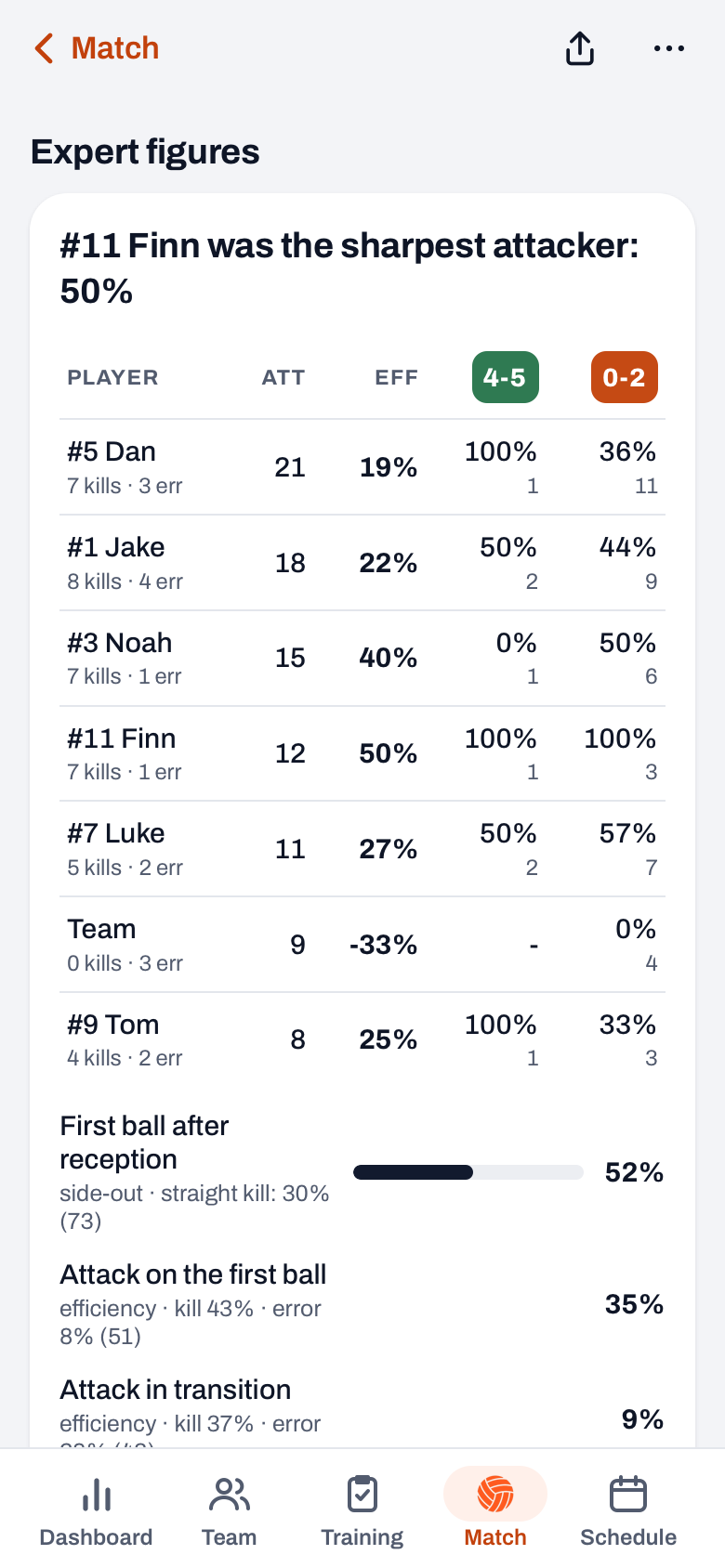
Which shot it was, tip or spike, the app does not record. You do see the pattern: a hitter with many attempts and few kills may keep hitting where the defense already is, and then needs a second shot. What Koach costs after the 14 free days is on the pricing page.
14 days free, no credit card. Track your next match in Expert and see which hitter still scores after a poor pass.
Try Koach at your next matchFrequently asked questions
How many types of hits are there in volleyball?
There is no fixed number, because you can classify attacks in three ways. By shot: spike, sharp angle, tip, poke, roll shot, block wipe and down ball. By spot: outside, right side, middle, slide, back row and the second ball. And by tempo: high ball, second tempo and first tempo.
Is a free ball also an attack in volleyball?
Under the rules, yes: every action that directs the ball toward the opponent, except the serve and the block, is an attack hit. That is why the rules for back-row players and the libero also apply to a free ball. If a libero plays the ball over while it is entirely above the top of the net, that is a fault.
Can a back-row player tip or poke the ball?
Yes, under the same rules as for a spike. If they take off behind the attack line, they may attack at any height and land in the front zone. If they are in the front zone, they may only attack the ball if part of it is below the top of the net at the moment of contact.
Which attack should a beginner learn first?
First the spike off a high ball from position 4, with the full approach and arm swing, because every other shot builds on it. Then the poke as a safe way out on a tight set, and only once the approach is stable the tip and the roll shot. Fast tempos come only when the pass allows it.


See which hitter really scores
14 days free, no credit card. After one match in Expert you see the efficiency of each hitter.
Get started with KoachOr read first what the volleyball coaching app does.