
The slide attack in volleyball: behind the setter, off one foot
Your middle hits the same quick in the same place every match, and the middle blocker on the other side has worked that out after one set. From then on he leaves early for your outside hitter and stands there two-handed. The slide is the cheapest way to get that blocker doubting again: you need no extra player for it, only a different approach and a different set.
What a slide actually is
In almost every attack the hitter runs towards the net, brakes with his last two steps and jumps straight up. The slide works the other way round. The middle blocker runs parallel to the net, behind the setter's back, and takes off from one foot in full movement — the same movement as a lay-up in basketball, right down to the knee swinging up.
He starts to the left of the setter, around the middle of the net, and ends up to the right of him, somewhere between zone 2 and the antenna. The set goes backwards over the setter's head: flat, travelling with him, coming down at the point the hitter is running to. Where exactly the ball is contacted is not fixed — that can be a metre and a half beyond the setter's shoulder, and it can be four metres.
That loose end is precisely the weapon. Every other attack your team plays has an address: the quick is hit at one point above the setter, the high ball outside comes down at the antenna. With a slide the address is a strip of net a few metres wide, and the blocker only knows which piece it will be once the hitter is already in the air.
Why the block struggles with it so much
A blocker does two things at once: he reads where the ball is going and he looks for the place he has to stand. Against a quick that second part is simple. Your middle stands at one point and jumps at one point, so the blocker only has to choose whether he goes with him or waits — exactly the choice pulled apart in read or commit blocking.
Against a slide that sum no longer works. The hitter moves sideways while the ball travels the same way, so the blocker has to go not to a place but to a moving target — and at the moment he would normally already be jumping. Anyone who gambled on the quick jumps where the slide is not. Anyone who waits arrives too late at the antenna.
The second gain does not show up in the count. Their middle blocker now has to watch the four metres to his right as well. So he leaves later for your outside hitter, or he leaves too early and leaves the slide open. The same trade as with a quick threat, but across a much wider strip of net; how the tempos relate to each other is in attack tempos: from high ball to first tempo.
One misunderstanding out of the way straight off: in terms of timing the slide sits closer to the second tempo than to the quick. The middle is still running while the setter plays the ball. So it is not a faster attack, it is a less predictable one.
Taking off from one foot is a skill of its own
The ordinary approach of three or four steps is in fact a braking system: you convert speed into height by braking with the last two steps and taking off from two feet at once. In a slide you do the opposite. You do not brake, you carry the speed up into the air with you. For a right-handed middle running to the right, that looks like this:
- The last step is long, low and on the left foot — the foot on the net side. Take off from the right and you turn away from the net and no longer have your hitting arm free.
- The right knee swings up and slightly towards the net. That knee swing supplies most of your height. Without it a one-footed take-off stays low and the whole movement feels pointless.
- The shoulders open out towards the court, so that the ball comes into view from the left and your hitting arm has room.
- You run the jump out. You land further along the net than where you took off. That is not sloppiness, that is the intention.
Two things always go wrong in the first practices. The first is braking: the middle wants to jump as high as on his quick, puts down two feet after all and stands still under a ball that travels on. The second is running too tight past the setter. Anyone jumping sideways has no steering left, so anyone who starts too close to the net touches it or steps over the centre line — both faults, even if the ball lands in.
And then the load. A one-footed take-off with a landing in movement puts the work on one leg instead of two. Build it up the way you build up any new jumping form: short series, spread across the evening, and not thirty times in a row on the practice where it finally starts to come off. How to teach the landing itself is in training landing technique. If a player keeps having knee, ankle or back complaints, that belongs with a physiotherapist or doctor and not with a drill — not even if he says himself that it is not too bad.
The set is the harder half of the agreement
Most coaches spend their first weeks on the hitter. In practice the problem sits with the setter, because a slide set is a backwards ball over the head, flat, to a target that is moving — a different task from a back set to somebody standing still and waiting.
The measurements that work for most teams: the ball comes half a metre to a metre above the top of the net, travels two to four metres along the net and drops about half a metre off the net, far enough that the hitter does not run his shoulder into it. More important than any measurement is the place. The ball has to come down in front of the hitter, in the direction he is running. If it drops behind him there is nothing left to save — during a sideways jump you cannot reach back. However it looks from the sideline: that is never an approach error.
Three standard mistakes, in order of how often you see them:
- Too high. The hitter has to wait, so has to brake, and the movement stalls. A slide you have to wait for has become an ordinary attack and the block is there after all.
- Too close to the net. The hitter has no room to run himself out and finishes against the net or over the centre line.
- Too far through. The ball runs into the antenna and your middle jams himself into the corner where he can do nothing.
Say it out loud, too. The slide is an agreement between two people who are not looking at each other at that moment: the middle makes his call during the pass, and the setter knows without looking round who is coming past behind him. One word is enough, and it has to be there before he is under the ball.
In which rotations it pays off most
Here is the reason teams playing the 5-1 system are so attached to the slide. With your setter in the back row you have three hitters at the net: outside in zone 4, middle in zone 3 and your opposite in zone 2. That opposite stands exactly in the space the slide wants to go. A short slide is still possible then, a metre and a half beyond the setter's shoulder, but the long version runs into your own player.
When your setter rotates to the front, the picture tips. In those three rotations there are only two real hitters at the net: your outside and your middle. Everybody in the hall then knows where the ball is going, and you notice that in the double block waiting on your outside hitter every rally. But the right-hand side of the net is empty in those rotations, because only the setter is standing there, and he is setting. The slide fills that space without needing an extra player.
That makes it a good companion to the pipe, which closes the same gap from the back. The difference is practical: a pipe needs an outside hitter in the right back-row position and is not available in every rotation, whereas there is always a middle in the front row.
How to build it up without wrecking your middle
- No ball, no net. Ten lay-ups along a line on the floor: last step on the left, right knee up, running out sideways. Hang this on the warm-up for two practices and do not make a separate block of it.
- Tossed from the setter's spot. You stand where the setter stands and throw the ball flat along the net; the middle runs and hits. Fifteen to twenty balls per practice, in series of five, with rest in between.
- Setter and middle alone. You throw to the setter, he puts up the slide. Keep going until the ball arrives at roughly the same height and distance ten times in a row. This is the step that takes the longest and the one you may not skip.
- Out of a real serve receive, with a choice. The middle now calls it himself: quick or slide. Only here does your setter learn to tell those two balls apart under time pressure, and only here do you hear whether the call comes in time.
- Game form with an assignment. In the rotations where your setter is in the front row, every good pass produces at least a slide approach — even when the ball goes somewhere else.
Reckon on four to six practices before the first slide lands in a match, and after that on three matches or so in which it mostly goes wrong. Introduce it with a comfortable lead or in a friendly, not at 20-20 in a set that counts.
Start with the short slide. A metre and a half to two metres beyond the setter's shoulder, rather than all the way to the antenna. The set is shorter and therefore easier, the hitter has less speed to handle, and the block gets confused by it just as much. The long version can always come later.
When you leave it alone, and how you measure whether it works
The slide only exists on a pass in the setter zone. If the ball comes from three metres behind the net, your setter cannot put up a flat backwards ball and your middle is running for nothing — with the risk of a collision between somebody running on and somebody who decided otherwise. So agree that the call lapses automatically on a poor pass.
Two to four slides a set is enough for most teams. Half the effect sits in the threat: their middle blocker stays in the centre longer and gets to your outside hitter more slowly. That is the same reason a middle blocker makes his approach even when he does not get the ball — and immediately the reason his work shows up so poorly in the figures.
So do not only count the slides that score. Lay three or four matches side by side and look at two numbers at once: the attacking points of your middle and those of your outside hitter. If the first stays the same while the second goes up, the slide is doing exactly what you brought it in for.
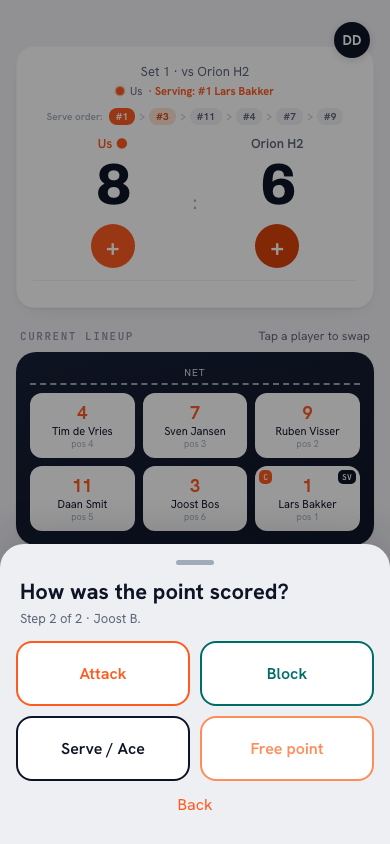
You record it like any other point — first who scored, then how; in Koach those two steps follow each other, see point tracking per player. An attacking point scored while your setter is on court is also automatically credited to him as an assist. That is not unimportant, because it is usually his ball that made the slide possible.
Frequently asked questions
What is a slide in volleyball?
An attack in which the middle blocker runs parallel to the net behind the setter and takes off from one foot while still moving, like a lay-up in basketball. The set goes backwards over the setter's head, flat and travelling with the hitter. Because the hitter is still moving when he jumps, the block only finds out late where the ball will be contacted.
What is the difference between a slide and a quick?
A quick is a first tempo: the middle is already in the air when the setter plays the ball, at one fixed point just above him. A slide is slower — the middle is still running during the set and leaves half a beat later — but he can strike anywhere along a strip of net a few metres wide. The quick buys time from the block, the slide buys uncertainty.
Why do you take off from one foot on a slide?
Because you want to keep your speed. An ordinary approach brakes in order to convert speed into height; do that on a slide and you are standing still under a ball that travels on. With a one-footed take-off you carry the sideways movement up into the air, which lets you hit later and further along the net — and that is exactly what the blocker cannot follow.
From what level can you play a slide?
As soon as your pass regularly reaches the setter zone and your setter can put up a flat backwards ball. That is well within reach across the amateur divisions; it is mostly a matter of repetition between two players. The brake is usually not the hitter but the set: as long as that stays too high, there is no slide.
Is the one-footed take-off hard on the knee?
A take-off and landing on one leg spread the load differently from the ordinary two-footed jump, so treat it as a new jumping form: small series, built up over weeks and not dozens of repetitions in a row in one practice. If a player develops knee, ankle or back complaints, have them assessed by a physiotherapist or doctor before he trains on. What is fine for one player need not be fine for another.


Try it yourself in Koach
Less admin, more coaching.
Get started with KoachOr read first what the volleyball coaching app does.