
Volleyball offensive plays: the X, tandem and double quick
The short answer
Volleyball offensive plays are agreed approach routes in which two hitters threaten at the same time, so the block has to choose. Common names: the X, where the routes cross, the tandem, with a second hitter right behind the middle, and the double quick, with two hitters on first tempo.
Volleyball offensive plays are the answer to a block that already sees your high ball to the outside coming. When two hitters threaten at once, the opposing middle blocker has to choose, and if he guesses wrong, your hitter swings against one blocker or none. These are the four plays you see most often, and this is how you build them.
What is an offensive play?
An offensive play is an agreement between the setter and two or three hitters about who approaches where and when. One hitter, usually the middle, goes for a quick set close to the setter. A second hitter comes a beat later, to a spot next to it or to the same spot. The setter chooses at the very last moment who gets the ball, with the same hands and the same contact point above the forehead, so the block cannot read anything.
Which tempos exist and what each one asks of your pass is covered in attack tempos from high ball to first tempo. How plays fit into the whole of serve, serve receive, attack and defence, you can read in the basics of volleyball tactics.
Why the block struggles with it
On every good pass the opposing middle blocker has two choices. If he jumps with your quick middle, he is out of the play for the second hitter. If he waits until he sees where the set goes, he no longer gets to the quick ball. A play forces him to make that choice again in every rally.
Your setter picks the other side: if their middle jumps, the ball goes to your second hitter; if he stays down, it goes to your quick middle. More on the two ways to block is in read blocking or commit blocking.
The four plays you see most often
There is no official list of plays: the rulebook does not mention them, and names and routes differ by country, by federation and by club. Many teams give everything a number code, where the first digit is the spot along the net and the second the height of the set. Below are the common names (X, tandem, double quick and slide), with a description of the routes. If your club calls them something else, the movements are the same. Position 4 is left front, position 3 the middle, position 2 right front; the setter stands at the net between position 3 and position 2.
The X
In the X, the routes of two hitters cross. A common version: the middle hits a quick set just in front of the setter, and the opposite comes in from the right, passing behind the middle (on the court side, not between the middle and the net). On the other side of the middle he gets a slightly higher, fast set, about a metre past the spot where the middle jumped. A second version comes from the left: the middle goes for a quick set a little further from the setter, and the outside hitter cuts inside and hits between the setter and the middle.
The block sees two hitters who seem to run into each other. The outside blocker who follows his own hitter gets pulled inside, and the middle blocker has half a second to choose. The trap is a collision. So agree that the second hitter always passes behind the middle: the middle left earlier and is already in the air when the second hitter goes past.
The tandem
In the tandem, two hitters approach one behind the other to the same spot. The middle jumps for the quick set in front of the setter, and a second hitter, usually the opposite or the outside hitter, runs in his track and jumps at the same spot as soon as the middle lands. His set is slightly higher and a fraction later. A blocker who jumped with the middle is just coming down when the second hitter swings. The tandem needs fewer routes than the X, but more timing: if the second hitter leaves too early, he runs into the middle's heels; if he leaves too late, the block is back up.
The double quick
In the double quick, two hitters go for a first tempo ball at the same time: the middle in front of the setter and a second hitter, often the opposite, for a quick set behind the setter. One middle blocker cannot jump at two spots at once. The downside is that both balls are fast. The pass has to be good, and you need two hitters who can handle first tempo.
The slide combination
In the slide, the middle runs behind the setter and takes off from one foot, towards position 2. That drags the opposing middle blocker to that side. The play lies in what a second hitter does with that space. Usually that is the outside hitter in position 4, who now hits against one blocker instead of two. If an opposite is in the front row, he can also cut inside for a quick set in front of the setter, in the spot the middle just left. The slide itself, with the one-foot takeoff and the set, is worked out in the slide attack.
| Play | Who runs what | What the block has to choose |
|---|---|---|
| X | Middle quick in front of the setter, second hitter crosses behind him | Go with the middle or with the crossing hitter |
| Tandem | Middle quick, second hitter a beat later at the same spot | Jump with the first or wait for the second |
| Double quick | Two hitters on first tempo, in front of and behind the setter | Which of the two quick balls |
| Slide combination | Middle on the slide behind the setter, outside hitter or opposite uses the space | Go with the slide or stay in the middle |
What a play asks of your team
- A pass in the setter's zone. You run plays off a good pass. If the setter has to chase the ball, the play is off and the ball goes high to the outside. Everyone knows that fallback without anyone calling it.
- A middle who always approaches. Without a quick threat there is no play. The middle approaches on every good pass, even when he knows he probably will not get the ball.
- A setter who gives nothing away. Both sets from the same contact point, with the same posture. If he already sinks into his knees for the higher ball, a good blocker sees it.
- An agreement before the serve. Everyone knows who has which route before the ball is in play, through a call or through signals from the setter. How to build such a system is in setter hand signals.
Which play fits which rotation?
In a 5-1 your setter is in the back row for three rotations and in the front row for three. When he is back, you have three hitters at the net: outside hitter, middle and opposite. Then everything works: the X with the opposite, the tandem, the double quick and the slide combination. When he is front row, you have two hitters at the net, the outside hitter and the middle. The play is then the X from the left, a tandem with the outside hitter, or the slide: the middle fills the empty right side, and that is exactly why many teams run the slide in these rotations. A back-row attack turns it into three threats again; see the pipe.
Do not start in all six rotations at once. Pick the rotations where your pass is strongest and you have three hitters in the front row, and run the play there off serve receive. In the rally, after a dig, a play is much harder: nobody is in their starting spot and the setter first has to get to the ball. At most levels you therefore run plays mainly off serve receive.
How to build a play in four steps
- Routes without a set. The setter stands at the net, the hitters in their serve receive starting spots. You toss the ball to the setter, who catches it; the hitters run their routes and jump. Watch two things: do they cross without colliding, and does the middle jump the moment the setter touches the ball, with the second hitter a beat later?
- With the ball, without a block. Now the setter really sets. From behind the hitters you show him with your hand which set to play, so both hitters approach every ball for real. Switch roles after ten balls, so every hitter learns both routes.
- With a middle blocker who chooses. Put a middle blocker on the other side and quietly tell him per ball: jump or stay down. The setter watches and picks the other hitter. That way he learns to read, and the team sees why the choice does the work.
- Off serve receive, in a game. Serve from the other side, pass, play. A point from the play counts double, and a good pass without a play does not count. Play it first in one rotation and then in the three rotations with the setter in the back row.
One play that works beats four that half work. Only add a second play when the first one runs by itself in matches, at 20-20 too. Until then your play is a practice drill, not a weapon.
Drawing and measuring plays in Koach
A play that only exists in your head is gone after a week. In Koach you draw it on the tactics board: on the Training tab you go to Boards and use New board to make one board per play, with an Arrow for every route and a Dashed line for the ball. With Share as image your players get to see it at home. If you want the routes to move, make your own drill with New exercise: you place the players for each phase, and on playback they move from phase to phase.
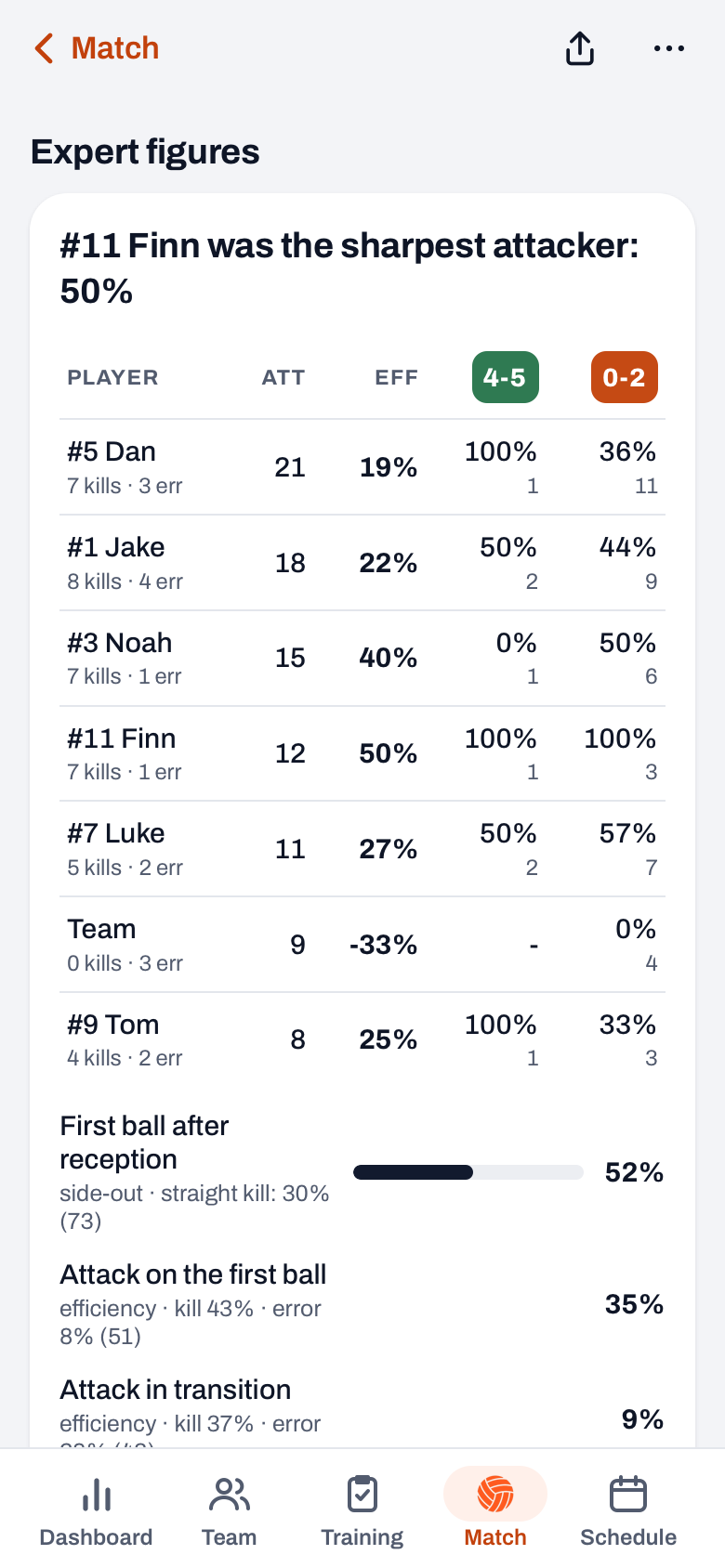
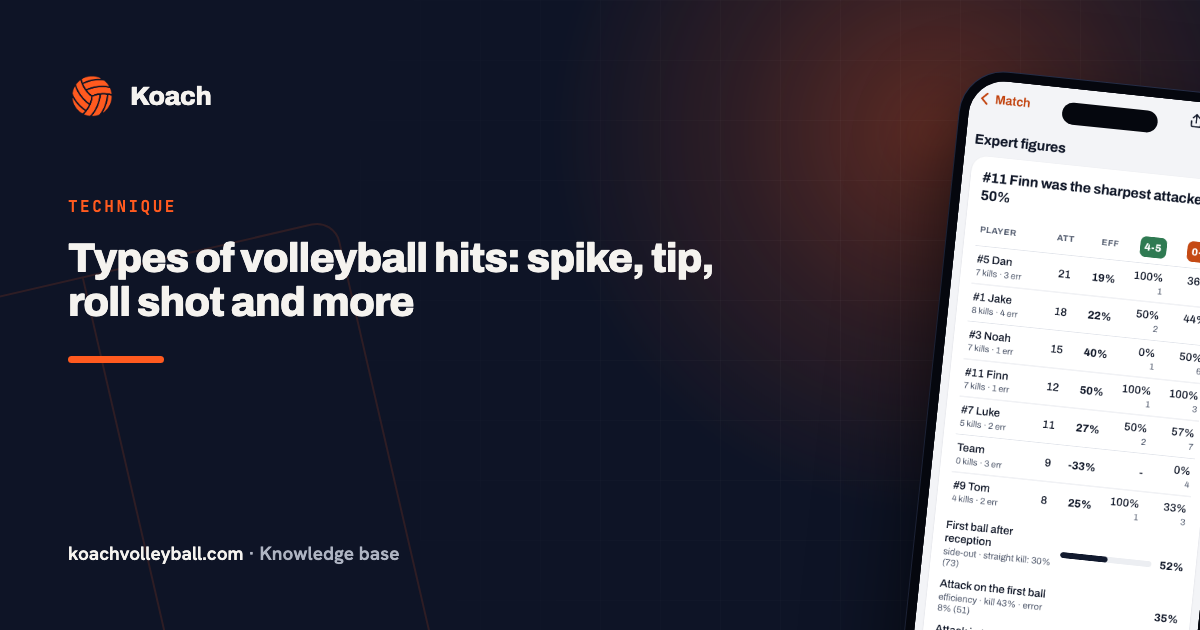
Whether it works, you see in the match. If you score in Expert mode, where every ball contact gets a rating from 0 to 5, then after the match Expert figures shows per hitter the attempts, the efficiency and how often he scored after a good pass (4-5) and after a poor pass (0-2). Koach does not know which play you ran. What you do see is whether your middle and your second hitter score after exactly the good passes your plays come from.
14 days free, no credit card. Draw your first play on the board tonight and see after the next match what your middle scored off a good pass.
Try Koach with your teamWhat Koach costs after the 14 free days is on the pricing page.
Frequently asked questions
Can you run offensive plays in a 4-2 or a 6-2?
Yes. In a 4-2 the setter who sets is always in the front row, so you always have two hitters at the net: the X from the left, the tandem with the outside hitter and the slide by the middle fit there. In a 6-2 the setter in the back row always sets, so you have three front-row hitters in every rotation and can run every play, as long as the pass is good.
What is the difference between a tandem and an X?
In a tandem two hitters swing shortly after each other at the same spot: the second jumps as soon as the middle lands. In an X they run to different spots and their routes cross. The tandem plays with time, the X with time and space. The tandem has less risk of a collision, but needs precise timing from the second hitter.
At what level can you start running offensive plays?
As soon as your pass regularly reaches the setter's zone and your middle reliably hits the quick set in front of the setter. Without those two, a play is mostly a chance to make errors. With youth and recreational teams you start with a middle who approaches on every good pass, even without getting the ball: that is already half of every play.
How many offensive plays does a team need?
Fewer than most teams think. One play you can run blind in the right rotations gets you more than four that half work. Only add a second one when the first runs by itself in matches. Top teams have more, but even they usually run a few fixed patterns per rotation.

Draw your first play tonight
14 days free, no credit card. After the next match you see whether it scores.
Get started with KoachOr read first what the volleyball coaching app does.