
How to Read the Hitter in Volleyball Defense: What to Watch
Good defenders seem to know where the ball is going before it is hit. That is not intuition, it is reading: every hitter gives away four or five signals in the second before contact. Know where to look and you are structurally in the right place - without running any harder.
The looking order: four moments, four questions
Defending does not start with the hitter, it starts much earlier. Every moment in the rally carries information, and a defender who keeps the order has three quarters of the answer by the time of contact.
- The pass. Perfect to the setter? Then anything is possible - stay wide. Bad pass? Then the quick attack is off the table and a high outside ball is almost certain, so creep forward: a hitter working off a mediocre set picks the off-speed shot far more often.
- The setter. Where are they, which way are the shoulders turning, are they balanced? A setter pushed backward is not giving a quick ball.
- The set in the air. Now you know who is attacking and how far off the net the ball is. Off the net means less speed and a better chance of a deep ball.
- The hitter. Only now do you look at the player - and that is where the real reading begins.
Defenders who only watch the ball miss the first three moments and have to solve everything in the last half second. Nobody can do that.
What the approach gives away
- The angle. A sharp approach from outside in makes cross-court likely; a straight approach at the net opens the line. See line or cross-court for the other side of that story.
- The speed. A hitter who checks up or half-jogs is not going to swing hard. Creep forward: a tip or roll shot is coming.
- The distance to the ball. A hitter who ends up too far under the ball can only push it up. A hitter comfortably underneath and on time can do anything.
- The start moment. Leaving late means contact at a lower point and therefore a flatter, deeper ball.
What the shoulders and the elbow give away
This is the finer reading, and it happens in the air:
- Shoulders closed (chest turned toward the sideline): line. Be ready in the line zone.
- Shoulders open (chest toward the middle of the court): cross-court.
- Elbow high and well back: a hard ball is coming. Get low and wide.
- Elbow low or arm already extended: no power available. A placed or off-speed ball is coming - step forward.
- Ball above or behind the head: the hitter cannot swing through it. Expect a deep ball or one over the block.
The rule of thumb for coaching it in practice: watch the elbow for the power and the shoulders for the direction.
Standing still so you can read
Reading only helps if your body can act on it. So every attack comes with a moment of stillness: at the instant the hitter swings, you are stopped, low, weight on the balls of your feet - the split step. A defender still moving at that moment cannot react, however well they read it. More on that posture is in defending in volleyball.
The distinction experienced defenders make: you may lean on what you read, but you may not gamble. Leaning is shifting your weight a fraction toward the expected side so your first step comes quicker. Gambling is already running there - and then you are out of position the moment you were wrong.
Do not read the ball, read the gap
A defender does not defend the whole angle but the zone their own block leaves open. If the block is on the line, you defend cross-court and the space behind it - not the other way around. Without that agreement everybody defends "a bit of everything" and every smart shot lands exactly between two players. How block and defense make that choice together is in organizing the block and defensive systems.
Remembering what you read
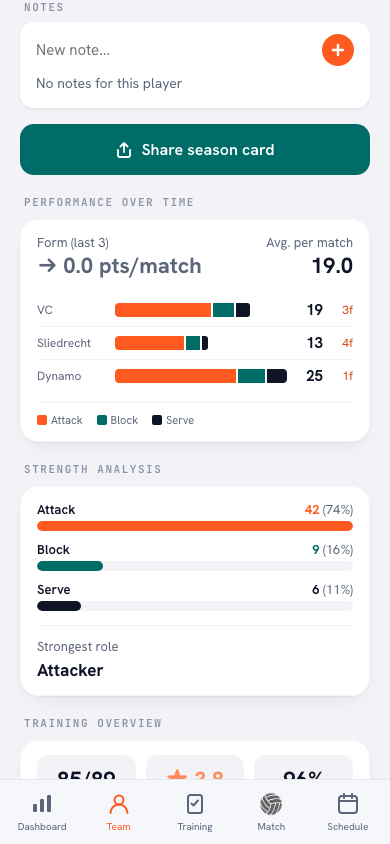
Hitters are creatures of habit. Number 9 always goes line under pressure, number 4 tips by default after a mediocre pass, their cross-court never lands deeper than six meters. You see those things in the first set, and by the time you could use them in the return match you have forgotten them - unless you write them down. Koach keeps a history per opponent, so you can note before the rematch which hitter always goes line under pressure, and your defense can be in the right place from point one. How to approach that preparation more broadly is in scouting the opponent.
How to train reading
- Call it out loud: the defender calls "line" or "cross" just before contact, without moving. Keep score - the reading improves visibly within a few sessions.
- Defending without a block: forces the defender to actually choose instead of leaning on the block shadow.
- Hitter with an assignment: the hitter gets a secret instruction (hard, tip or deep) and the defender has to react. Discuss after each series what the signal should have been.
- Video of one hitter: five attacks watched back to back on a phone - patterns you never notice live jump straight off the screen.
Frequently asked questions
What should you look at as a defender?
In order: the pass, the setter, the flight of the set and only then the hitter. On the hitter you watch the approach angle and speed, and in the air the position of the shoulders and the height of the elbow.
How do you see a tip coming?
From the arm: a low elbow or an arm already extended early cannot produce power. A hitter who checks up in the approach or ends up too far under the ball also picks an off-speed shot almost every time.
Are you allowed to gamble as a defender?
Lean yes, gamble no. Shift your weight a fraction toward the side you expect so your first step comes quicker, but do not run there. Be standing still at the moment the hitter swings - otherwise you cannot react to anything.
Should you follow the ball or the hitter?
Both, at different moments. Follow the ball through the set so you know who is attacking and where the ball is, then move your eyes to the hitter. Anyone who watches only the ball until the last moment misses every signal.


