
How to tape a volleyball court: straight lines in any gym
The short answer
To tape a volleyball court, work in a fixed order: first the center line under the net, then the sidelines square to it, then the end lines 9 meters from the center and finally the attack lines. Check the corners with the 3-4-5 method and with the diagonals, which on an 18 by 9 meter court are both 20.12 meters.
How to tape a volleyball court is a one-hour job if you measure in the right order. Here you read which tape to choose, exactly where the edges of the lines go, how to make square corners without a carpenter's square, how to lay out smaller courts for kids and how to keep the floor intact.
First check with the gym
A wooden or synthetic sports floor is expensive, and not every tape leaves it undamaged. So ask the facility manager beforehand whether tape is allowed on the floor, which kind, and how long it may stay down. Some gyms have fixed rules, or their own tape that they have approved before. Also ask whether there are existing lines you can use: in many gyms a volleyball court already sits among the lines of other sports, and then you only need to add a second color.
Which tape, and what else you need
- Floor marking tape for sports floors. Made to lie on a gym floor and come off again. Choose 5 centimeters (about 2 inches) wide, because that is the width of the lines in the rulebook (Rule 1.3.1), and a light color that stands out against the floor and the other lines.
- Painter's tape for one evening. For a court that has to come up again after practice. Less visible and tears more easily, but if you remove it the same day, the risk of residue is small.
- Do not use: strong duct tape, or tape when you do not know how it comes off. It can leave adhesive residue or pull the finish off the floor when you remove it.
- Also: a 25 or 30 meter tape measure (the diagonal of the court is 20.12 meters, so a 20 meter tape is just too short), a second tape measure or measuring tape, a long rope, scissors and a helper. Use small pieces of tape as markers; do not write on the floor with pencil or marker.
Where the edges of the lines go
The dimensions themselves are in the dimensions of a volleyball court. To lay out the court, what you mainly need to know is on which side of your measuring point the tape goes:
| Line | Where the tape goes (FIVB) |
|---|---|
| Sidelines and end lines | Inside the measurement: the court is 18 by 9 meters to the outer edge of the lines (Rule 1.3.2) |
| Center line | The middle of the line is exactly under the net (Rule 1.3.3) |
| Attack line | The rear edge of the line is 3 meters from the axis of the center line (Rule 1.3.4) |
| Free zone | At least 3 meters clear all around the court (Rule 1.1) |
If you put the tape on the wrong side of your measuring point, the court ends up 10 centimeters too big or too small. That shows on every ball on the line, because a ball that touches the line is in.
How to tape a volleyball court in six steps
- Set the center line. Start under the net, because everything hangs on it. If the posts sit in fixed floor sleeves, measure the distance between the posts and place the court exactly between them: the posts stand 0.50 to 1.00 meter outside the sidelines (Rule 2.5.1). Mark the center point of the court under the net; the outer edge of the sidelines is 4.50 meters to the left and right of it.
- Square up the sidelines. At a point where the center line and a sideline cross, make a right angle with the 3-4-5 method: measure 3 meters along the center line and mark that point. Then find the point on the sideline that is 4 meters from the crossing and 5 meters from your first point. That is a 90-degree angle. More accurate is the same triangle made bigger: 6, 8 and 10 meters.
- Measure the corners. Along each sideline, measure 9 meters back from the axis of the center line, the middle of the tape under the net. Those are the outer corners of the court.
- Check the diagonals. Measure from corner to corner, crosswise. If both diagonals are 20.12 meters, the court is a rectangle. If they differ, the court is skewed: move the two back corners of one half until the diagonals are equal. For each 9 by 9 meter half the diagonal is 12.73 meters, handy for checking each half separately.
- Lay the lines. Stretch a rope tight between two markers and lay the tape next to it. Do not stretch the tape while you lay it: stretched tape pulls back and lifts at the ends. Press it down firmly, best by walking over it after laying it. Start with the long lines and finish with the short ones.
- Add the attack lines. On both sidelines, measure 3 meters from the axis of the center line and lay the tape on the net side of that point, so the rear edge of the line is at 3 meters. If you also want to mark the service zone: the rulebook uses two short lines of 15 centimeters for it, 20 centimeters behind the end line, as extensions of the sidelines (Rule 1.4.2).
Save the corners on your phone right away. After measuring, take a photo of each corner with the tape measure next to it, and write down the distance from the center line to a fixed point in the gym, such as a post sleeve. If the court has to be redone after the floor is refinished, you are done in half the time.
Smaller courts for kids
For the youngest players you lay out smaller courts, inside the big court or next to it. The dimensions differ by federation and by age; check your own federation's rules, and for the rules of play see the mini volleyball rules. Three tips for laying them out:
- Measure from the middle of the net. A small court under a big net is measured from the middle of the center line out to the sides and back. That way the small court sits symmetrically under the net and is the same size on both sides.
- Use a different color. Otherwise kids cannot tell which line is theirs in a gym full of lines.
- Use existing lines. A sideline or attack line of the big court can also be the boundary of a small court. How to divide a whole gym for a group is in the volleyball PE lesson.
If the small court only needs to be there for one practice, you can also mark the corners with cones just outside the court, although kids then cannot see the line itself. Do not put anything on the lines or in the court that someone can step on, slip on or trip over: the rulebook requires a floor that poses no danger of injury (Rule 1.2.1).
Removing tape without damaging the floor
- Pull slowly and low. Fold the tape back over itself and pull it flat along the floor, not upward.
- Adhesive residue: only use what the facility manager approves. A solvent that works on one floor can damage the finish of another.
- Do not leave tape down longer than agreed. The longer tape stays down, the harder it often is to remove.
Once the court is down, the net comes next; why you measure it in the middle and not at the posts is in how to set up a volleyball net. If you are building a court on sand, different steps apply: see building a sand volleyball court. The rest of the rules that rely on these lines are in all the volleyball rules at a glance.
Which part of the court do you need tonight?
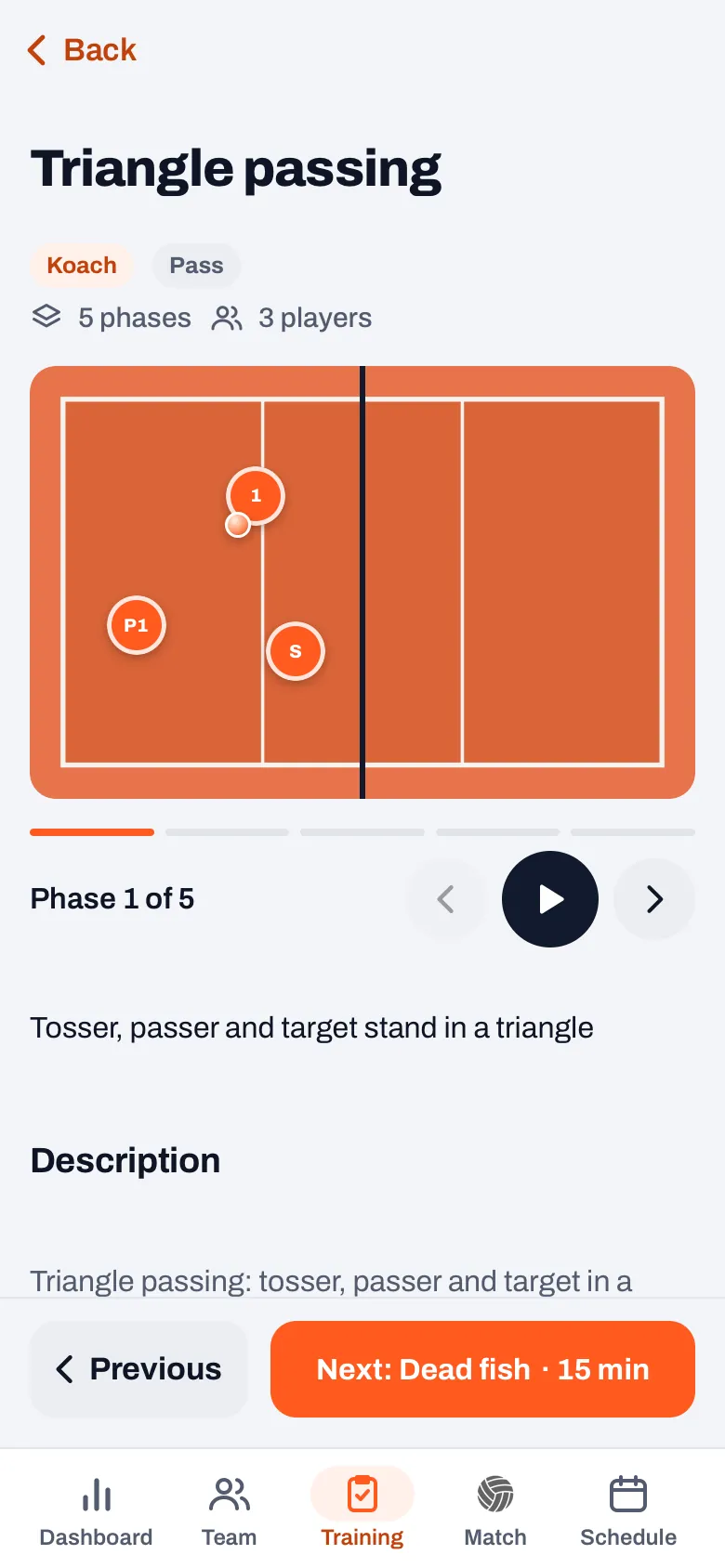
Not every drill needs the whole court. The Koach drills show, phase by phase, where the players and the ball are on the court, so you can see in advance whether you need half a court, a strip along the net or the whole court, and where you might tape an extra line. If you open a drill from your practice plan, you go through the drills in order with Next at the bottom. If your club has a hall with several courts, the club records under Halls which team practices on which court; that is part of the Club plan, see Koach for clubs.
14 days free, no credit card. Set up your next practice and see in advance which part of the court each drill uses.
Try Koach with your teamWhat Koach costs after the trial is on the pricing page.
Frequently asked questions
How wide are the lines on a volleyball court?
Five centimeters, about 2 inches. The FIVB rules state that all lines are 5 centimeters wide, in a light color that differs from the floor and from other lines. The sidelines and end lines lie inside the court dimensions, so the court is 18 by 9 meters measured to the outer edge of the lines.
How do you check that a volleyball court is square?
Measure the two diagonals from corner to corner. On an 18 by 9 meter court they are both 20.12 meters; for each 9 by 9 meter half it is 12.73 meters. If the diagonals are equal, the corners are square. You check a single corner with the 3-4-5 method: 3 meters along one line, 4 meters along the other, and 5 meters between those two points.
What tape do you use for a volleyball court on a gym floor?
Floor marking tape made for sports floors, 5 centimeters wide and in a color that stands out. For a court that is only down for one evening, painter's tape works. Always ask the facility manager first which tape is allowed and how long it may stay down, because strong tape can leave adhesive residue or damage the finish.
How much space do you need for a volleyball court?
The playing court is 18 by 9 meters, and the rulebook requires a free zone of at least 3 meters all around. Together that is at least 24 by 15 meters. Above the court there should be at least 7 meters of clear height. For practice you can make do with less, but near walls and bleachers leave enough room to chase a ball safely.



Set up your next practice in Koach
14 days free, no credit card. You see per drill which part of the court you need.
Get started with KoachOr read first what the volleyball coaching app does.