
Insoles for volleyball: when orthotics make sense
The short answer
You usually don't need insoles for volleyball: a good volleyball shoe has its own cushioning, and shock-absorbing insoles did not prevent injuries in research. An orthotic can make sense for persistent complaints, but have those assessed first by a podiatrist, physiotherapist or sports physician.
Insoles for volleyball seem like a small change, but there is a big difference between a soft insole off the shelf and an orthotic on professional advice. Here you read which types there are, what research says about cushioning and complaints, when to see a clinician first and how an insole fits in your volleyball shoe.
Insole, sports insole or orthotic: what is the difference?
The word insole covers four very different things:
| Type | What it is | What for |
|---|---|---|
| The insole of your shoe | The thin, removable insole that comes with the shoe | Comfort and a little cushioning; usually enough |
| Shock-absorbing sports insole | A soft insole of gel or foam, sold in stores | Meant to make landings softer |
| Off-the-shelf orthotic | A pre-shaped insole with a raised part under the arch | Meant to support the position of the foot |
| Custom orthotic | Made by a podiatrist or other clinician after examining your foot and the way you move | For a complaint where the clinician thinks an insole makes sense |
The shoe itself matters most. A volleyball shoe already has cushioning under the forefoot, where you usually land, and support at the sides. What to look for in the shoe and when to replace it is covered in volleyball shoes. An insole doesn't fix a shoe whose cushioning is worn out.
What does research say about insoles and injuries?
The idea makes sense: volleyball is jumping and landing, so more cushioning should mean fewer injuries. Research shows something else.
- Shock-absorbing insoles did not prevent injuries. A systematic review pooled 7 trials on shock-absorbing insoles and 11 on orthotics. The shock-absorbing insoles did not prevent any type of injury: not injuries overall, not stress fractures and not injuries to muscles, tendons and ligaments (Bonanno and colleagues, 2017).
- Orthotics did somewhat better. In the same study, orthotics (foot orthoses) lowered the risk of injuries overall and of stress fractures, but not of injuries to muscles, tendons and ligaments. The quality of the trials did vary widely, and the study was not about volleyball players in particular.
- Heel pain. For pain under the heel, orthotics in a review of 19 trials gave slightly less pain than sham insoles in the medium term, but it is uncertain whether that difference is noticeable (Whittaker and colleagues, 2018). Another review found no advantage over sham insoles or other treatments (Rasenberg and colleagues, 2018). Neither found a difference between custom and off-the-shelf insoles.
- Pain at the front of the knee. The Cochrane review on orthotics for pain around the kneecap saw no clear advantage over simple flat insoles or physiotherapy. People who got orthotics more often had chafing and blisters (Hossain and colleagues, 2011).
In short: according to this research, buying extra cushioning as protection against injuries has no proven benefit. An orthotic can do something for some complaints, but the effect is modest and depends on the complaint. That is why an orthotic starts with someone who looks at your foot, not on a store shelf.
Flat feet: do you need insoles?
Not automatically. According to the NHS, you don't need to do anything about flat feet, yours or your child's, as long as they cause no problems, and they shouldn't stop you from playing sports. If they do cause problems, a specialist may recommend an insole. It won't change the shape of your foot, but it can help with pain or stiffness. So a foot that looks different from your teammate's is no reason to buy insoles. A foot that hurts is a reason to have it checked.
When should you see a clinician first?
See a family doctor, sports physician, physiotherapist or podiatrist before buying insoles yourself if:
- your foot, heel, shin or knee hurts when you jump and it doesn't go away after a few weeks of jumping less;
- your flat feet are painful, stiff, weak or numb, are new or only affect one foot, or you often injure your foot or ankle with flat feet; the NHS names these as reasons to see a doctor;
- you are coming back from an injury and are unsure whether your shoe and insole still fit;
- it is about a child with complaints: during growth you would rather check once too often.
Pain along the inside of your shinbone after a lot of jumping is a separate story; see shin splints in volleyball. Whether you can go straight to a podiatrist or must go through your family doctor first differs by country.
Bring your shoes to the clinician. Your volleyball shoes often show how you move: where the sole wears down and whether the heel counter has been pushed crooked. And an insole that fits your running shoe doesn't automatically fit a narrower indoor court shoe.
How does an insole fit in your volleyball shoe?
- Replace, don't stack. Take the removable insole out of your shoe and put the new one in its place. Two insoles on top of each other lift your foot so high that your heel starts to slip.
- Compare the shape. Lay the old insole on top of the new one. If something has to be cut off, follow the instructions of the maker or the clinician; never trim a custom orthotic yourself.
- Try it with what you wear in the gym. Your sports socks, and your ankle brace if you wear one. A brace and an orthotic together take up space; how to fit a brace in your shoe is covered in ankle brace for volleyball.
- Check heel and toes. Your heel shouldn't slide up when you rise onto your toes, and your toes shouldn't hit the front of the shoe when you brake hard.
- Get used to it at practice. Wear a new insole for a few practices first, never for the first time in a match. If it chafes or presses, stop and go back to whoever recommended it.
- Replace it in time. An insole that has gone flat, tears or starts sliding around in the shoe no longer does what you bought it for. For a custom orthotic, ask the clinician how long it lasts and when to come back for a check.
The FIVB rules say nothing about what goes inside your shoe. They only require light and pliable shoes with rubber or composite soles and without heels (rule 4.3 of the Official Volleyball Rules 2025-2028).
A player with foot complaints on your team
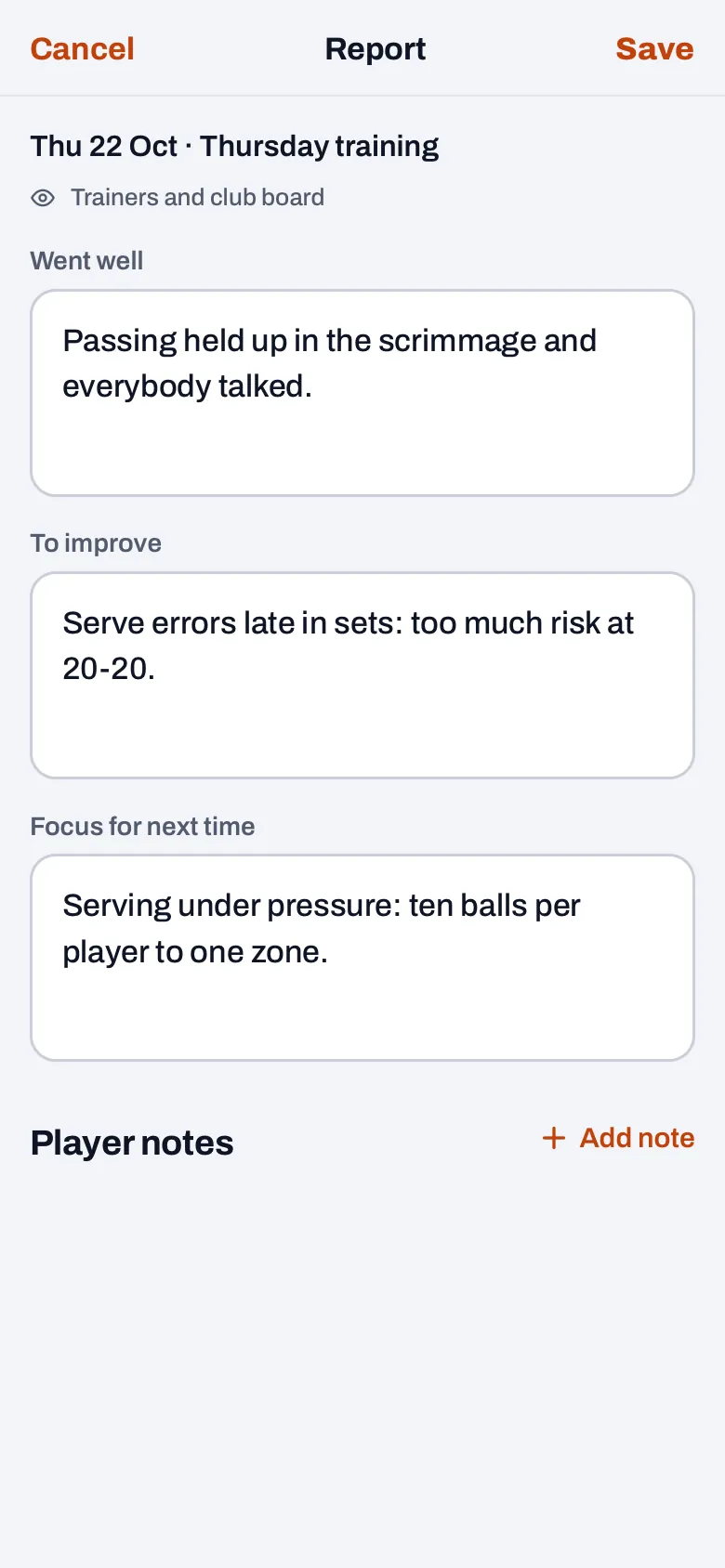
As a coach you don't prescribe insoles, but you do see who limps to the locker room after an evening of jumping. If a player gets insoles on professional advice, agree on how they train in the first weeks, for example with fewer jump series. In Koach you write that after practice under Player notes in the report, so your fellow coach knows it too; players and parents don't see those notes. If they can't train for a while, open Edit player and set their status to Injured, and they get no reminders for practices and matches.
If you are new to coaching, starting as a volleyball coach covers what to arrange from the first week. What Koach costs after the trial is on the pricing page.
14 days free, no credit card. After your next practice, record per player what you agreed.
Try Koach with your teamFrequently asked questions
Do you need orthotics if you have flat feet?
Not automatically. According to the NHS, you don't need to do anything about flat feet as long as they cause no problems. If your feet hurt, feel stiff or numb, you didn't have flat feet before or it only affects one foot, have them assessed by a family doctor or podiatrist. An insole won't change the shape of your foot, but with complaints it can help with pain or stiffness.
Do gel insoles prevent injuries from jumping?
According to research, no. In a systematic review with 7 trials on shock-absorbing insoles, those insoles did not prevent any type of injury, including stress fractures and injuries to tendons and ligaments. The cushioning you need in volleyball comes from a good volleyball shoe. If your shoe's cushioning is worn out, replace the shoe instead of adding a softer insole.
Are custom orthotics better than off-the-shelf orthotics?
For heel pain, two systematic reviews found no difference between custom and off-the-shelf insoles. For other complaints this has been studied less well. Whether you need an orthotic, and which one, is therefore something you decide together with a podiatrist, physiotherapist or sports physician who has looked at your foot and your complaint.
Can you put insoles in volleyball shoes?
Yes, as long as you replace the removable insole instead of putting a new one on top. Then try the shoe with your sports socks and any ankle brace: your heel shouldn't slip and your toes shouldn't hit the front. An orthotic takes up space, so bring it along when you try on new shoes.

Record what you agree per player
14 days free, no credit card. Your fellow coach knows before the next practice.
Get started with KoachOr read first what the volleyball coaching app does.