
Shin splints in volleyball: causes, load and return to play
The short answer
Shin splints in volleyball are an overload of the shinbone and the tissue around it, usually after a sudden jump in the amount of jumping and running. Cut back the load that hurts and build the jumps up again step by step. If it does not ease, see a sports medicine doctor or physiotherapist.
Shin splints in volleyball often start in the first weeks of the season: a nagging pain along the inside of the shin that flares up during hitting warm-ups and is still there the next morning. Here you read what it is, where it comes from and how to build back up, as a player and as a coach.
What are shin splints?
Shin splints is the common name for pain along the inner edge of the shinbone that comes from sport. Doctors call it medial tibial stress syndrome. The name is a little misleading: it is mainly an overload of the bone and of the periosteum, the thin layer around the bone that a few deep calf muscles attach to. The shinbone takes more impact than it can keep up with at that pace.
How to recognize it:
- The location. Pain and tenderness on the inside of the shin, usually in the lower half, spread over a strip of several centimeters.
- The pattern. Pain at the start of practice that eases a little during the warm-up and comes back afterwards or the next morning. If you keep going, the pain stays for the whole session and eventually also at rest.
- What sets it off. Jumping, landing, sprinting and running on a hard surface. Normal walking is usually still fine at first.
When it might be something else
A few signs do not fit ordinary shin splints and need a doctor or sports medicine doctor straight away: pain you can point to with one finger on one spot of the bone, pain at night or at rest, a swelling on the bone, and pain in the shin when you hop on that leg. That can be a stress fracture, a hairline crack in the bone. Do not test it further yourself: stop jumping and have it examined. Another picture is a tight, cramping feeling in the lower leg muscles that builds up during exercise and goes away with rest, sometimes with tingling in the foot. Have that examined too. This article helps you adjust practice and have the conversation; a diagnosis comes from a doctor or physiotherapist.
Why volleyball players get shin splints
The cause is almost always the same: the load goes up faster than the lower leg can keep up with. The UK's National Health Service lists three well-known triggers in its patient information: starting to exercise again after a break, running or jumping on hard surfaces, and poor running technique (NHS, Shin splints). In a volleyball season they come together at predictable moments:
- The first weeks of the season. After a summer break, suddenly two or three practices a week, lots of blocking and hitting drills, and often conditioning on top.
- Running on the road. Long runs and sprints outside during preseason give the lower leg a different kind of impact than a sprung gym floor.
- From the sand back to the gym. Players who spent the summer on the sand still have their jump, but their legs are no longer used to the hard floor.
- Shoes. New shoes you still have to get used to, or worn-out shoes whose cushioning is gone. What to look for is in volleyball shoes.
- Two teams at once. A youth player who also practices with the adult team adds up the sessions, while neither coach sees the whole picture.
Research on risk factors has mostly been done in runners and military recruits, not in volleyball players. A review in the British Journal of Sports Medicine found links with a higher BMI, a foot arch that drops more under load, an ankle that points down further and a hip that rotates out further (Hamstra-Wright et al., 2015). A review in runners also named female sex and a previous episode of shin splints (Newman et al., 2013). You cannot change most of those factors. You can change how the load builds up, and a player who has had it before deserves extra attention in the first weeks.
What to do when your shin hurts
Stopping completely is rarely needed, and practicing through the pain is not the answer either. The NHS advises stopping the activity that causes the pain, keeping active in a low-impact way such as swimming in the meantime, and then building up gradually instead of going straight back to your old level. For a volleyball player that means:
- Fewer jumps, not less volleyball. Passing, setting from a standing position and serving without a jump put far less load on the shin than blocking, hitting and a jump serve.
- No running on the road. Keep up your fitness on a bike or in the pool.
- A clear yardstick. What you do may be at most slightly noticeable during practice, and the next morning it should not be worse than before. If it is, it was too much and you do less next time.
- Calf and foot. Exercises for the calf and foot, such as slow calf raises, are often part of the build-up. Which ones suit your complaint is up to the physiotherapist.
See a doctor, sports medicine doctor or physiotherapist if the pain does not ease after a few weeks of adjusted training, if it gets worse, or with any of the signs above.
Ask every week, especially in preseason. At the start of the first practice of the week, ask one question: who has pain anywhere that comes up when jumping? A shin reported in week two costs a few adjusted practices. A shin that only gets reported once someone can no longer jump often costs a lot more.
Managing jump load as a coach
Most shin problems in a team start in a week when everything went up at once. So look at the first six weeks of your season as one block:
- Build up the jumping drills. Do not open with a whole evening of blocking and hitting. Alternate a practice with lots of jumps with one that centers on passing, setting and defense.
- Do not stack. Conditioning with jumps, a blocking drill and a hitting drill in one evening is too much in the first weeks for anyone just back.
- Count what happens outside your practice. Ask who also trains with another team, plays on the sand or runs a lot for school.
- Give an adjusted role. A player with shin pain can feed the balls in a hitting drill, pass and defend without blocking in a game-like drill, and stays part of the group that way.
How to keep a jump budget per player is worked out in jumper's knee; the same approach works for the shin. Softer landings help the whole lower leg, and how to teach them is in learning to land safely. If you have just started coaching, spotting overload is part of what you learn in your first season, along with the rest of starting as a volleyball coach.
Return to play after shin splints: building the jumps back up
A common mistake is coming back fully on the day it stops hurting. Walking without pain says little about hundreds of jumps a week. So work in phases, with a few practices per phase, and only move on when the previous phase gave no extra pain the next morning. The table is a common progression for practice, not a treatment plan: agree it with your physiotherapist or sports medicine doctor.
| Phase | What you do | Move on when |
|---|---|---|
| 1. Less load | Practice without jumps and sprints, fitness on the bike or in the water | Walking and stairs are pain-free all day |
| 2. Jogging | Short stretches of easy jogging on a soft surface | Jogging is pain-free, also the next morning |
| 3. Low jumps | Block footwork, approach and low jumps at half effort | No extra pain the next morning |
| 4. Full jumps, fewer of them | Hitting and blocking with fewer jumps than normal, for example half | Two practices without after-effects |
| 5. Full participation | A normal practice, then part of a match first | Two full practices without after-effects |
The pace differs per player. With a recurring problem or a suspected stress fracture, the clinician decides when you return, not the match schedule. After the return, also look back: was it the build-up, the shoes, or the running outside? The general rules for a safe return after an injury are in injury prevention in volleyball.
Keeping track of who is on modified training
With modified training, the hard part is not the drill but remembering. Was he already doing low jumps last week, and does your assistant coach know that too? In Koach a player can decline a practice with Can't make it and the reason Injured, or under I'm in use Add comment to write something like "joining without jumps". As the coach you set the status to Injured under Edit player; in the player list that player then shows the Injured badge. After practice you write in the report under Player notes what he did and how it went, and switch on Follow up if you want to come back to it later.
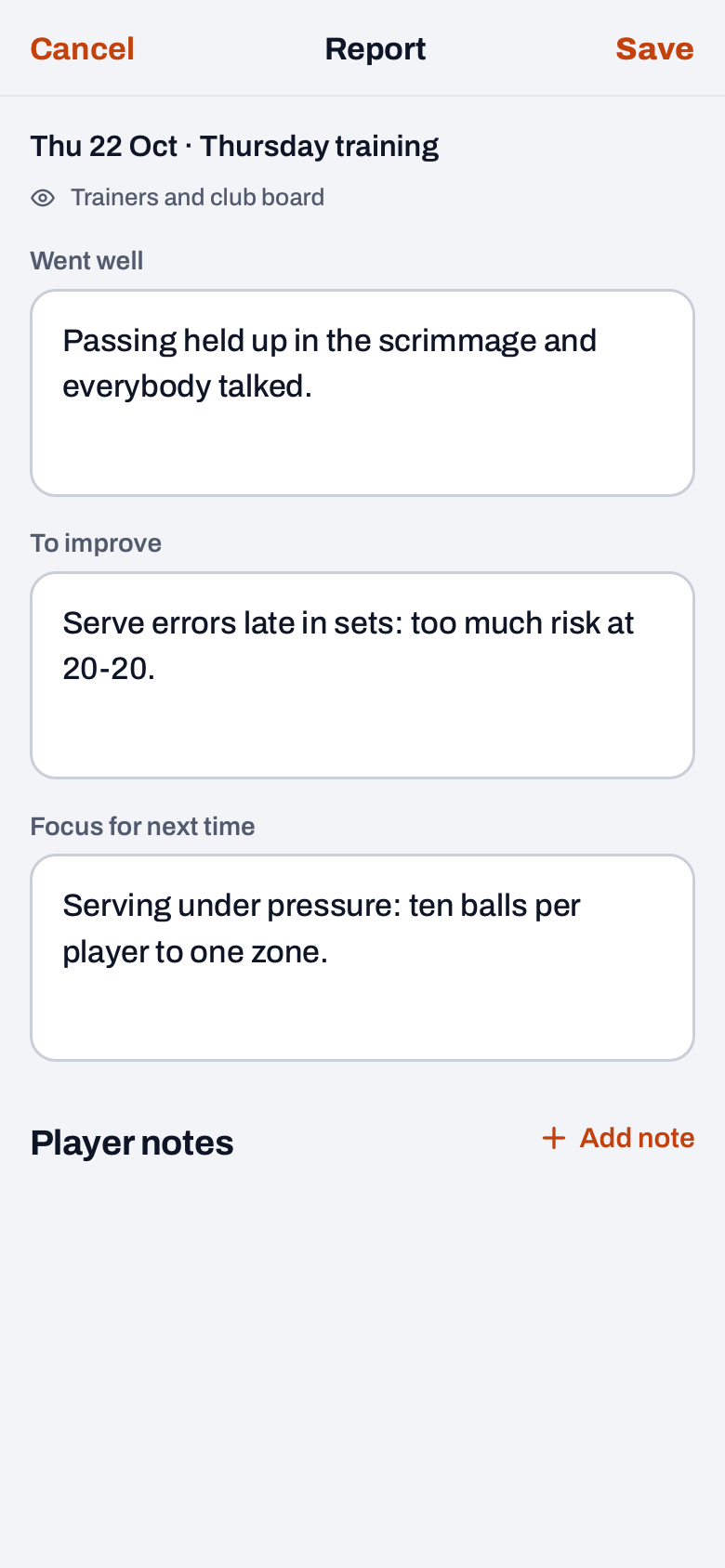
The report and player notes are only visible to the team's coaches, and in a club also to the club leadership through the team log; players and parents do not see them. Koach does not count jumps and does not diagnose injuries: it keeps what you and your players record, so the build-up does not depend on one person's memory. What Koach costs after the 14 free days is on the pricing page.
14 days free, no credit card. After your next practice, record who joined on modified training, and next week see at a glance where you left off.
Try Koach with your teamFrequently asked questions
Can you play volleyball with shin splints?
Often yes, but adjusted. Join in with everything that puts little load on the shin, such as passing, setting from a standing position and serving without a jump, and leave out blocking, hitting and running for a while. What you do may be at most slightly noticeable and should not be worse the next morning. With pain at rest, at night or on one spot of the bone, see a doctor first.
How long do shin splints last?
According to the patient information from the UK's NHS, they usually get better within a few weeks if you adjust the load and then build up gradually. Players who keep training through the pain often take much longer. If it does not ease after a few weeks of adjusted training, have it assessed by a doctor, sports medicine doctor or physiotherapist.
Are shin splints the same as a stress fracture?
No. With shin splints the pain is spread over a strip along the inside of the shin and is linked to load. A stress fracture is a hairline crack in the bone: the pain is usually on one spot you can point to with a finger, and it is also there at rest or at night. If in doubt, have a doctor examine it before you jump again.
Do different shoes help with shin splints?
Replacing worn-out shoes is a logical step, because the cushioning wears down over time. Ideally you break in new shoes during easy practices before doing a jump-heavy session in them. Whether insoles or other aids help in your case varies from person to person; have that assessed by a sports medicine doctor or physiotherapist.



Keep track of who is on modified training
14 days free, no credit card. After a month you see per player how the build-up went.
Get started with KoachOr read first what the volleyball coaching app does.