
Knee brace for volleyball: when it helps and which type
The short answer
A knee brace for volleyball makes the most sense after an injury, on the advice of a physiotherapist or sports physician. For healthy knees there is no good evidence that a brace prevents injuries, and for knee pain, sleeves, braces and patellar straps added little or nothing in studies.
You usually buy a knee brace for volleyball after an injury or because your knee aches. But a knee sleeve, a patellar strap and a hinged brace are three different things. Here you read which type is meant for what, what research says about them, what you give up in feel and movement and what the rules allow.
Knee sleeve, patellar strap or brace: the types
In the store, almost everything gets called a knee brace. In the gym you come across three types, plus a fourth that you only get after surgery or a serious injury. This article is about what goes around the knee joint; the padded cushions against impacts on the floor are covered in volleyball knee pads.
| Type | What it is | What it is meant for |
|---|---|---|
| Knee sleeve | Elastic tube of fabric or neoprene, sometimes with an opening or ring around the kneecap | Compression, warmth and a more comfortable feel with an aching knee; hardly any mechanical support |
| Patellar strap | Narrow band that runs across the tendon just below the kneecap | Pain in the tendon below the kneecap, jumper's knee |
| Hinged brace | Sturdy brace with bars and hinges on both sides of the knee | Support after an injury to the knee ligaments, usually on the advice of a clinician |
| Rehab brace | Long brace that limits how far the knee bends | The first period after surgery or a serious injury, prescribed; not for playing in |
The stiffer the brace, the more it restricts, but also the more it gets in the way in a jump, a low pass or a dive. That is why the question is never which brace is the sturdiest, but which type fits your complaint.
What does research say about knee braces?
Most studies are about other athletes or about people with a specific complaint, not about volleyball players in particular. The picture differs by situation:
- Healthy knees. A review of seven studies in American college football players found conflicting results: three studies pointed to fewer knee injuries with a brace, four to more. The researchers could therefore neither recommend nor advise against a preventive brace (Pietrosimone and colleagues, 2008). What does lower the risk of an ACL injury in volleyball is covered in ACL injuries in volleyball.
- Pain at the front of the knee. The Cochrane review on knee orthoses for patellofemoral pain pooled five studies with 368 people. A sleeve, brace or strap on top of exercise therapy made no clinically important difference in pain or function in the short term, and the evidence was of very low quality. In one study, 36 percent of the knees with a sleeve had discomfort or skin abrasion (Smith and colleagues, 2015).
- Jumper's knee. In a randomized study of 97 athletes with problems in the tendon below the kneecap, a patellar strap and athletic tape gave less pain during a single-leg squat than no aid, but no less than a placebo tape (de Vries and colleagues, 2016). Such an aid can dampen the pain a little in the short term, but a sham tape did that too, and the study only looked at the short term. A strap doesn't treat the tendon problem itself. How to dose jumper's knee is covered in knee pain in volleyball.
- After ACL surgery. A review of 12 randomized trials found no evidence that a brace improved pain, range of motion, the stability of the new ligament or protection against a new injury (Wright and Fetzer, 2007). A later review of 15 studies still called the benefit unclear (Lowe and colleagues, 2017). Whether you wear a brace after surgery, and for how long, is up to your clinician.
When does a knee brace make sense?
Weak evidence doesn't mean a brace never helps. It means you choose one for a reason, and not because half the team wears one. Three situations in which a brace can have a place:
- Returning after an injury to the knee ligaments, if the physiotherapist or sports physician advises support for the first weeks back on court. The brace is then part of the recovery plan, with an agreement on when it comes off again.
- Confidence during the build-up. In the review by Lowe and colleagues, one study reported that patients felt more confident with a brace after ACL surgery; another study found less pain and a faster return to work without one. A player who dares to go fully into a jump again with a brace gets something out of it, as long as the brace doesn't replace the exercises.
- A sleeve for an aching knee, if it feels good and comes alongside the exercises. Don't expect it to heal anything.
The ankle is a different story: there the evidence is mainly about players who have sprained it before, see ankle brace for volleyball. What a knee brace should not do: let you keep playing on a knee that swells up, locks or gives way. Those are signals for a family doctor, sports physician or physiotherapist, as is pain that persists or gets worse while playing. They also decide which type of brace fits and how long you wear it.
What a brace costs you in feel and movement
Every brace takes away some of your freedom of movement, and volleyball asks a lot of your knee: you get low for a pass, you jump a lot and sometimes you go to the floor. In their review of people after ACL surgery, Lowe and colleagues saw that a functional brace can lower the activity of the quadriceps, the big muscle at the front of your thigh, without that showing up in functional tests. In practice this means:
- Get used to it at practice, never on match day. The first few times your takeoff feels different. Give it a few practices.
- Size according to the manufacturer's chart, measured at the spot the chart indicates. A brace that slides down is too loose; tingling toes or an edge digging into the back of your knee mean too tight.
- Hinges level with your knee joint. If they sit too high or too low, the brace works against your bending.
- Fit brace and knee pad together. A brace with bars often doesn't fit under a tight knee pad. Try the combination in your defensive stance.
- Skin and hygiene. If it chafes or presses, have the fit checked by whoever advised it. Let it dry after every practice and wash it according to the label.
Agree on an end date. With a brace after an injury, don't just ask the physiotherapist whether you should wear it, but also when it can come off and how you will notice. Without that agreement, a player is sometimes still wearing it a year later, out of habit.
Can you play a volleyball match with a knee brace?
Usually, yes. The FIVB rules don't mention a knee brace by name. They forbid objects that may cause injury or give an artificial advantage (rule 4.5.1) and allow compression pads, padded protection devices, to be worn for protection or support (rule 4.5.3 of the Official Volleyball Rules 2025-2028). The FIVB Casebook 2025 makes it concrete for the leg: a hard cast is not allowed, a padded leg brace is (case 1.1). The distinction is whether something can injure someone else. A brace with exposed hard or metal parts can therefore meet objections; during the match, the first referee decides.
In official FIVB senior competitions there is also a color rule for compression pads; what it says, and that it can differ by country or competition, is covered in volleyball uniform rules. If in doubt, ask the referee before the match.
A player with a knee injury in Koach
While a player is recovering, open Edit player and set Status to Injured. They then get no reminders for practices and matches and no nudge to respond, and during live scoring they are grayed out on the bench, so you don't sub them in by accident. Teammates see Absent for them, not Injured: how their knee is doing is their story to tell. On their profile you see the status below their name.
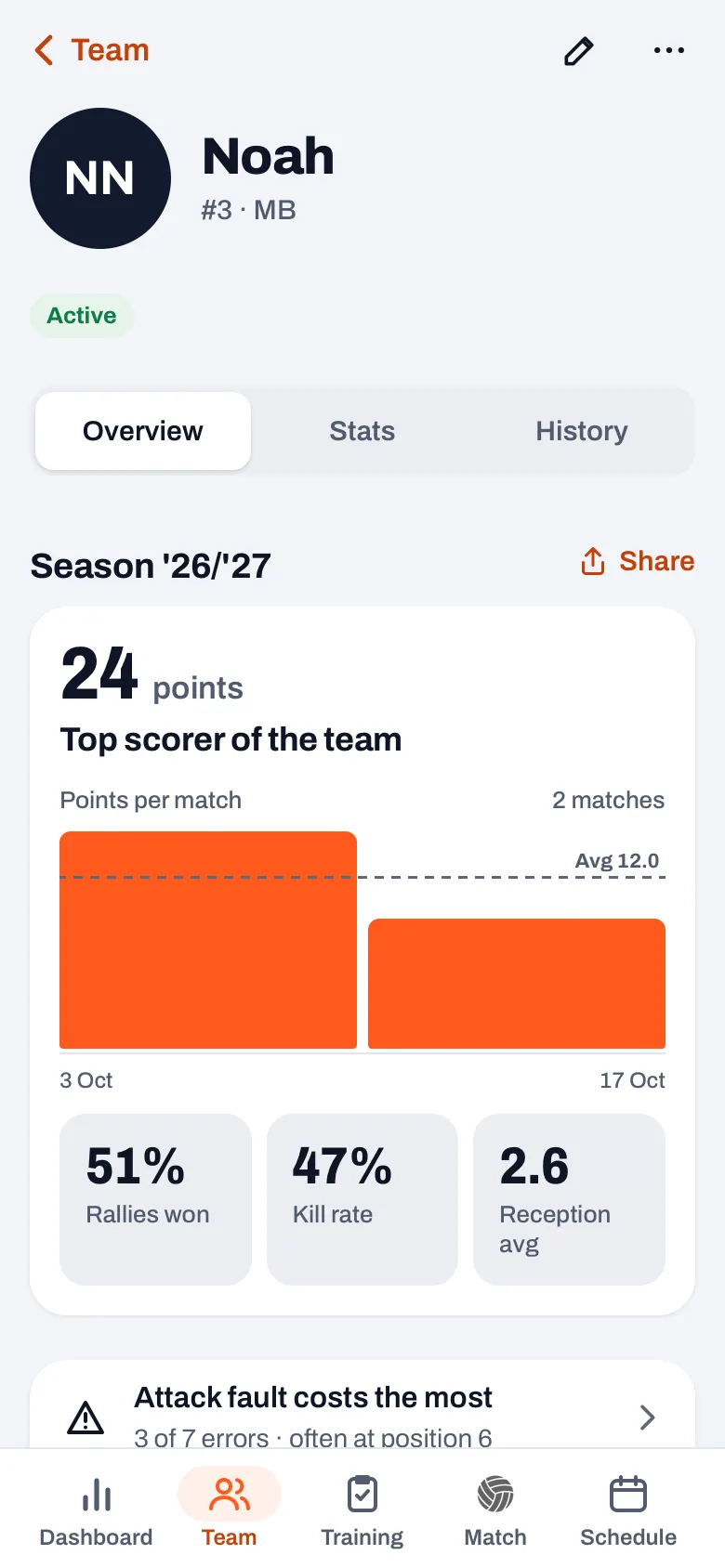
When they come back with a brace, set them back to Active, and after practice write under Player notes what was agreed with the physiotherapist: brace for jump drills, fewer blocking series, the date of the next check-up. Players and parents don't see these notes; your fellow coach can read them before running the next practice. If you are new to coaching, starting as a volleyball coach covers what else to arrange from the first week. What Koach costs after the trial is on the pricing page.
14 days free, no credit card. Add your squad and keep track, player by player, of who is recovering and what was agreed.
Try Koach with your teamFrequently asked questions
What is the difference between a knee brace and a knee sleeve?
A knee sleeve is an elastic tube of fabric or neoprene. It gives compression and warmth, but hardly any mechanical support. A knee brace is sturdier, often with bars and hinges on both sides, and limits sideways movement of the knee. You usually wear a brace after an injury to the knee ligaments and on the advice of a physiotherapist or sports physician.
Can you play a volleyball match with a knee brace?
Usually, yes. The FIVB rules don't mention a brace by name, but they allow padded protection for protection or support and forbid objects that may cause injury. According to the FIVB Casebook, a padded leg brace is allowed and a hard cast is not. A brace with exposed hard or metal parts can therefore meet objections. It can differ by country or competition, so ask the referee if in doubt.
How long do you wear a knee brace after an injury?
Your physiotherapist or sports physician decides that, and it depends on the injury and on how your recovery goes. Agree at the start when the brace can come off and how you will notice, for example after a few tests in the gym. Without that agreement, a brace often stays on out of habit, even when it no longer adds anything.
Can you wear a knee brace and a knee pad at the same time?
You can, but test the combination. A thin sleeve usually fits under a knee pad; a brace with bars and hinges often doesn't. Get into your defensive stance, drop onto one knee and do a few jumps. If something shifts, the edge digs into the back of your knee or the pad no longer sits on your kneecap, it doesn't fit.
Keep track of who is recovering and what was agreed
14 days free, no credit card. Your fellow coach knows before the next practice.
Get started with KoachOr read first what the volleyball coaching app does.