
Match analysis
Statistics, results and reviews: coach with data instead of gut feeling.
Understanding and using volleyball statistics as a coach
Understanding volleyball statistics: which numbers matter, how to read them without drowning in data, and how to turn them into lineups and practices.
Read article →
The match overview: all results in one place
Tracking match results per season: every match played with set scores and top scorers in one overview — the archive that feeds every debrief and analysis.
Read article →
Volleyball statistics app: which one fits you (and why volleyball-specific wins)
Looking for an app to track volleyball statistics? How to choose a statistics app that fits your level — from simple point counting to analysis per player.
Read article →
Reading per-player statistics after the match
Reading player statistics after a volleyball match: what points, breakdowns and errors per player really say — and which conclusions are drawn too quickly.
Read article →
Your team's top scorers: attack, block and serve
Your volleyball team's top scorers per category: who scores most from attack, block and serve — and how to use that list without breaking team spirit?.
Read article →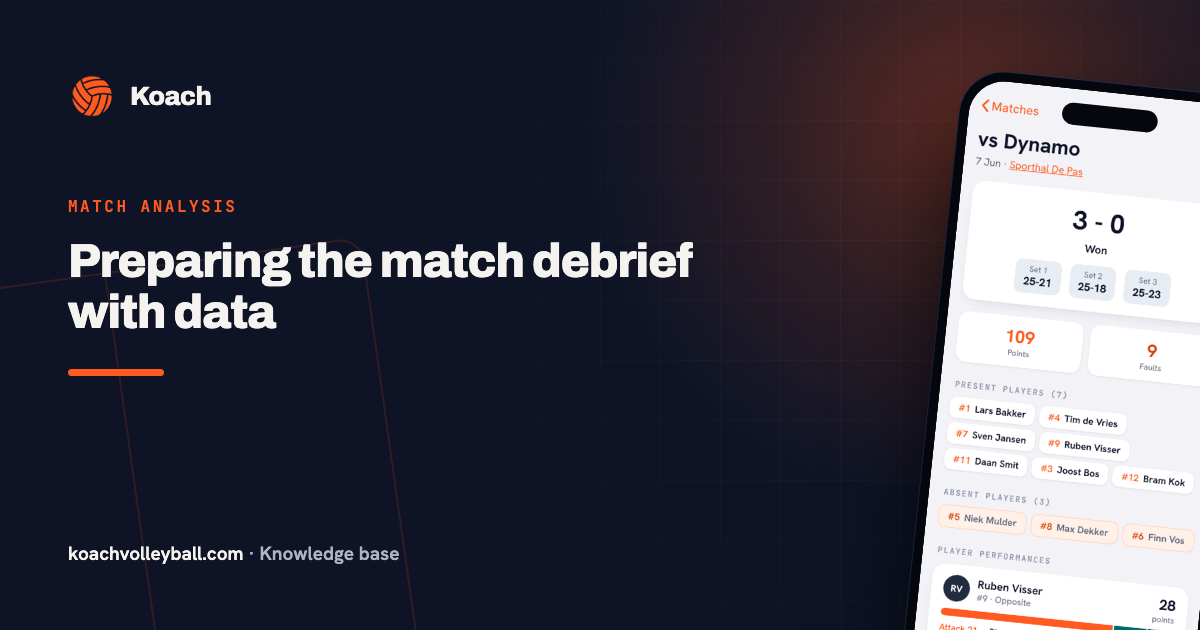
Preparing the match debrief with data
Preparing a match debrief with statistics: the structure, the three numbers you pick and the pitfalls — so the debrief becomes instructive instead of long.
Read article →
Free volleyball statistics app: what you get for free (and when you want more)
A free app for volleyball statistics? Discover what you can track for free, where free apps stop and when a complete package becomes worth it.
Read article →
Calculating and improving your attack percentage
Attack percentage in volleyball: how to calculate it, what a good percentage is at amateur level and which practice work raises it structurally.
Read article →
Serving statistics: measuring aces and serve pressure
Serving statistics in volleyball: counting aces, weighing service errors and making serve pressure visible — measure if your serve is a weapon or a risk.
Read article →
Measuring block points: the undervalued statistic
Measuring block points in volleyball: why the kill block is the most undervalued statistic, what a good number is and how to steer your blocking practice with it.
Read article →
Error load per player: risk versus return
Analyzing errors per player in volleyball: which error load fits which role, when are errors investments and when a problem? The analysis without a blame culture.
Read article →
Planning a tournament and tracking every match
Planning a volleyball tournament with your team: organizing, tracking and debriefing multiple short matches in one day — without administrative chaos.
Read article →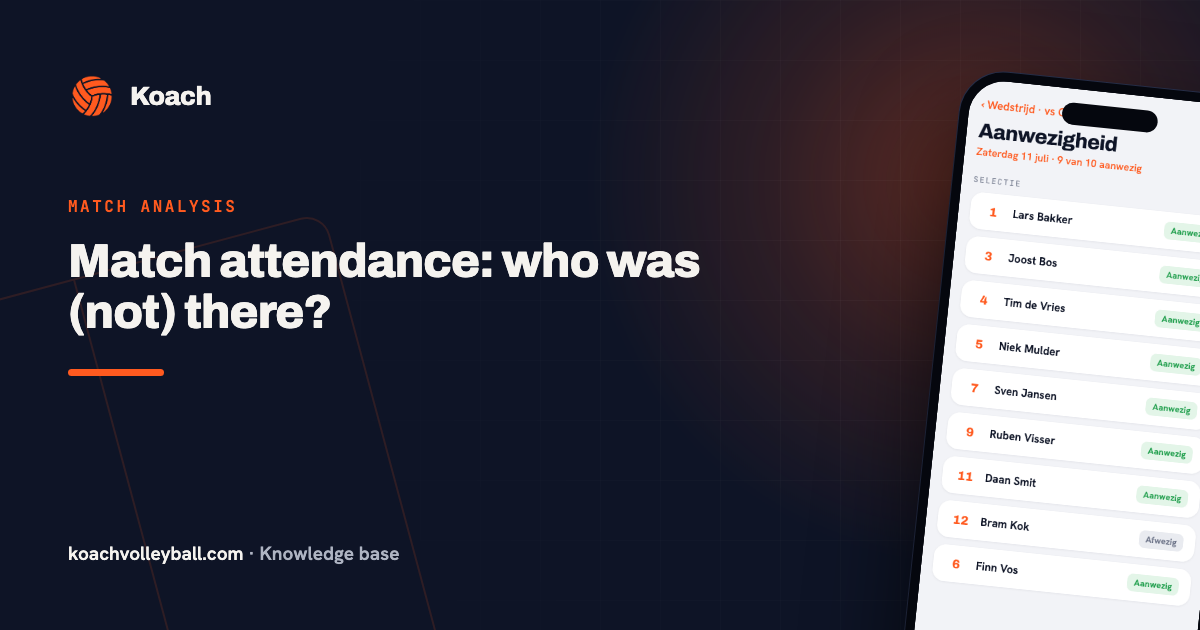
Match attendance: who was (not) there?
Tracking match attendance in volleyball: who was at which match, why it counts alongside practice attendance and how to record it in seconds.
Read article →
Season analysis: trends across all your matches
Making a season analysis of your volleyball team: trends in results, point types and players across all matches — the analysis next season builds on.
Read article →
Reading your own match statistics as a player
Reading your volleyball match statistics as a player: see your points and errors after every match, spot patterns and talk them through with your coach.
Read article →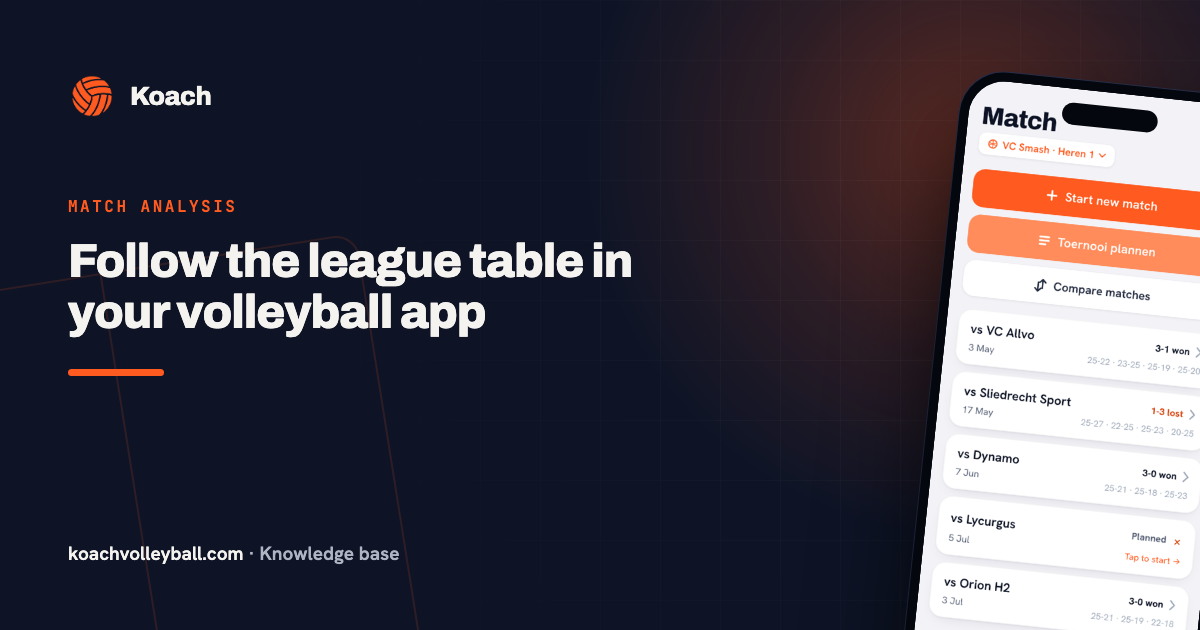
Follow the league table in your volleyball app
Show the league table in your volleyball app: for Dutch leagues, link your Nevobo pools once and see the official standings next to your own matches — league and cup side by side.
Read article →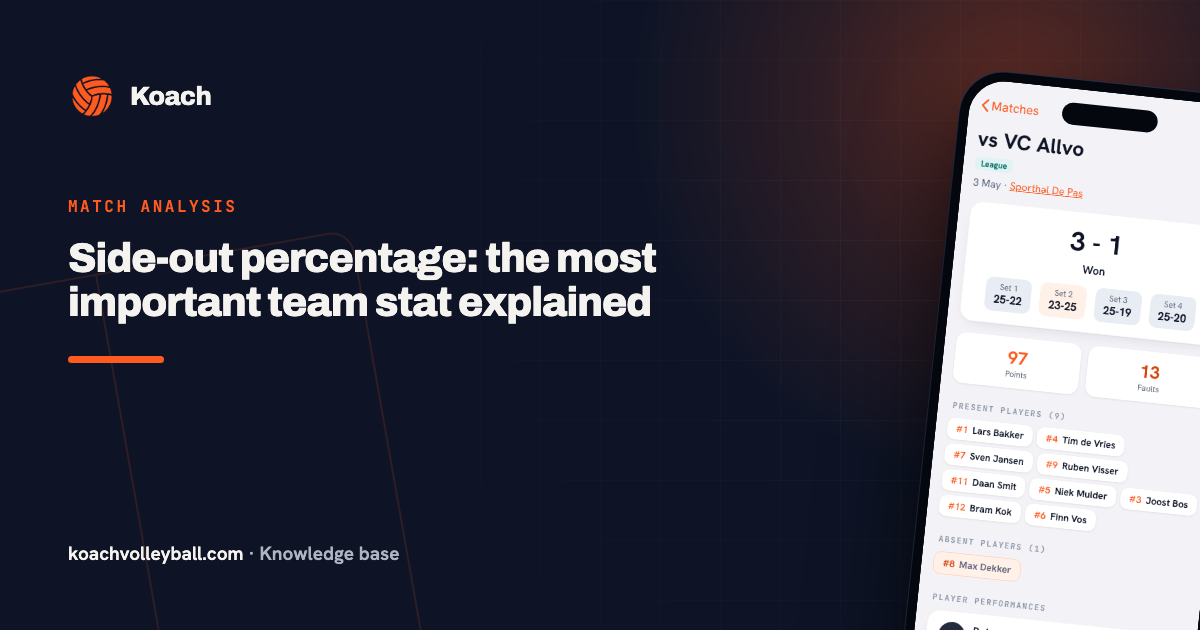
Side-out percentage: the most important team stat explained
Side-out in volleyball explained: what the percentage means, how to break it down per rotation and why it says more about your team than the final score.
Read article →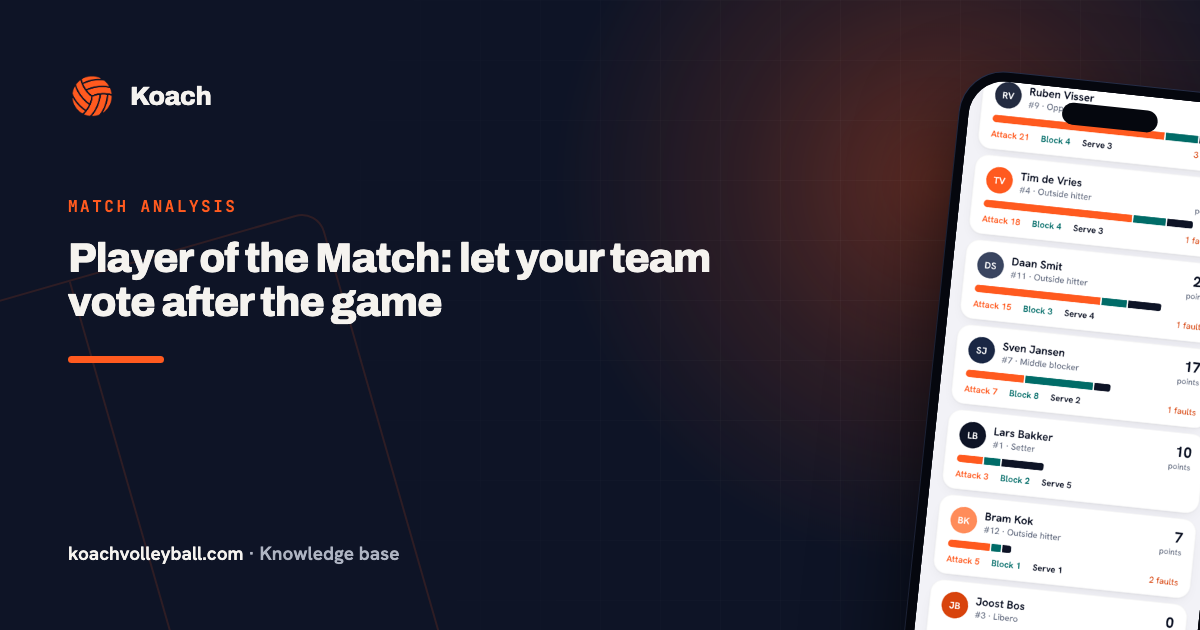
Player of the Match: let your team vote after the game
Player of the Match in volleyball: let players vote for the best player after every match.
Read article →
The momentum line: see where the match turned
The momentum line in Koach shows the match as a wave: the cumulative point difference per rally, with a dot on each set's turning point.
Read article →
Importing the match schedule from your pool
Import a volleyball match schedule into your app: for Dutch leagues, pull a whole season out of your Nevobo pool in one go — date, time, home or away and the venue come along.
Read article →
Pre-season tournament: what are you really measuring?
Pre-season volleyball tournament: use the day as a measuring day.
Read article →
Volleyball scouting sheet: writing a rally on a single line
Volleyball scouting sheet: how to write a rally as one readable line instead of tally marks, so you can still see afterwards where that rally went wrong.
Read article →
Defence as a statistic in volleyball: digs per set and what is good
Defence as a statistic in volleyball: what exactly counts as a dig, how many digs per set are normal per position, and how to count them without missing the match.
Read article →