
Defence as a statistic in volleyball: digs per set and what is good
Your libero has played an outstanding match. He got to three balls nobody thought reachable, kept two rallies alive that you went on to win, and stood still all afternoon at exactly the right moment. Then you open the match report and there he is at the bottom on zero points. That is not a bug in the app: defence rarely scores a point itself. Anyone who still wants to weigh that work has to count it separately — and then the question comes straight away: how much is actually a lot?
The defender does not appear in a single column
Every match report you come across at amateur level counts the same things: points from attacking, points from blocking, points from serving, and errors alongside them. Those four columns cover everything that ends a rally. Defence ends nothing. A dig does not make a point — it makes a chance. The rally goes on, somebody sets, somebody hits, and that somebody gets the point in his name.
You see the consequence on every player sheet: the opposite is at the top, the middle is halfway down, and the libero is at the bottom on zero. That is the well-known blind spot of reading player statistics. For hitters the column is a mirror, for defenders it is a blank sheet. And what stays blank disappears from the debrief — not because you do not value it, but because there is nothing to point at.
The fix is not complicated, but it is handwork: you count the defence yourself. One figure, one set per match, with an agreement in advance about what you include. From there the rest — comparing, setting a target, choosing a drill — becomes exactly as easy as it is for attacking and serving.
What counts as a dig and what does not
A dig is saving an opponent's attack: the ball comes into your court hard or placed, and you keep it playable and in play. That is the whole idea. But around that sentence sit four edge cases where counters consistently diverge, and you have to nail those down in advance or you will be comparing apples with pears next month.
- A received serve is not a dig. That is serve receive, and it has a scale of its own — see tracking pass scores 0 to 3. Serve receive is a prepared action with five counts of thinking time; a dig is a reaction. Throwing them on one pile makes both figures useless.
- A free ball is not a dig. If the opponent plays the ball back high and without pressure, picking it up is not an achievement but routine. Count those and the player who happens to stand nearest the middle scores highest.
- The ball rebounding off the block does count. Your own attack is blocked, the ball drops back into your court and somebody keeps it up: that is defending, and it is also the kind of ball that most often goes unnamed.
- Defending overhead counts perfectly well. Plucking a high, soft tip out of the air with your hands is just as much a save as a dive. Only the dive gets applause; for your count the technique does not matter.
One rule keeps it practical: the ball came from the other side with attacking intent, and after your touch a teammate could still do something with it. If the ball did come but sprayed off your arms into the stands, it is not a dig — that is a defensive attempt, which you count separately if you want to know how often you were there.
Digs per set: which numbers are normal
Rough guidelines for amateur volleyball, with the emphasis on rough: in a set to 25 a team usually ends up on eight to fourteen digs. Below that almost always means the opponent's attacks came straight through; above it you often see a team that defends a lot because it blocks little.
Per position the ratios sit roughly like this:
- Libero: three to six per set, and more on a busy evening. He stands where most of the balls come and never leaves the back row.
- Outside hitters in the back row: two to four per set. They pick up the cross-court balls and the ones down the line.
- Setter: nought to two per set, depending on your system — a setter who is often in the back and covers the short ball behind the block ends up higher.
- Middles: often none, simply because they block in the front row and are substituted in the back. A middle with four digs a set is not a hero but a signal: somebody is standing in a place where he should not be.
The sting is in the comparability. Digs are not an achievement of your team alone — they are also a function of the opponent. Against a side that attacks hard twenty times a set you get more digs than against a side that taps the ball back neatly, while your defence was identical. That is why the raw number is only usable within the same match; across matches you look at the share: of the attacks that came within reach, how many did you keep in play? Count per set the attacks that came at a player and how many of those stayed playable. A third to a half is a healthy ratio at amateur level; drop below a quarter and the opponent is winning the rallies you could have kept on the court.
The half nobody counts: what happens after the dig
A dig on its own is half an achievement. The question that counts is what your team did with the ball that was saved. A ball that lands high in the middle of your own court gives your setter time and your hitter an approach. A ball that drops back just over the net or lands behind the end line is formally saved and practically given away.
So note beside every dig whether the rally afterwards was won. That costs you one extra tick and delivers the most interesting figure of the whole subject: your conversion. At amateur level you win roughly a third of the rallies that start with a dig — the opponent is well positioned, after all, and you are playing out of system. If you are consistently below that, the problem rarely lies with the defenders. It is the first ball after the save that does not arrive, or the hitter who never gets to his approach because he was standing on the floor watching.
That distinction changes your practice completely. More digs you train with defensive work; more converted digs you train with transition forms in which the ball has to become an attack immediately after the save. The figure tells you which of the two you need, and that is exactly what a statistic is supposed to do.
How to count it without missing the match
Nobody keeps fifteen columns while coaching. So here are three versions, from light to heavy — pick one and stick to it all season.
- One set, one figure. Count only your team's total number of digs in the second set. Four matches later you have a line. This costs you almost no attention and is enough to see whether your defence is moving.
- One set, per player. Write the names of your back row underneath each other and put a tick per dig. A slash through the tick means: rally won. At the end of the set you have both number and conversion, at a glance.
- Everything, delegated. Give the list to an injured player, a substitute or a parent who is watching anyway. Counting defence is the easiest thing you can hand over: it needs no positional knowledge, only the four agreements from the previous section.
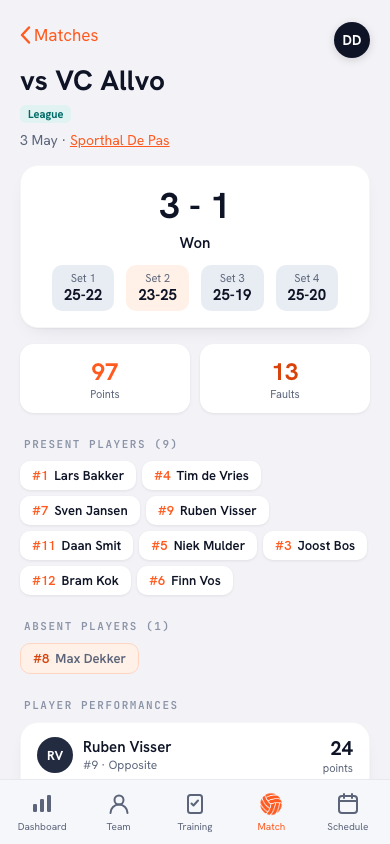
Whatever you choose: put it on paper, not in your head. The handiest format and its pitfalls are in keeping volleyball stats on paper. If you track live in Koach in Expert mode, you can give every defensive play a rating from 0 to 5 and mark who made it; the match detail then shows the average and the count per player under Defense. A separate count of digs and how many were converted is not something the app keeps. If you still want to keep that outcome without starting a second system, put it in the note with the player afterwards: "12 digs in set 2, 5 converted" is still readable in three months' time, and it sits in the same place as the rest of your observations about that player.
Count a set that means something. The first set is a warm-up and the last is often decided. Always count the same set — the second, for instance — and then you are comparing matches in which your team was equally sharp, rather than a nervy opening one time and a dead rubber the next.
What you can read from the figures — and what you cannot
Four patterns come back so often that you will recognise them after three matches.
- A libero with strikingly few digs. Usually not a bad evening, but an opponent playing around him. That is a compliment disguised as a low figure — and at the same time a tactical fact: if they are avoiding him, he is standing on the wrong half of the court.
- Lots of digs by your middles. Your block is touching nothing. The ball comes through unhindered and the first person to meet it is the one who has just jumped. That is a blocking problem, not a defending problem: see organising your block.
- Many digs, little conversion. You save the balls but do not win the rallies. Look at the ball after the dig and at the cover around your own hitter.
- All the digs with one player. Rarely a sign of class, usually of a gap beside him. One defender who gets everything means his neighbour is letting balls go that he could have reached.
And the limits, because they are wider here than with other figures: these are small numbers from one set, with a human counter who misses a few balls. Twelve against nine digs is not a difference. Twelve against four over three matches is. Use the figure to direct your attention, never to give a player a mark — and certainly not to compare two players in different positions with each other. A middle and a libero do not do the same job, so their columns should not lie side by side.
From figure to practice
A measured defence is only worth something once something changes. The translation is usually one of these three.
If it is mainly the soft balls that drop — tips, roll shots, balls landing halfway up the court — then it is not a question of being faster. Then your team is standing too deep or is not still at the moment of contact. That is posture and position, and it improves quickly: defending: posture, position and diving technique is about exactly that.
If it is mainly the hard balls you are not touching, you train reaction forms and reading the hitter. Choose your drills accordingly — digging drills run from calm posture work to balls you only see coming at the last moment.
And if the digs are there but the rallies are not being won, the work lies behind the defence. Then the transition from save to attack belongs in your programme, and it is useful to look at it alongside your side-out percentage: that tells you whether you have the same problem on the balls you did have time for. If your side-out is fine and your conversion is low, it really is the chaos after the dig. If both are low, it is in your build-up and not in your defence.
Two figures per match, counted for one set, kept up for three months: that is enough to finally show something to the one player on the court who never appears in a column.
Frequently asked questions
Does a ball coming back off the block count as a dig?
Yes. The ball comes into your own court at attacking speed and you keep it playable — that is precisely what a dig is. It makes no difference whether it comes off the opponent's block or straight from the hitter. Agree this in advance, because it is the edge case where counters diverge most often.
What is the difference between a dig and a reception?
A reception is receiving a serve, a dig is saving an attack. The distinction is not formal but practical: with a serve you know exactly when the ball is coming and you are set, with an attack you react in a fraction of a second. So keep them in two separate lists, otherwise neither figure says anything any more.
How many digs per set is good for a libero?
Three to six per set is a normal range at amateur level, but it depends heavily on how often the opponent attacks in his direction. A libero who rarely gets the ball because the opponent plays around him can have an outstanding match with two digs. So compare him above all with himself across several matches.
Can I have digs tracked automatically?
Not with the usual match recording: that records who scored the point, and a dig does not score a point. Video analysis can do it, but costs more time per match than most amateur coaches have. Counting one set per match by hand delivers virtually the same conclusions in practice.
My best defender has the fewest digs. How can that be?
That happens more often than you would think, and there are two explanations. Either opponents are deliberately playing around him, or he positions himself so well that balls others reach by diving simply arrive at him — and that looks unremarkable. So always lay his number alongside what you saw, not instead of it.
How long do I have to count before it means anything?
Reckon on three to four matches before there is a line in it. One set from one match is a snapshot with small numbers: a difference of two or three digs can be pure chance. Only when the same pattern repeats is it a fact you can base a training choice on.




Try it yourself in Koach
Less admin, more coaching.
Get started with KoachOr read first what the volleyball coaching app does.