
My Child Wants to Quit Volleyball Mid-Season
"I don't want to go anymore." That sentence usually arrives on a Tuesday evening, mid-season, with no trigger you can point at. What the child says is almost never the whole reason, which makes your first reaction more important than the eventual decision.
First find out what is really going on
Children rarely name the real cause, mostly because they have not worked it out themselves. In practice it nearly always sits in one of these five corners:
- Their friends are gone. The most common and the most underrated reason. A team selection that split up two friends weighs more heavily at this age than anything happening on court.
- Fear of failure and pressure. The child no longer dares to call for the ball, is scared of making the error that costs the set, or feels expectations from home. Often visible as: fine in practice, invisible in matches.
- Not enough court time. Whoever consistently plays least loses their connection to the team. Under fifteen especially, playing time is not a reward but a learning tool.
- The atmosphere in the group or with the coach. Anything from friction in the changing room to a coach whose tone does not suit this particular kid.
- It has simply become too much. A new school year, homework, a second sport, three evenings booked. That is not a motivation problem but a calendar problem.
And sometimes it is none of the five and the child just fancies something else after four years. That is allowed too.
The conversation that works
Not in the car straight after a lost match, and not straight in with the door. What does help: a calm moment, an open question and plenty of room. Try "what's the least fun part of Tuesday evening right now?" instead of "why do you want to quit?" — the first question produces information, the second produces a defence. Promise nothing along the way: no "fine, then stop" and no "you're finishing the season". Agree a horizon instead: go two or three more times, then talk again. Surprisingly often the subject is off the table after those two weeks, and if it is not, you know it was not a mood.
When to ask them to push through and when not to
The argument that a child has an obligation to the team is real, and from about twelve you may use it: a team of six that loses one is standing there on Saturday with five. Finishing the season is then a reasonable ask, and often a valuable lesson. That ask disappears the moment the child is genuinely suffering: stomach aches on match days, crying while getting changed, or a climate in the team in which they do not feel safe. Then quitting is not giving up but the right decision, and a quick one.
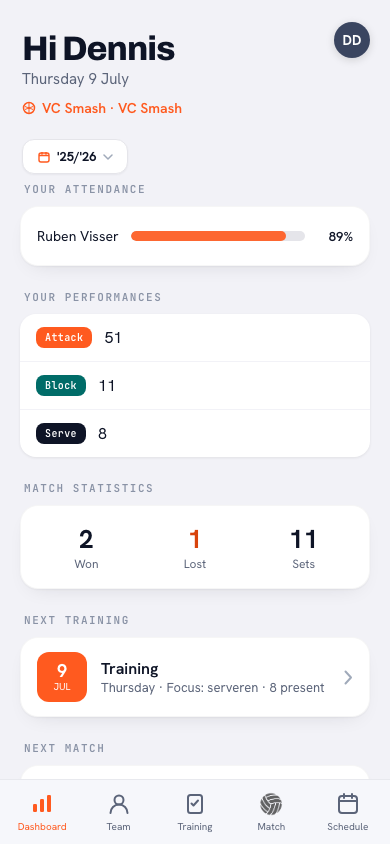
That puts the conversation between coach and parents on a sharper footing straight away. Parents have their own account in Koach, so both sides start from the same picture of attendance, playing time and development instead of from two different memories. That spares you the usual debate about how often a child actually played — a subject covered in more detail in sharing playing time fairly.
What a coach can change
- Playing time. Half a set extra per match is often enough to bring the connection back.
- Give them a role. Leading the warm-up, looking after the balls, being co-captain — responsibility works better than encouragement with a wavering kid.
- Pair them with a buddy. Certainly when the reason is social, this is the fastest tool you have.
- Agree a personal goal that has nothing to do with winning, such as ten successful serves in a row. How to go about that is in working with a personal goal.
- Try another position. Kids who are stuck in one role sometimes come alive somewhere else entirely.
When quitting is the right choice
Then stop properly. Let the child do one last session and say goodbye rather than quietly disappearing, and leave the door explicitly open: "if you fancy it again in six months, just call." A sizeable share of the kids who quit between twelve and fifteen come back within two years, to the same sport or another one — but only if leaving did not feel like a failure.
The signals before it gets that far
Dropping out usually announces itself weeks in advance: a child skips practice more often, comes in last, stops asking questions, sits alone in the changing room, or plays with no visible enjoyment. Whoever tracks attendance per child sees that pattern before the conversation instead of after it — and can still do something about it. Improving practice attendance covers what helps.
Frequently asked questions
Should I make my child finish the season?
From about twelve that is a reasonable ask, because a team is counting on them. The ask disappears if the child is genuinely suffering — with stomach aches, crying or an unsafe team climate, quitting quickly is the better call.
What if my child cannot explain why they want to quit?
That is normal. Do not ask why, ask about concrete moments: what is the least fun part of the evening, and what is the best part? The real reason usually surfaces from those answers within a couple of minutes.
Should I discuss this with the coach?
Yes, and preferably before the decision is made. A coach can adjust playing time, position or role as long as the child is still in the team. After they resign, that conversation usually never happens.