
Volleyball burnout: the signs and what you do as a coach
The short answer
Volleyball burnout is exhaustion around the sport, the feeling that it gets you nowhere, and a player who cares less about the sport. Unlike overtraining, it is mainly motivation that drops. A coach can lower pressure and load and give choice; lasting low mood belongs with a family doctor or psychologist.
From the outside, volleyball burnout looks like a player who has lost interest. They come less often, laugh less and say it doesn't matter. This article helps you recognize it, tell it apart from overtraining and an ordinary slump, and shows what you as a coach or parent do and do not do.
What is burnout in sport?
In sport, burnout is usually described by three features that occur together. That is how the International Olympic Committee puts it in its consensus statement on the mental health of elite athletes (IOC, 2026) and, in slightly different words, the clinical report of the American Academy of Pediatrics on young athletes (AAP, 2024):
- Exhaustion, physical and emotional. The player is drained, even after a free weekend.
- The feeling that it no longer gets them anywhere. "I'm not getting any better anyway", however hard they work.
- The sport matters less. Where volleyball used to be the highlight of the week, it becomes something they "have to" do.
The AAP calls burnout one of the main reasons young athletes quit. According to the IOC, burnout is not in the handbook of psychiatric diagnoses (DSM-5-TR), and in some respects it resembles overtraining and depression. So you do not make a diagnosis. You watch for a pattern and you adjust what is in your power.
This article is about one player. If a whole team drops off at the same time while everyone keeps showing up, it is more likely the load of your whole schedule; that is covered in spotting overtraining in your team.
Burnout, overtraining or a slump: the difference
From the outside they look alike: a player who performs worse and looks tired. In its consensus, the IOC lists the differences between burnout, overtraining and depression:
| What you see | Burnout | Overtraining | Depression |
|---|---|---|---|
| Mood and enjoyment | Lower, around the sport | Lower, around the sport | Lower, everywhere |
| Motivation | Lower, around the sport | Can stay high | Lower, everywhere |
| Energy | Lower, around the sport | Lower, everywhere | Lower, everywhere |
| Rest | Helps, with other changes | Helps, with other changes | Makes it worse |
Source: IOC consensus on the mental health of elite athletes (2026), table 5. "Other changes" are changes in the athlete's environment.
The sharpest difference from overtraining lies in motivation. An overtrained player can still want it badly, but their body cannot keep up; the IOC adds demonstrably worse performance and exhaustion that also shows outside the sport. With burnout it is the drive that is gone, and mainly around the sport. A slump is something else: a few bad weeks after a loss, a busy period at school or a falling-out in the team, which passes on its own once the cause is over. And with depression, low mood, lack of enjoyment and low energy are there everywhere, not just around the sport. That always belongs with a family doctor or psychologist.
Signs that coaches and parents can see
One bad evening says nothing. Look for a pattern over weeks, and for a combination of signs:
- Exhaustion: tired at the start of practice, even after a quiet week; dreading practice at home.
- No longer feeling any progress: lines like "it's not working anyway" or "I'm just bad at it", even from a player who is improving.
- The sport matters less: "doesn't matter", no reaction to winning or losing anymore, canceling more often without a reason.
- Behavior: quieter in the group, more easily irritated, less fun in game drills they used to ask for.
Coaches and parents each see a different part. You see practice and matches, the parents see how their child comes home, sleeps and talks about the club. In research, burnout is associated with sleep problems (Dišlere and colleagues, 2025). So put those two pictures side by side before anyone draws conclusions. A child who only wants to quit is not yet a child with burnout; that conversation is covered in my child wants to quit volleyball.
What counts outside practice
Burnout rarely develops in the gym alone. A review of 32 studies that followed athletes over a longer period (Dišlere and colleagues, 2025) shows which factors are associated with more or less burnout. These are associations, not proven causes:
- Perfectionism. Especially worrying about mistakes and the feeling that others expect perfection went together with more burnout later in the season.
- School. In a study of young talents at a high school with a sports program, burnout symptoms seemed to spill over from school to sport. How to combine sport and school is in combining sport and school.
- The coach. In a study of student athletes, a coach who supports autonomy, with choice and explanation, went together with less burnout at the end of the season; punishing feedback went together with more exhaustion.
- The group. Support from others and feeling connected to teammates and coaches went together with less burnout.
Then there is playing one sport all year round. In a meta-analysis of eight studies, young people who had already specialized in one sport scored higher on all three features of burnout than young people who played several sports (Giusti and colleagues, 2020). That too is an association, not proof, and of the 1429 young people only 58 played several sports. What that means for the choice between one sport or more is in early specialization in sport.
What you can change as a coach
According to the IOC, burnout improves with rest and other changes in the environment. Part of that environment is you. This is what is within your reach:
- Ask and listen. A calm moment, not an interrogation. "I've noticed you seem to be enjoying it less these last few weeks; is that right?" Give no judgment and no solution in the same conversation.
- Give choice. Let the player have a say in their role, their goals and how often they come. Giving choice went together with less burnout in the research above.
- Temporarily lower the pressure and the load. Fewer practices, fewer minutes in matches, or an agreed break. Put a date on it to talk again, so a break does not turn into a quiet exit.
- Keep them connected. A player who stays part of things, with a role, a buddy or just a message after a match, does not lose sight of the team.
- Look at your feedback. Punishment, sighing and calling players out in public cost more than they bring. Name the task, not the mistake.
- Talk with the parents. Together you see more, and together you prevent the player from feeling pressure from two sides. The IOC also asks coaches and parents to be on the same page when it comes to seeking help.
What does not help: "work harder", extra practices, comparing them with teammates or writing it off as a lack of character. You do not bring back a player who is already drained with more of the same.
Give the player something to choose. Once a month, let them pick the warm-up or a game drill, or set their own goal for the coming weeks. It costs you nothing and it gives them a piece of the sport back.
When it is more than the sport
If the low mood, poor sleep and tiredness are also there outside the sport, if they persist after a few weeks of rest and less pressure, or if you or the parents are worried, the player belongs with a family doctor or psychologist. Say it out loud, and add that their place in the team stays open. A player who thinks seeking help will cost them their place will not go. What a mental coach or sport psychologist can do for a team is in a mental coach for your volleyball team.
If a player says they no longer want to live or want to hurt themselves, always take it seriously. Do not leave them alone, inform the parents if the player is a minor, and seek help the same day through a family doctor or the suicide prevention helpline in your country. If there is immediate danger, call the emergency number: 112 in the European Union, elsewhere your own country's emergency number. If you are new to coaching, also read starting as a volleyball coach on what to agree with parents from the first week.
In Koach: attendance, agreements and a break
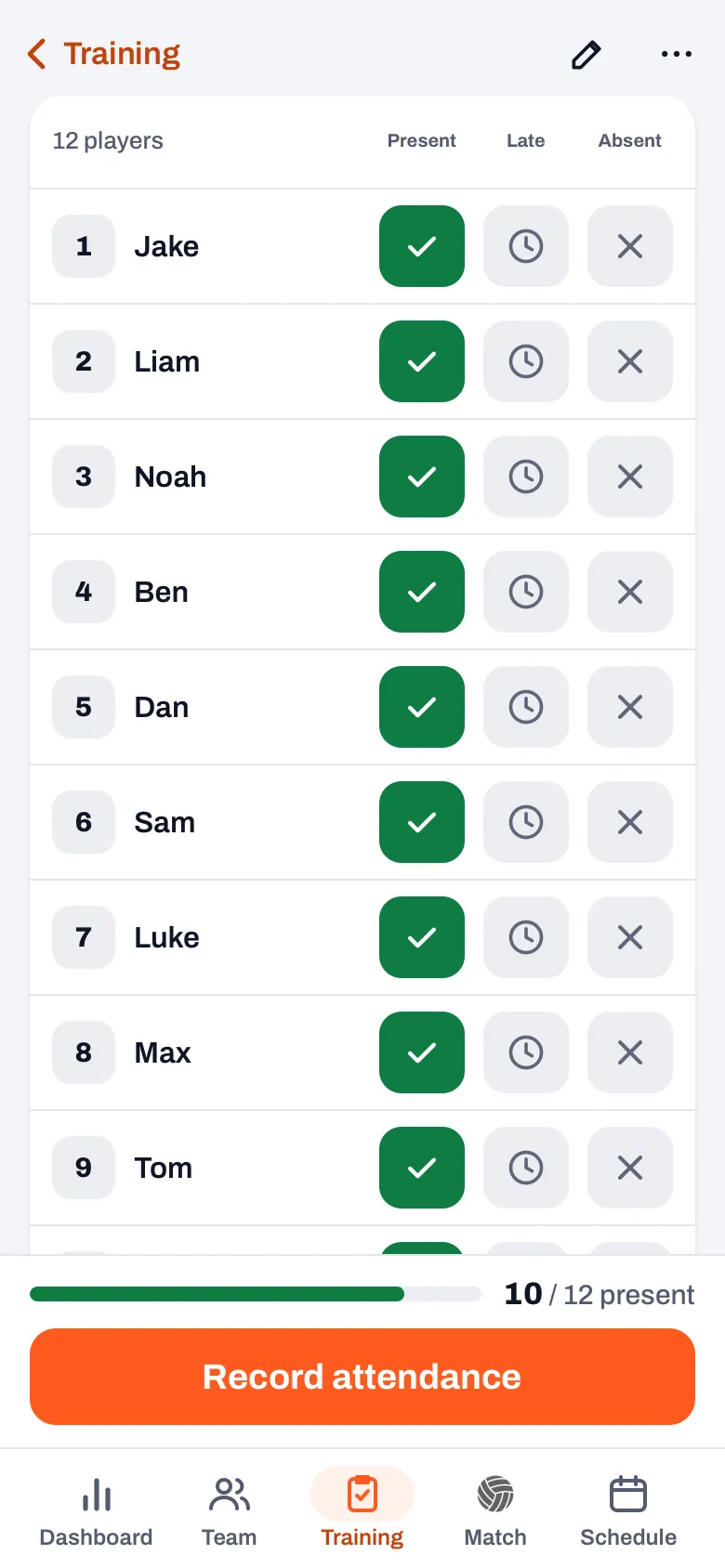
Koach does not see burnout; you do, if you can look back at the pattern. After every practice you record attendance. On the player profile, under History in Trainings, you see how many practices the player attended, and if you rate effort after practice, you also see their average effort and how it develops. When a player declines a practice, they can choose a reason (Sick, Injured, Work or School), with an optional note; only coaches see that reason.
Whatever you agree with the player or the parents, you write on the profile under Overview in Notes. Players and parents don't see those notes; if your team belongs to a club on the Club plan, the club board can read them. If you agree on a break, tap the pencil (Edit player) and under Status set the player to Absent. They then get no nudge or reminder to sign up, so the app does not add pressure that you just took away in your conversation. The status has no end date: when they come back, you set them back to Active yourself.
14 days free, no credit card. Start recording attendance this week and see for each player how turnout and effort develop.
Try Koach with your teamWhat Koach costs after the trial is on the pricing page.
Frequently asked questions
What is the difference between burnout and overtraining?
With overtraining, performance drops because of too much load and too little recovery; motivation can stay high, but the player is also tired outside the sport. With burnout it is mainly the drive that is gone: the player is drained around the sport, feels it gets them nowhere and cares less about the sport. According to the IOC consensus (2026), both improve with rest and other changes in the environment.
Can kids get burnout from sport?
Yes. The American Academy of Pediatrics (AAP) calls burnout one of the main reasons young athletes quit, with exhaustion, less of a sense of achievement and a sport that matters less. According to a meta-analysis by Giusti and colleagues (2020), young people who had specialized in one sport scored higher on burnout than young people who played several sports. It is not a diagnosis a coach makes.
Should a player with burnout stop playing volleyball?
Not necessarily. According to the IOC, burnout improves with rest and other changes in the environment. For a coach that can mean less pressure, fewer practices, a different role or an agreed break with a date to talk again. Whether the player carries on is their own decision, and for young players a decision made together with their parents. If low mood or exhaustion persists, also outside the sport, they go to a family doctor or psychologist.
When do you bring in a psychologist for burnout?
When the symptoms also show outside the sport, such as low mood, poor sleep or no longer wanting to do anything, when they do not ease after a few weeks of less pressure, or when you or the parents are worried. The family doctor is often the first step. If a player says they no longer want to live or want to hurt themselves, seek help the same day through a family doctor or the suicide prevention helpline in your country, and call the emergency number if there is immediate danger.


See attendance for each player
14 days free, no credit card. Attendance, effort and agreements in one place.
Get started with KoachOr read first what the volleyball coaching app does.