
Volleyball mental coach: the role and when to bring one in
The short answer
A volleyball mental coach helps a team or a player with the mental side of performing: handling pressure, routines, confidence and teamwork. They do not treat mental health problems; for that you refer to a family doctor or psychologist. Titles and training differ by country.
Bringing in a volleyball mental coach sounds like something for the elite, but club teams sometimes work with someone who looks at what goes on in players' heads too. What does such a person do, how do they differ from a sport psychologist, and how do you work together without losing your role as coach?
What does a mental coach do in volleyball?
A mental coach works on what happens in players' heads when it really counts. The techniques themselves, such as a serving routine, breathing and dealing with mistakes, are in mental training for volleyball. This article is about the person who teaches them. They usually work on three levels:
- With the team. Agreements about communication on the court, what the team does after a run of points against, the role of the captain, or preparing for a tournament. Through a few team sessions and by watching practices and matches.
- With a player. Conversations about a concrete problem: a player who no longer dares to serve, a player who is afraid to land after an injury, or someone who plays below their level in matches.
- With the coach. How you give feedback, what you say in a timeout and how you stay calm yourself. That carries through to the whole team.
Concentration and pre-match nerves are topics a mental coach can work on. They are covered in volleyball concentration drills and nerves before a match.
Mental coach, sport psychologist or psychologist: the difference
The names are used interchangeably, but they are different people with a different field of work. The question that makes the difference: are they allowed to treat mental health problems?
| Who | For what | Treats mental health problems? |
|---|---|---|
| Mental coach or mental skills trainer | Mental skills for performance: pressure, routines, goals, teamwork | No |
| Sport psychologist | Performance and well-being of athletes, with training in psychology | Only if they are also licensed as a health professional in your country |
| Health professional: family doctor, psychologist, psychotherapist or psychiatrist | Assessment and treatment of mental health problems | Yes |
Whether a title such as mental coach or sport psychologist is protected, and which registration goes with it, differs by country. So always ask about training and registration, and reach a health professional through your family doctor or the health system in your own country.
The most important difference is treatment. The consensus statement of the International Olympic Committee (IOC) on mental health in elite athletes, published in August 2026, makes that distinction too: psychotherapy is a treatment by health professionals qualified to provide it, something different from the support and guidance that, for example, performance coaches and mentors give outside of treatment. The same statement asks that coaches and support staff know enough about mental health to spot signs in time and refer safely (source: IOC consensus statement, British Journal of Sports Medicine, 2026).
When do you bring in a mental coach?
- The team keeps collapsing the same way. Sets that slip away despite a lead, or a team that freezes after three points against, while it works fine in practice.
- A player stays stuck despite the work in practice. You have tried routines and pressure drills, and the problem remains.
- A big step is coming. A higher division, a final tournament, or a newly assembled team that has to become a unit in a short time.
- You want to get better at coaching under pressure yourself. That too is a question a mental coach works with.
A mental coach is not an emergency fix for a team in crisis. If you want to take it seriously, plan it into the season: a few sessions in preseason, a follow-up halfway and an evaluation at the end.
When do you refer to a doctor or psychologist?
A coach or mental coach does not make a diagnosis. But you do need to notice when something is more than match nerves. Think of a player who has been low or anxious for weeks, sleeps badly, eats differently from what you are used to, withdraws from the team or seems to have lost the joy in everything. Severe or persistent mental health problems belong with a family doctor or psychologist, not with a mental coach. If there is acute danger, call the emergency services in your country.
- Talk to the player themselves, calmly and without others around. Say what you see ("you seem different these last few weeks"), not what you think is going on.
- With a minor you usually involve the parents, and you follow your club's procedures. If your club has a welfare officer, you can also go there with your doubts.
- Point the way to a family doctor or psychologist, and after that simply stay the coach: ask how things are going and adjust the load if needed.
If a player seems burned out by volleyball itself, also read burnout in volleyball players.
Working together without losing your role as coach
- Agree on the roles. You decide on the team, the lineup and the practice. The mental coach advises and works with players, but does not decide who plays.
- Confidentiality. What a player discusses with the mental coach stays there, unless the player shares it or there is danger. As coach, do not ask about the content of conversations; do ask what you can do in practice.
- One language in the gym. Use the cue words or routines the mental coach teaches in practice and during timeouts too. That way it does not stay a one-off session.
- Evaluate together. After the agreed number of sessions, look at what it achieved, for the team and for you.
A mental coach is one of the people around your team, like an assistant or a team manager. How to organize the rest of that work is covered in managing a volleyball team as a coach.
What to look for when choosing a mental coach
- Training. Ask what training someone has, whether they belong to a professional association for sport psychology or coaching, and what that means in your country.
- Experience with team sports and with your age group. Working with a team of fifteen-year-olds asks for something different than working with one adult athlete.
- Do they know when to refer? A good mental coach knows their limits and knows where to send someone when something falls outside their field.
- A concrete plan. What will they do, how many sessions, and how will you see whether it works? Be careful with promises about results.
- Agreements beforehand about cost and privacy, and with young players about what the parents get to hear.
Start with one question, not with a program. Let the mental coach watch one practice and one match first, and then ask what they see. That conversation tells you more about their way of working and whether you click than a presentation does.
What you record in Koach, and what you do not
Koach does no mental training and is not a place for conversations with a mental coach. But you can record what you do in the gym. In the report of a practice you write under Focus for next time, for example, that every player uses their routine on every serve; that focus then appears above the plan at the next practice. Above the report you see who can read it: the coaches of the team, and if the team belongs to a club, the club board too.
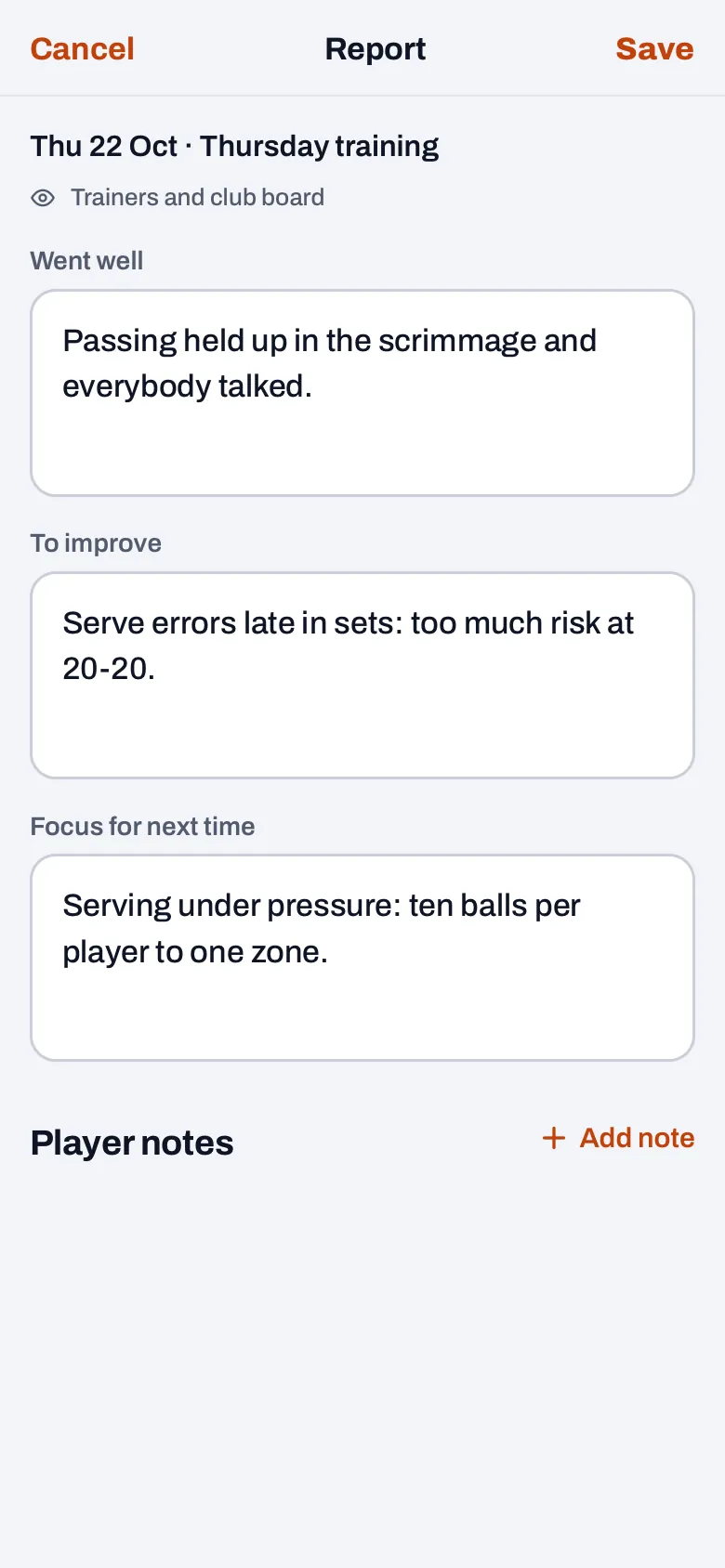
Hence a rule of thumb for notes about players: write down what you see in practice, not what a player told you in confidence, and no suspicions about mental health problems. Player notes on a practice are read by the team's coaches, and if the team belongs to a club also by the club board; players and parents do not see them. If you add a mental coach to your team as a coach, they also see the notes and the absence reasons. So consider whether that is necessary. What does and does not belong in a note is in keeping notes per player. What Koach costs after the 14 free days is on the pricing page.
14 days free, no credit card. After your next practice, put one mental focus in the report and see whether the team shows it again the following week.
Try Koach with your teamFrequently asked questions
Does a youth team need a mental coach?
Usually not as a permanent member of staff. With young players the coach does most of the mental work: a safe climate, routines and the language after a mistake. A mental coach can be useful for a talent team, for the coaches of the youth section or for a player with a concrete problem. With minors, agree beforehand with the parents what will be discussed and what they get to hear.
Can a mental coach tell the coach what a player says?
Not without the player's consent. A player only talks openly if they know the conversation is confidential. The exception is danger to the player or others; then the professional rules and the law in your country apply. Agree beforehand what the coach does get to hear, for example which routine a player is practicing, so the coach can support it in practice.
How many sessions with a mental coach do you need?
That depends on the question. A team topic, such as how you respond after a run of points against, takes a few sessions plus practice in training. A player with a stubborn problem often needs a longer series. Agree on a block with an evaluation at the end, instead of an open end. If you notice it is about more than performance, refer to a family doctor or psychologist.
Can the coach give mental training themselves?
Yes, for a large part. Serving routines, breathing, the language after a mistake and pressure drills in practice are things every coach can offer. A mental coach comes in when a problem persists despite that work, when a team has to grow in a short time or when you want to learn to coach under pressure yourself. Mental health problems belong with a family doctor or psychologist in both cases.
Set the focus for your next practice
14 days free, no credit card. The report sits with the practice, for all coaches of the team.
Get started with KoachOr read first what the volleyball coaching app does.