Read Blocking vs Commit Blocking: Which System Fits You?
A middle blocker makes one decision per rally that shapes everything: do I jump with their quick, or do I wait and see where the ball goes? That is the difference between commit and read — and most teams never choose between them on purpose.
Two answers to the same question
The opposing middle blocker is the pivot of every blocking scheme. In under a second she has to decide whether to stay with the middle attacker or leave for the pin. There are two ways to organise that decision.
Read blocking means: she waits, reads the setter and only leaves once she knows where the ball is going. Commit blocking means: she decides in advance to jump with the quick, regardless of what the setter does. Both are valid systems. The difference is not effort or courage, but which risk you are willing to take.
Read blocking: looking in the right order
In read blocking your middle stands roughly at P3, half a meter off the net, hands at chest height. She looks in a fixed order: first the pass (where does the ball end up?), then the setter (shoulders, hands, distance to the net), and only then the ball. As soon as the set is out, she moves with a side step plus a crossover step to the attacking side and closes with the pin blocker.
The upside: she is almost never completely wrong, and in most cases there is a double block at both pins. The price: against a genuinely fast quick she is late — the ball simply goes under or over her. If you want to dig into the footwork behind it, that is in blocking: footwork, timing and hands.
Commit blocking: choosing before the set
In commit, your middle jumps with the opposing middle attacker, on her approach, before the setter has even played the ball. If the ball does go to the quick, you are on top of it with two hands and the odds of a block point are high. If the ball goes anywhere else, your middle is out of the play: she is landing while the attack is still to come.
Commit is a gamble with a good payout. You use it against one specific threat: a middle attacker who scores so much that the rest of the offense is worth risking.
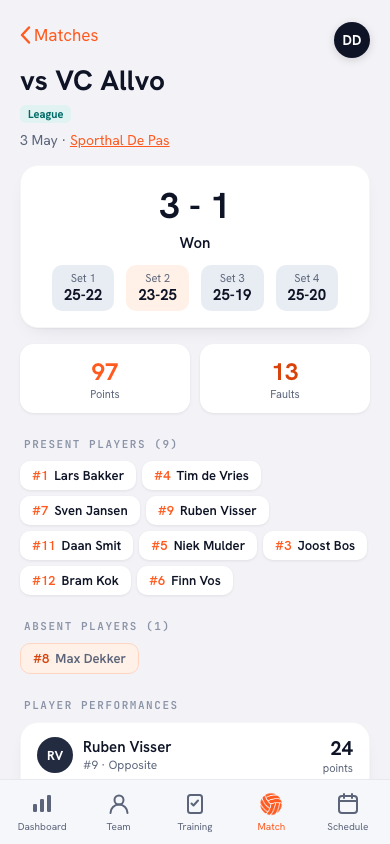
Whether the gamble pays is simply visible afterwards: block points per player in Koach show whether committing is paying off or just opening up the pins.
What commit costs you at the pins
This is the part coaches underestimate. The moment your middle commits, your pin blockers are on their own: every attack from the sides becomes a one-man block. That has two consequences. Your blockers have to be technically good enough to take away one direction by themselves — a single block standing in a random spot is worse than no block at all. And your floor defense has to be set up for it: the zone to cover behind a single block is much larger, so your back-row players stand differently than they do behind a double. Anyone who plays commit without adjusting their defensive system is just moving the problem backwards.
Which system suits which team?
| Situation | Choice | Why |
|---|---|---|
| Juniors and lower adult divisions | Read | The quick barely exists; reading produces doubles everywhere |
| Opponent rarely runs a quick | Read | Commit would block a threat that is not there |
| One dominant middle attacker across the net | Commit, selectively | Her points cost more than the risk at the pins |
| Strong pin blockers, fast defense | Commit works | The single block and the coverage behind it hold up |
| Small or inexperienced pin blockers | Read | They will not survive one-on-one |
For the vast majority of club teams the answer is therefore read, and that is not a cop-out: at a level where the quick is rare, reading simply blocks more balls.
The middle ground: commit on call
You do not have to choose one system for the whole match. The practical middle ground is 'commit on call': you play read as your base and commit only in clearly defined situations. For example: only on a perfect pass by the opponent (only then is their quick available), only against number 12, or only in the rotations where their middle is in the front row alongside their best setter. One agreement, called out loud by the middle before the rally, is enough. Write choices like that into your blocking plan, as described in organising your block.
How to train it
You train read by forcing the looking order: have blockers point at where the set is going without jumping, and count the hits. Then add the movement, and only last the jump. You train commit the other way round: have the middle jump with a fixed quick approach, ten times in a row, until the timing is there — then have the setter deliberately vary it, so your middle feels what it costs when the ball goes elsewhere. Always finish with a game format in which the middle chooses for herself and says out loud what she did. That way she learns not just to block, but to decide.
Ban half-committing. A middle who jumps 'a bit' with the quick neither blocks it nor makes it to the pin. Commit or read — but fully, and that is a call your middle makes out loud, rally by rally.
Frequently asked questions
What is the difference between read and commit blocking?
In read blocking the middle blocker waits until she sees where the set is going and moves after that. In commit she jumps with the quick regardless of what the setter does — a gamble with a high payout and a big risk.
Which blocking system is better for club teams?
Read, in almost every case. At levels where the fast middle attack is rare, reading consistently produces more double blocks, while commit mostly opens up the pins.
Can I switch between read and commit rally by rally?
You can, provided it is an explicit call: the middle blocker announces before the rally what she is doing, so the pin blockers and the back row know where they stand.
Does my defense have to stand differently for commit blocking?
Yes. Behind a single block the zone to cover is much bigger, so your back-row players stand wider apart and deeper. Playing commit without adjusting the defense only shifts the problem.