
Types of blocks in volleyball: single, double, read and commit
The short answer
Types of blocks in volleyball can be grouped three ways: by purpose (offensive to score, soft to slow the ball down), by number (single, double or triple block) and by how blockers decide (read, commit or swing). On top of that, the block chooses which zone it takes away: the line or the angle.
Types of blocks in volleyball are often mixed up: a double block can be read or commit, and offensive or soft. This overview puts the forms side by side, with the FIVB rules, when to choose which and how to train them.
What the rules call a block
Blocking is the action of players close to the net to intercept the ball coming from the opponent by reaching higher than the top of the net, regardless of the height of the ball contact (Rule 14.1.1). The rules that apply to every form:
- Only front-row players may complete a block, and at the moment of contact part of the body must be higher than the top of the net. A back-row player or libero who takes part in a block that touches the ball commits a fault, and the libero may not even attempt it (Rule 14.6).
- Block attempt and block. If you jump without touching the ball, it is a block attempt; if a blocker touches the ball, the block is completed. A collective block is executed by two or three players close to each other and is completed when one of them touches the ball (Rules 14.1.2 to 14.1.4).
- Reaching over the net is allowed, as long as you do not interfere with the opponent's play. Touching the ball on their side is only allowed after their attack hit (Rule 14.3).
- The block does not count as a team contact. After a block touch your team still has three contacts, and the blocker may play the first of them (Rule 14.4).
- Blocking the serve is forbidden (Rule 14.5).
The block is one of the basic skills in learning volleyball technique. How you jump, set your hands and move along the net is in blocking: footwork, timing and hands. Below is about the choices on top of that: for what purpose, with how many players, how you decide and what you take away.
Offensive or soft block
The offensive block aims to score. The blocker reaches over the net toward the ball, with spread, tense fingers and firm wrists, so the ball drops back into the hitter's court. It takes reach and timing, and it has a cost: a blocker who hangs over the net too early touches the net or gets tooled off the hands by the hitter.
The soft block, also called a defensive block, aims to slow the ball down. The hands are higher and tilt back slightly, palms angled upward. If the ball hits them, it pops up on your own side and your team can build a counterattack. It is the choice for a blocker who cannot get over the net against a taller hitter, or who is too late to penetrate. A playable touch is the goal then, not a block point.
Many teams agree on it per blocker: the tall middle blocks offensively, the shorter outside blocker blocks soft. Against a hitter who gets high above the block, a soft block is the smart choice for everyone.
Single, double or triple block
- Single block. One blocker, for example against a quick middle attack, or on the pin when your middle has jumped with the quick. A single block cannot cover everything: it takes away one direction, and the defense covers the rest.
- Double block. The standard form against an attack from the outside. The outside blocker sets the position, the middle blocker closes, shoulder to shoulder and with no gap between the hands. Who closes on whom and when a third blocker joins is in double and triple block.
- Triple block. All three front-row players against one hitter, usually on a high ball after a bad pass from the opponent. It takes away a lot, but leaves the short balls behind the block and the back court more thinly covered.
Read, commit, guess or swing: how blockers decide
- Read. The blocker waits, watches the pass, the setter and the ball, and only moves once they see where the set is going. They are almost never completely wrong and more often get two blockers on the ball.
- Commit. The middle blocker jumps with the quick middle hitter before the set is even there. If the quick comes, they are right on top of it; if it does not, the outside blockers are on their own.
- Guess. The blocker picks a hitter in advance, based on what they know about the setter, for example that the setter always goes outside after a bad pass. A guess only works with good information and when the whole block knows about it.
- Swing. Instead of shuffling sideways, the blocker uses a crossover approach and swings the arms, as in an attack approach. They jump higher and cover more ground, but the timing is harder. You mainly see it at high levels.
Read and commit are the two systems every team chooses between; how to weigh them per opponent is in read blocking vs commit blocking.
Line or angle: which zone the block takes away
A block cannot take away everything, so it chooses. If the outside blocker takes away the line, a hard hit is mostly left with the angle, and that is where your defense stands. If the block takes away the angle, your back-row defender covers the line. Block and defense are therefore one agreement: what the block closes, nobody needs to cover in the back court. You make that choice per hitter, based on what you see from them: if they hit almost everything cross-court, you close the angle. How to organize that against a strong opposing hitter is in organizing the block.
The starting position at the net is a choice too. If the three blockers spread out, with the outside blockers close to the antennas, you are quick to a tight set to the outside. If they bunch together in the middle, you cover the middle attack and can shift to both sides, but you have a longer way to the antenna.
| Type of block | What it does | When |
|---|---|---|
| Offensive | Hands over the net, ball back into their court | Blocker gets high enough |
| Soft | Hands high and tilted, ball up on your own side | Hitter gets above the block |
| Single block | Takes away one direction | Quick attack, or the middle has jumped |
| Double block | Outside sets, middle closes | Standard attack from the outside |
| Triple block | All front-row players on one hitter | High ball, one dominant hitter |
| Read | Wait until the set is clear | The base for many teams |
| Commit | Go with the quick, before the set | Against a strong middle hitter |
| Swing | Approach with arm swing along the net | Experienced blockers, high level |
Count the playable touch. In a scrimmage, give an extra point to the team that wins the counterattack after a block touch. Your blockers learn that a soft block that slows the ball down can be worth as much as a block point, and your defenders learn to be ready behind the block.
How to train the different blocks
- Offensive versus soft. A coach hits from a box on the other side. The blocker blocks five balls offensively and five soft, and after each ball says where it landed. That way they feel the difference in hand position.
- Read first, then move. A setter gets a tossed ball and chooses: outside, middle or right side. The middle blocker may only move once the ball leaves the setter's hands, and calls out where they are going as they leave. Whoever leaves too early blocks the next ball alone.
- Line or angle on command. Before each rally the coach calls which zone the block closes. The defense sets up behind it, and the hitter tries to find the open zone.
More drills are in blocking drills for your middle blockers.
Tracking blocks in a match
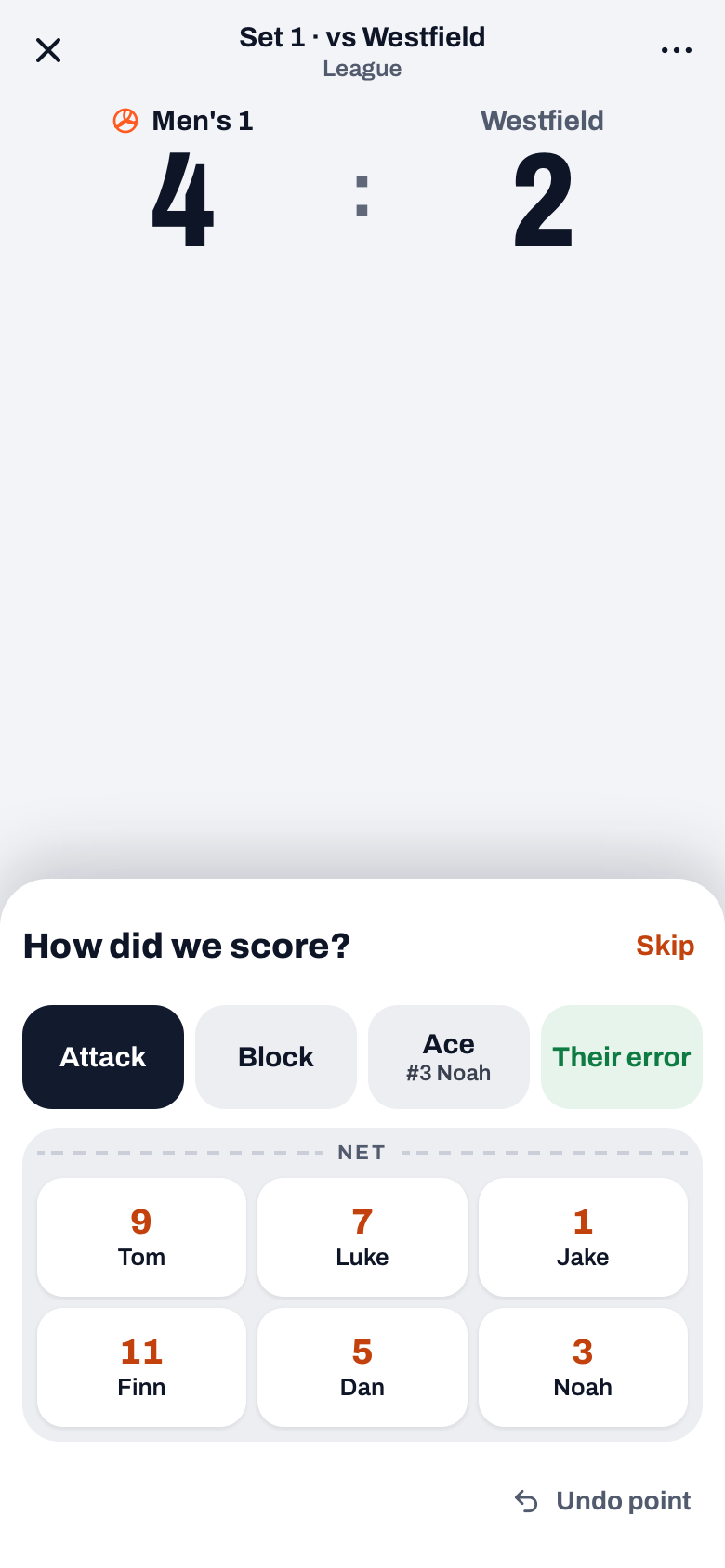
Block points are rare, so each one counts. In Koach, after a point, you tap Block in the How did we score? drawer and then the player; the libero cannot be tapped there, because the libero may not block. If you track the match in Expert, every block action gets a rating from 0 to 5: Their point, No block, Weak, Usable, Good or Block point. That way you also see the soft blocks that did not produce a point but did slow the ball down. How to steer with the block points themselves is in measuring block points.
What Koach costs after the 14 free days is on the pricing page.
14 days free, no credit card. Track every block action on Saturday and see which blocker slows the ball down and who scores.
Try Koach at your next matchThe full text of the blocking rules is in the FIVB Official Volleyball Rules 2025-2028, Rule 14.
Frequently asked questions
What is the difference between a block attempt and a block?
In a block attempt you jump to block but do not touch the ball. If a blocker touches the ball, the block is completed. That difference matters for back-row players: only front-row players may complete a block, and a back-row player who takes part in a block that touches the ball commits a fault. The libero may not even attempt a block.
Does a block count as one of the three contacts?
No. A block touch does not count as a team contact, so afterwards you still have three contacts to return the ball. The player who touched the ball in the block may also play the first contact after it. Beach volleyball is different: there the block does count as a contact.
When do you choose a soft block?
When your blocker cannot get high enough to reach over the net, when the hitter gets above the block, or when the blocker is too late to penetrate. The hands are high and tilt back slightly, so a touch sends the ball up on your own side instead of out of play.
Which is better, read or commit blocking?
For most amateur teams read is the base, because the quick middle attack comes less often there and reading produces more double blocks. Commit pays off against a middle hitter who scores a lot, but then your outside blockers are on their own more often. Many teams read and only commit in agreed situations.


See what your block really does
14 days free, no credit card. After one match in Expert you see more per blocker than block points.
Get started with KoachOr read first what the volleyball coaching app does.