
Double block in volleyball: who sets the block and who closes?
The short answer
In a double block in volleyball, the pin blocker on the side of the attack sets the block in front of the hitter's hitting arm, and the middle blocker closes on them, shoulder to shoulder with no gap. They jump together. A triple block is for a high, predictable set to a strong hitter.
A double block in volleyball is more than two players jumping at the same time. One blocker sets the position, the other closes, and together they take away part of the court. This article explains per attacking spot who does what, how the middle closes in time, when to block with three and how to train it.
Setting and closing: the roles in a double block
In the rules, a block by two or three players is called a collective block: it is executed by players close to each other and is completed when one of them touches the ball (Rule 14.1.4 of the Official Volleyball Rules 2025-2028). In practice every double block has two roles:
- The lead blocker, who sets the block. The blocker on the side the attack comes from decides the position. They line up in front of the hitter's hitting arm, on the line of the hitter's approach, and jump on the hitter's timing. Their outside hand turns slightly in, toward the middle of the court, so a ball that hits that hand falls back into the court and is not wiped off over the sideline.
- The closer. Usually the middle blocker. They come in next to the lead blocker, hip to hip, and jump at the same moment. No ball should fit between their inside hands. The gap between two blockers is called the seam, and the closer is responsible for it.
The lead blocker decides, the closer follows. If the lead blocker is in the wrong spot, the middle still closes on them: two hands in the wrong place without a gap are better than two good hands with a gap between them. The basics of stance, jump and hands are in blocking: footwork, timing and hands; here it is about working together.
Who sets and who closes, by attacking spot
| Opponent's attack | Who sets the block | Who closes |
|---|---|---|
| Outside hitter, their left side | Your blocker in position 2 | Your middle |
| Opposite or right side, their right side | Your blocker in position 4 | Your middle |
| Quick middle attack | Your middle | Only if there is time: the nearest pin blocker |
| Back-row attack through the middle | Your middle | The pin blocker you agree on for it |
The blocker who is not involved drops off the net and covers the sharp angle and the tip. Whether your middle waits until they see the set or jumps with the opposing middle hitter in advance determines how often a double block forms on the pins: that is the choice between read and commit blocking.
If you run a 5-1, your setter is in the front row for three rotations and blocks right front, in position 2. The setter is then the lead blocker against the opponent's outside hitter, who often gets a lot of sets. If your setter is short, agree that the setter takes the line and that the middle leaves earlier to close off the rest. Front-row players switch to their blocking spots after the serve. Since the 2025 rules the serving team may already stand anywhere on its own court at the serve (Rule 7.4), so your blockers can start in their blocking spots on your own serve; the receiving team must still be in rotational order. What else changed is in the new volleyball rules.
The footwork of the closing middle
The middle waits in the middle of the net, hands in front of the shoulders. How far they have to go determines the footwork:
- Up to about two meters: a shuffle step to the side, two steps, shoulders parallel to the net.
- Farther, out to the antenna: the crossover step. Open with the foot on the side you are going to, cross over with the other, plant the last step so your feet are parallel to the net again, and jump straight up.
Two details make the difference. First: the last step stops the movement. A middle whose hips keep sliding drifts sideways into the lead blocker and lands on their feet. Second: the middle watches the hitter while moving, not the lead blocker. The lead blocker is already standing still; you find the spot next to them by feel, the timing only by watching. Advanced middles swing their arms at takeoff, as in an attack jump. That gives height, but it takes a lot of training and a good landing.
What the hands take away
A double block takes away part of the court and channels the attack toward your defenders. A common agreement: the lead blocker takes the line with their outside hand, the closer takes the ball and the angle behind it. Your defenders then stand in the shadow of the block and defend what goes around it. Agree per match what your block takes away, and tell the defenders too. Against a hitter with only one shot, you deliberately shift the block toward that shot; how to make such a plan is in organizing the block against a strong hitter. All types of block side by side, from single to read and commit, are in types of blocks in volleyball.
When to send three: the triple block
Only front-row players may complete a block or take part in a completed block, and the libero may never block (Rules 14.1.1, 14.6.2 and 14.6.6). A triple block therefore consists of all three of your front-row players. The third blocker closes on the inside, next to the middle.
A triple block pays off in three situations:
- A high set after a bad pass. The opponent has only one option and the ball hangs in the air for a long time. There is time to get three blockers up.
- Their go-to hitter at the end of the set. At 22-22 everyone knows where the ball is going.
- A hitter you cannot stop with two. Three pairs of hands take away more of the court.
The price is high. Behind the block only three defenders remain for a tip, a ball off the block and both deep corners. And the third blocker comes from the far end of the net and has a long way to go. If they arrive late, they jump into the seam and create an extra gap. The rule: a good double block beats a late triple block.
How to train the double block
- Without a ball. Groups of three at the net. The coach points left or right: the pin blocker on that side sets the block, the middle closes, and both jump together. After the landing, the coach throws a ball at the seam. If it fits through, the block was not closed.
- Against an attack from a box. A coach or player hits from a box on the other side, alternating left and right. The blockers set and close on a predictable ball, so the timing can grow.
- With a setter and two hitters. The setter chooses. The middle reads and closes. Scoring for the block: a touch that slows the ball down is one point, a block point two, a ball through the seam minus one.
- In a scrimmage. Six against six, with a block point counting double. Now the block has to read, decide and close at the pace of a real rally.
Let the lead blocker call, not the middle. Agree that the blocker who sets the block calls one word at the moment of the set, for example "Here". The middle then knows where to go without looking at their neighbor, and can keep their eyes where they belong: on the hitter.
How the block fits into the whole of serve, reception, attack and defense is in volleyball tactics.
Tracking block points and block touches
A double block scores less often than you hope, but it slows down a lot of balls. If you want to know what your block does, track more than block points. In Koach's live scoring you first record the point; in the How did we score? drawer you then choose Block and tap the blocker. With a double block you tap one player, so agree as a team who gets the point, for example the blocker who touched the ball first.
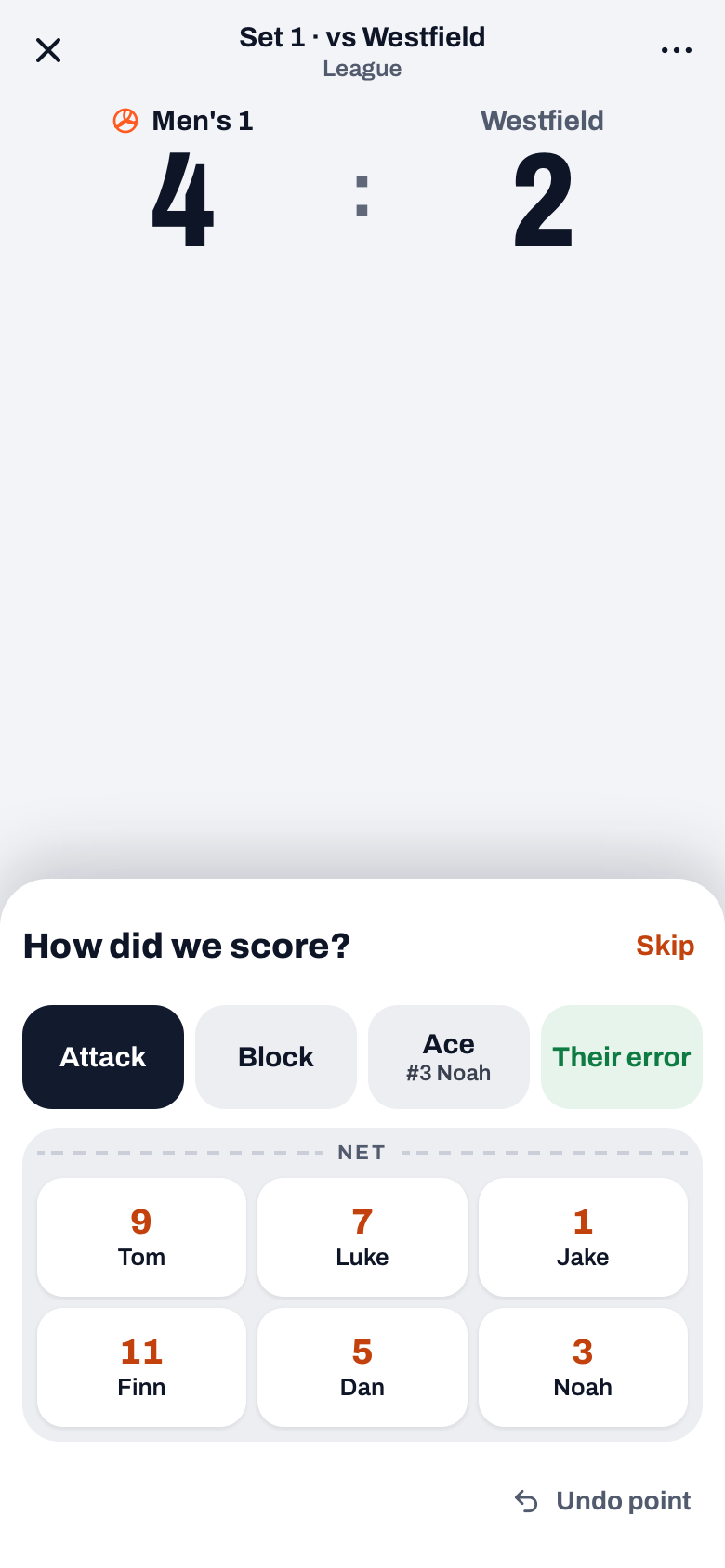
In Expert mode you also rate every block from 0 to 5, from Their point and No block to Usable, Good and Block point. That way the touches that made the ball playable for your defenders count too. What Koach costs after the 14 free days is on the pricing page.
14 days free, no credit card. Track every block point on Saturday and see after three matches which side of your block does the work.
Try Koach at your next matchFrequently asked questions
Who sets the block in a double block?
The pin blocker on the side the attack comes from: against their outside hitter your blocker in position 2, against their opposite your blocker in position 4. They line up in front of the hitter's hitting arm. The middle blocker closes on them, even if the spot is not perfect, because a closed block in the wrong place is better than a gap.
Does a double block count as a contact?
No. A block touch does not count as a team contact, so after a block your team still has three contacts. The ball may also touch several blockers in succession in one action, and the player who blocked may play the next ball. That is in Rules 14.2 and 14.4 of the FIVB rules.
Can a back-row player join the block?
No. Only front-row players may complete a block or take part in a completed block, and the libero may not even attempt one. Since 2025 the serving team may stand anywhere on its own court at the serve, but a back-row player who stands at the net may still not block afterwards.
What does the middle blocker do if they are late?
They do not jump halfway into the seam. A blocker who arrives late makes the gap bigger and gets in the way of their defender. Better one well-placed block: the middle stays down or drops off the net and defends the tip and the short ball behind the lead blocker.


Track your block points in Koach
14 days free, no credit card. After three matches you see which side of your block works.
Get started with KoachOr read first what the volleyball coaching app does.