
Setting a personal goal for every player
"Just get better" is not a goal, it is a wish. One concrete, measurable goal per player changes the dynamic of an entire season: practices get direction, conversations get substance and growth becomes visible.
The anatomy of a good player goal
- Measurable: "attack percentage up to 45%" instead of "attack better" — you need to be able to see in March whether it is working. See also the attack percentage.
- Within the player's control: the goal depends on what the player does, not on the opponent's lineup or the coach's favour.
- Owned by the player: a goal you impose is homework; a goal the player chooses (and you sharpen) is a mission.
- One per season: two goals means half the focus. Pick the goal that unlocks the most.
Examples per position
Outside hitter: attack percentage up to 45%. Middle blocker: an average of 2 block points per match. Opposite: points-to-errors ratio up to 3:1. Setter: team attack percentage +5% (the team's number is their number). Libero: not a scoring goal but a behaviour goal — go full tilt in the passing drill at every practice.
Recording it and keeping it alive
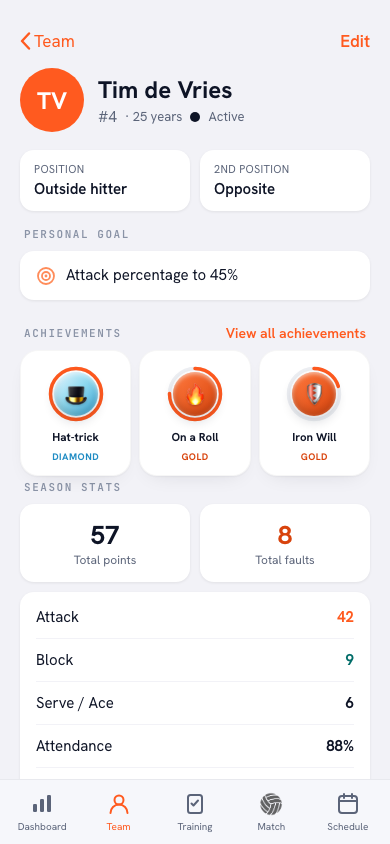
In Koach the personal goal sits at the top of the player profile, directly above the season statistics — the goal and the measurement on one screen. Keeping it alive takes three moments: name it briefly when it is relevant ("that tip was exactly your goal behaviour"), spend two minutes looking at it together every six weeks, and take stock in the evaluation talk. That is all it needs — a goal that gets discussed every week wears out.
Link the goal to the team goal. If the team wants promotion and the opposite is working on cutting errors, the two reinforce each other — and the player feels that their goal matters. See also setting a team goal.
Frequently asked questions
What if a player hits their goal halfway through the season?
Celebrate it visibly and then raise the bar or deepen the goal ('45% achieved — now 45% against the top-3 teams'). A goal achieved is momentum; do not let it evaporate into aimlessness.
And if a goal clearly turns out to be too ambitious?
Adjust it together — an unreachable goal demotivates just as much as no goal at all. Frame it as recalibrating, not failing: the first goal was a hypothesis, not a contract.
Do personal goals also work for youth and recreational teams?
Especially there: young players grow on experiences of success and recreational players on visible progress. Keep the goals smaller and more concrete ('dare one jump serve every match') and the mechanism is exactly the same.

Try it yourself in Koach
Less admin, more coaching — starting at your next practice.
Get started with Koach