
Volleyball goal setting worksheet: free PDF and Word template
The short answer
A good volleyball goal setting worksheet puts one goal on paper, with a starting point, a measure, a deadline and regular check-ins. You can download one free here, as a PDF and in Word. In Koach you then add that goal to the player's profile under Personal goal.
If you are looking for a volleyball goal setting worksheet, you want something you can print tomorrow and fill out with a player. Below is one built for volleyball players, with a personal development plan included. After that you will see how to fill it out and what an app adds to it.
Download the free volleyball goal setting worksheet
First, what you probably came for. The worksheet is free, with no account and no email address required. You are welcome to print it, copy it and adapt it.
- Volleyball goal setting worksheet (PDF): printable, A4 portrait, three pages. The worksheet, a personal development plan and a completed example.
- Volleyball goal setting worksheet (Word): the worksheet and the development plan as an editable Word template. Put your club's name at the top, or swap the volleyball skills for the ones in your own sport.
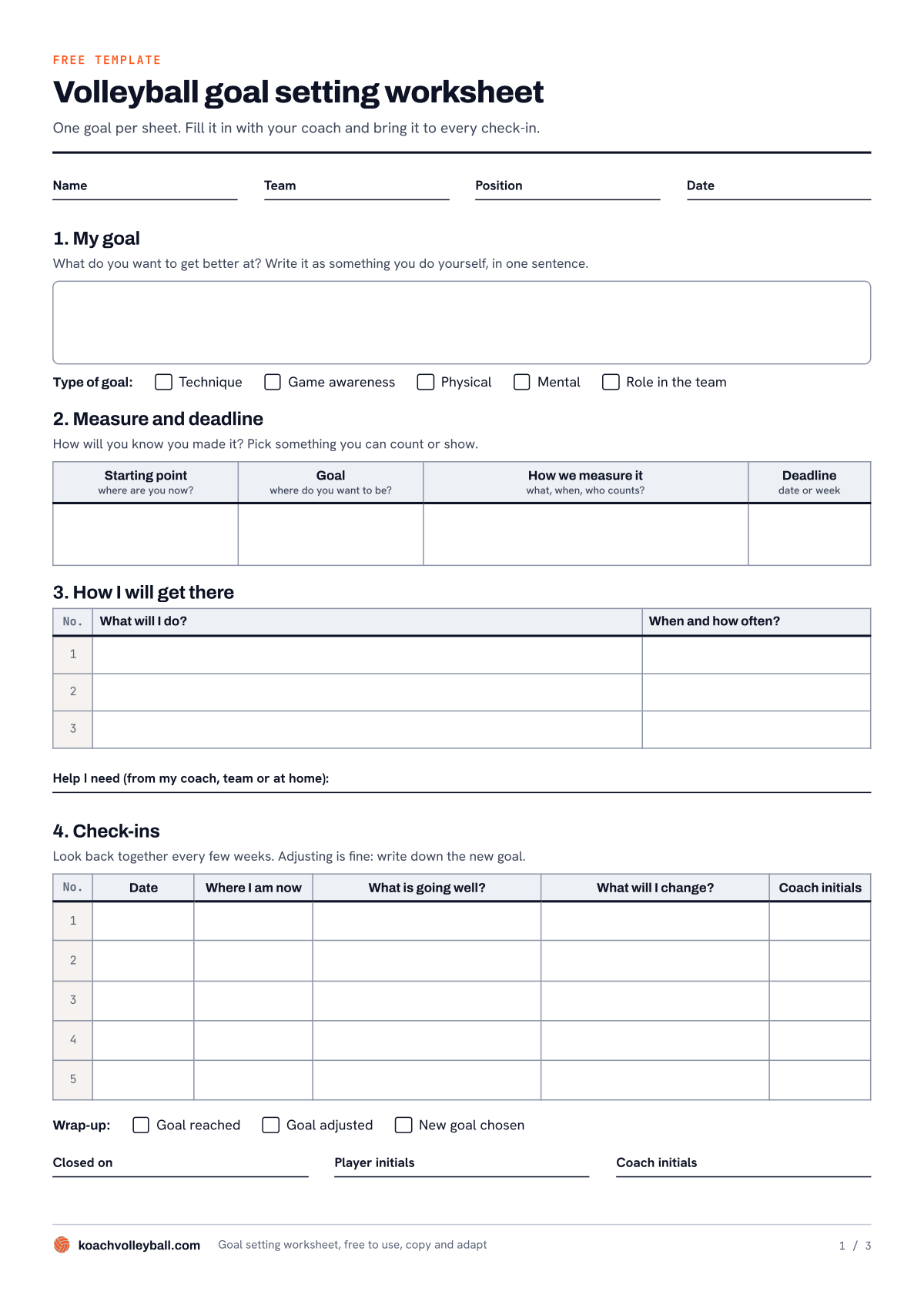
Page 1 of the PDF: one goal per sheet, with the measure, the deadline, three actions and room for five check-ins.
What is on the goal setting worksheet?
The first sheet is the worksheet itself. It works with one goal per sheet, so every goal gets its own measure, deadline and check-ins. At the top you fill in name, team, position and date. Below that are four sections:
- My goal. One sentence, written as something the player does. Underneath you tick the type of goal: technique, game awareness, physical, mental or role in the team.
- Measure and deadline. Four boxes: the starting point (where are you now?), the goal (where do you want to be?), how you will measure it (what, when and who counts?) and the deadline, as a date or a week.
- How I will get there. Three lines for what the player will do and how often, plus a line for the help they need from the coach, the team or at home.
- Check-ins. Five rows for looking back together every few weeks: the date, where the player is at that point, what is going well, what they will change and the coach's initials.
At the bottom you close out the goal: reached, adjusted or replaced by a new goal, with the date and the initials of player and coach. The second sheet is a personal development plan, the third a completed example.
How to fill out the worksheet with a player
- Let the player write the first sentence. You sharpen it, but the words are theirs. How to pick a goal that fits each player is covered in setting a personal goal for each player. This worksheet is where you work that goal out.
- Write down the starting point before you begin. Without one, you will not know at the check-in whether anything has changed. Count it once at practice, or take a number from the last few matches.
- Pick a measure someone can actually count. That is why the measurement box also asks who counts. If the answer is nobody, it is not a measure but a wish.
- Book the check-ins right away. Write down the first date before the player walks off. A check-in you mean to schedule later often never happens.
The example on page 3 shows what that looks like. A 15-year-old outside hitter wants to serve overhand every time and get more serves in: from 4 to 7 out of 10, with week 8 as the deadline. The assistant coach counts ten serves during the warm-up at the first practice of the week, and three check-ins record what is going well and what the player will change. The name and the numbers are an example, not a benchmark.
Personal development plan: the second sheet
Where the worksheet covers one goal, the personal development plan covers one player and one season. You start with where the player is now. For ten skills the player circles a number from 1 to 5, and the coach does the same in a separate column: serve, passing and serve receive, setting, attack, block, defense, game awareness, communication on court, physical and mental. Wherever the two numbers are far apart, you have your first conversation.
Below that the player writes down their biggest strengths and most important areas to work on, and picks no more than three goals for the season. Each of those goals gets its own worksheet. At the bottom are two review boxes, for mid-season and the end of the season, with room for the initials of the player, the coach and, for youth players, a parent.
If you want to evaluate players in more depth, with a fixed description for each level, the volleyball player evaluation form is a better fit. The development plan is deliberately short: a starting point for goals, not a report card.
Why a worksheet drops out of sight after a few weeks
Filling it out is the easy part. The hard part comes after. The sheet is at home when the check-in comes around, the measure needs someone to do the counting, and a few weeks in nobody remembers exactly how the goal was worded. That is not the player's fault or the coach's: a goal you do not see slips out of view.
There are three ways to deal with that, and each has its own strength:
- The worksheet on paper. Costs nothing, works in any sport and forces you to actually write the goal out. Putting their initials under a goal of their own can mean more to a young player than a line in an app. The weak spot: the sheet has to be there at the moment you need it.
- A shared document or a spreadsheet. Also free, and you can edit it anywhere. You have every player in one file. But players rarely open a file like that on their own, and you enter the numbers by hand.
- An app that keeps the goal with the player. The goal sits where you already look, and some of the numbers come from what you already record. On the other hand, an app does not force you to work the goal out.
Worksheet or app for goals: an honest comparison
We make Koach, so read the right-hand column with that in mind. We have tried to write down what the app cannot do as well.
| What you want | Worksheet (paper or Word) | Koach |
|---|---|---|
| Work out a goal with a measure, deadline and actions | Yes | No, the goal is one sentence |
| Check-ins with date and initials | Yes | No, but dated notes per player |
| Starting point per skill, from player and coach | Yes, in the development plan | No, but coach star ratings after each practice |
| Goal always at hand for player and coach | If the sheet is with you | Yes, on the player page |
| Team goal visible to the whole team | On a sheet in the locker room | Yes, on the dashboard of every player with an account |
| Numbers to track the measure | Count them yourself | Partly: points, faults, reception, attendance |
| Works for any sport | Yes | No, volleyball only |
| Cost | Free | 14 days free, then €2.99 per month for one team |
The takeaway is not a choice between the two. On paper you work the goal out; in the app it stays in view and the numbers come along with it.
What Koach does with the personal goal and the team goal
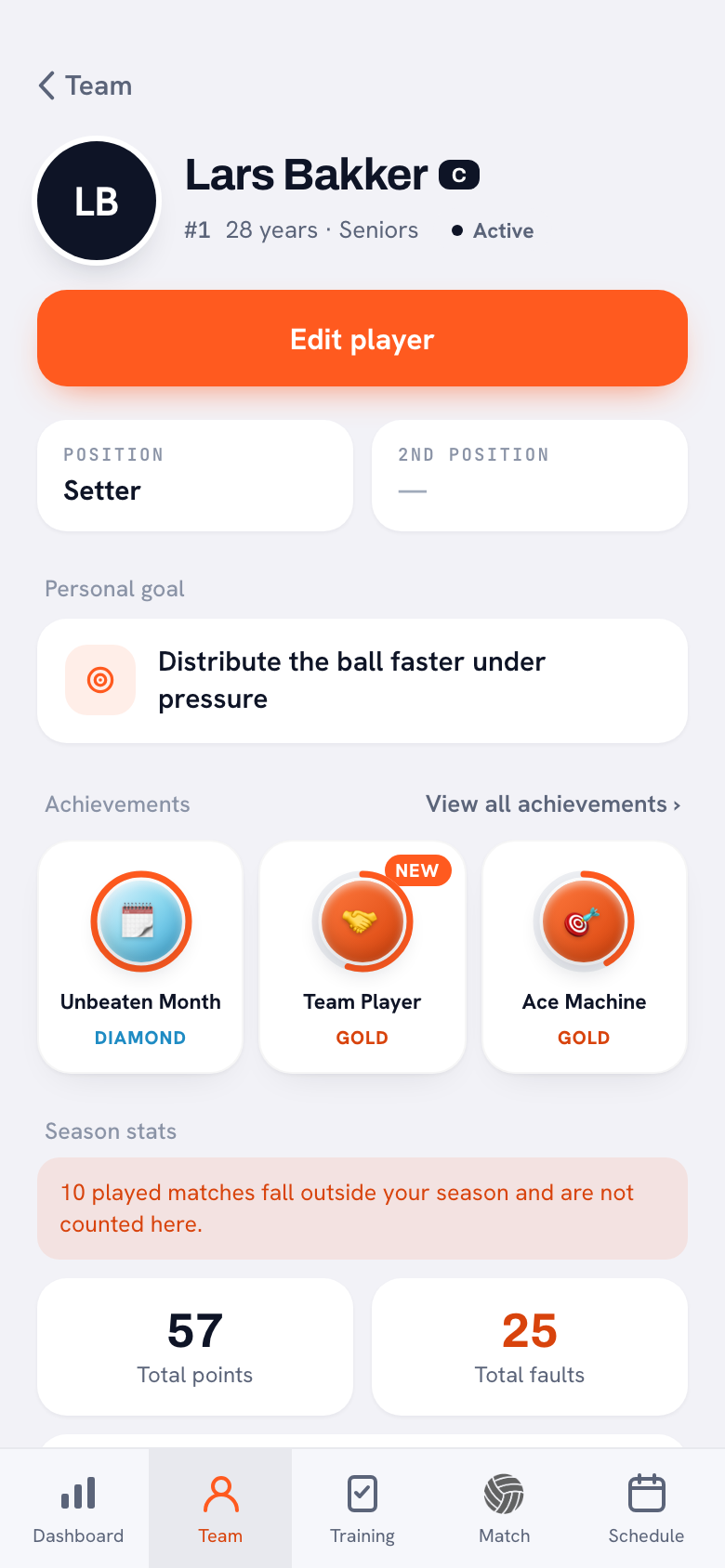
Open a player on the Team tab, tap Edit player and enter their goal in the Personal goal field. On the player page it then appears below the position, in its own card. If the player has their own account, they see the goal on their own page and can edit it themselves. If nothing has been set yet, they see Tap to set your personal goal; to change it they tap Edit. The player account is free.
14 days free, no credit card. Add each player's goal under Personal goal tonight, and it will be waiting on the player page at the first check-in.
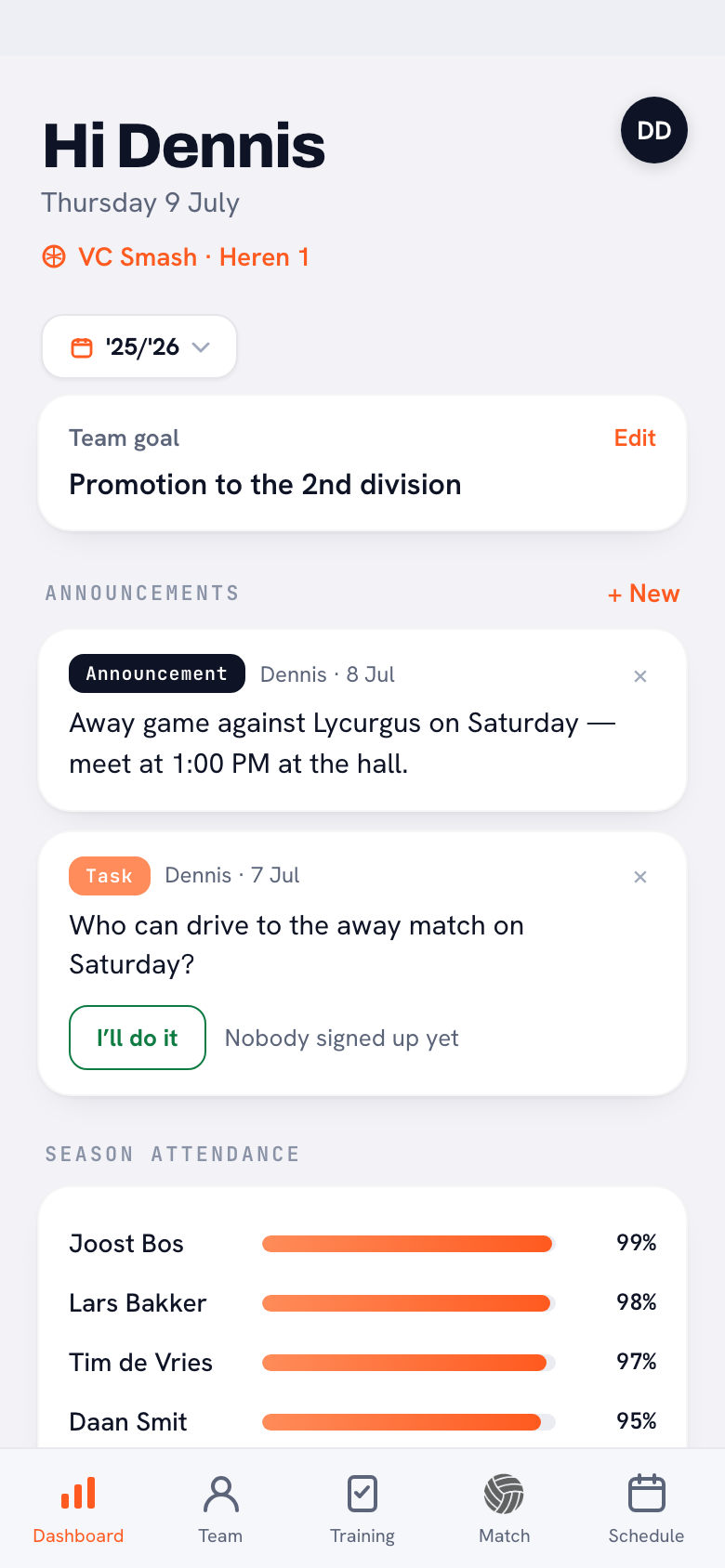
Set your goals in KoachYou set the team goal on the Dashboard. That is where the Team goal card lives; tap Edit to type in the goal. Players with an account also see the team goal on their own dashboard. How to choose a team goal that lasts the whole season is covered in setting a team goal for the season. How to link the team goal, behavior goals and player goals is explained in setting and tracking season goals.
How do you track in Koach whether a goal is working?
A measure has to come from somewhere. Koach keeps track of part of it from what you already record:
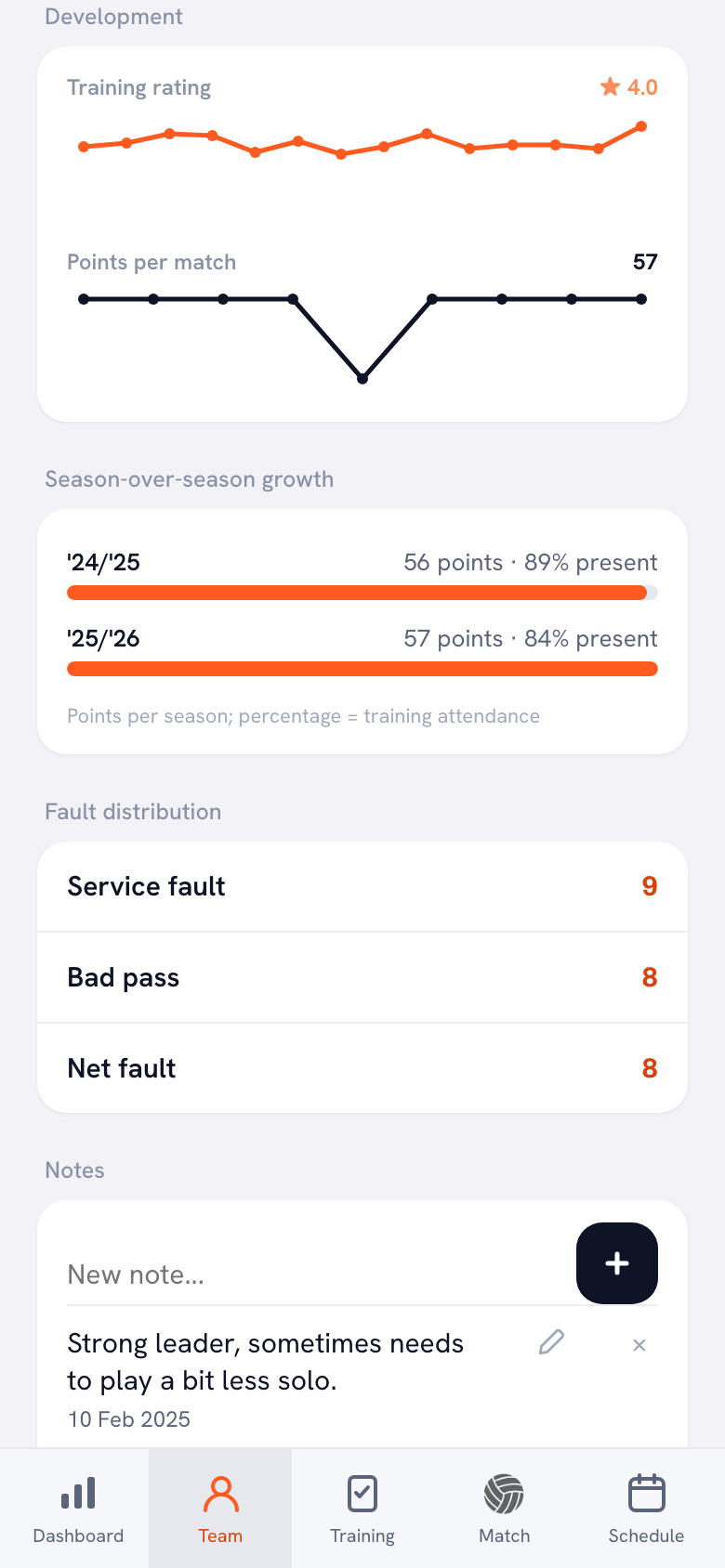
- Points and faults per player. Whether you score a match live or enter the stats afterwards, you see each player's points from attack, block and serve. Under Fault distribution on the player page you see how often each type of fault occurs, such as Service fault or Bad pass, as long as you mark who made the fault while scoring.
- Reception. If you rate an opponent's serve from 0 to 3 and pick the player at Who received the ball?, the stats for that match show the average per player under Reception.
- Attendance and stars. The player's Season stats include their Attendance. After a practice you give stars from 1 to 5 for Technique, Game awareness, Coachability, Work ethic and Effort. Under Development the Training rating appears as a line across the season. Only the coach sees that line, not the player.
- Notes. Under Notes on the player page you write down what you agreed at a check-in. Every note gets a date, and the player does not see your notes.
What Koach does not do: there is no deadline field, no check-in schedule and no progress bar showing how far a player is with their goal. Koach counts what happens in matches, not drill reps at practice: you count the ten warm-up serves from the example yourself. The app does not make a PDF of the goals either. What players see themselves and how they track their own growth is covered in how to track your own growth as a volleyball player. A broader overview of what you can track per player is in tracking player development in volleyball.
Who the worksheet suits, and when to add Koach
- The worksheet on its own suits you if you work with a handful of players, coach a different sport or first want to see whether goal setting catches on with your team. The first sheet works in any sport; in the Word version you can change the skills in the development plan.
- The worksheet plus Koach suits you if you coach a volleyball team and want to keep the goals in view all season, with the numbers from practices and matches alongside them and a team goal your players see for themselves.
- Koach is not a fit if you coach a different sport or beach volleyball, or if you want an app that monitors goals with deadlines and reminders for you. Koach does not do that.
You can try Koach free for 14 days, with no credit card. After that, Coach costs €2.99 per month for one team with two coaches, or Club €9.99 per month for unlimited teams. With a yearly plan you pay €2.49 or €8.33 per month. In the App Store and Google Play you see the price in your own currency. The prices are on the pricing page.
Bring one number to every check-in. Put the worksheet next to the player page in Koach and write what you see there, or what you counted at practice, in the Where I am now column. With a number, the conversation is about what has changed; without one, it is about how it feels.
Frequently asked questions
What should a goal setting worksheet include?
A good worksheet has one goal in one sentence, the starting point, the measure that tells you it worked, a deadline and the actions the player will take. It also leaves room for check-ins: the date, where things stand at that moment and what you will change. The free volleyball goal setting worksheet on this page has exactly those sections, plus a box to close out the goal.
Where can I find a free volleyball goal setting worksheet PDF?
On this page, as a PDF and as a Word file. Both are free, with no account and no email address. You can print, copy and adapt them, for example with your club's name or with the skills of another sport. If you then want to track the goals in an app, you can try Koach free for 14 days; after that Coach costs €2.99 per month for one team.
What is a personal development plan for athletes?
A personal development plan describes, for one player and one season, where they stand now, what their strengths and areas to work on are and which goals they choose. In the template, player and coach each rate ten skills separately on a scale of 1 to 5. The player picks no more than three goals, and you review them mid-season and at the end of the season.
How often should you check in on a player's goals?
Every few weeks is enough. The completed example in the PDF does it every two weeks, for a goal with a deadline in week 8. Check too often and little has changed yet; check too rarely and the goal drops out of sight. You can adjust the goal at any check-in: write down the new goal and close out the old one.
Can players set their own goal in the app?
Yes. A player with their own Koach account sees their personal goal on their player page and can set or change it there. The coach sets the goal through Edit player. Players with an account also see the team goal on their dashboard. The player account is free; the coach pays after the 14-day trial.


Put your players' goals in Koach
14 days free, no credit card. After one week you will know whether the goals stay in view.
Get started with KoachOr read first what the volleyball coaching app does.