The 5-2 Volleyball Rotation: Two Front-Row Setters
Most coaches know the 5-1, the 4-2 and the 6-2. The 5-2 sits in between and is therefore rarely explained properly. Yet for a lot of teams with two half-setters it is the most practical solution on the floor.
What the numbers 5-2 actually mean
The name of a volleyball system is always the same piece of arithmetic: the first number is how many players attack, the second is how many players set. In a 5-1, five players attack and one sets. In a 4-2, four attack and two set — and those two setters never attack. In a 5-2, five attack and two set, and there is only one way to arrange that: the setter who is in the front row sets and does not attack, while the setter who is in the back row at that moment is a full back-row player — passing, digging, serving and, if you want it, attacking from behind the ten-foot line.
Put simply: a 5-2 is a 4-2 in which your setters are not half players. In their three back-row rotations they do everything the other five do. That is the whole difference, and it is exactly that difference that decides whether the system fits your team.
Where your two setters stand in the rotation
The two setters start opposite each other, three positions apart in the rotation order. Put setter A at P2 (right front) and setter B at P5 (left back), and exactly one of the two is always in the front row. Rotate once and A moves to P1 while B moves to P4 — so the setting job hands over from one to the other. Each setter sets for three rotations and then plays three rotations in the back row.
For the attack that means you always have two front-row hitters alongside the setter. Never three, but never one either — the front-row make-up is identical in every rotation. That predictability is the system's biggest strength: your hitters know what is being asked of them in every single rotation.
The six rotations, one by one
- Setter at P2 (right front): the ideal rotation. She is already where she needs to be and can step straight into the setter's zone between P2 and P3 after the serve. Your two hitters are at P4 and P3.
- Setter at P3 (middle front): she shifts two meters to her right after the serve. Agree that the player at P2 slides a little toward the sideline, so the setter gets her space and does not end up in the outside hitter's approach.
- Setter at P4 (left front): the hardest front-row rotation. She has to travel all the way across the net to the right, and that is precisely where your best hitter wants to approach. Two fixes: let the setter start as far to the right of P4 as the overlap rules allow (legal, as long as she stays left of P3), or deliberately run your offense through P3 and the back row in this rotation.
- Setter at P1 (right back): she serves and defends the right-hand corner. Her partner sets from the front row.
- Setter at P6 (middle back): she defends the middle and is the logical pipe attacker if you ever add one.
- Setter at P5 (left back): she is a passer in the zone where most deep serves land. This is the rotation that tells you whether your setters can really pass.
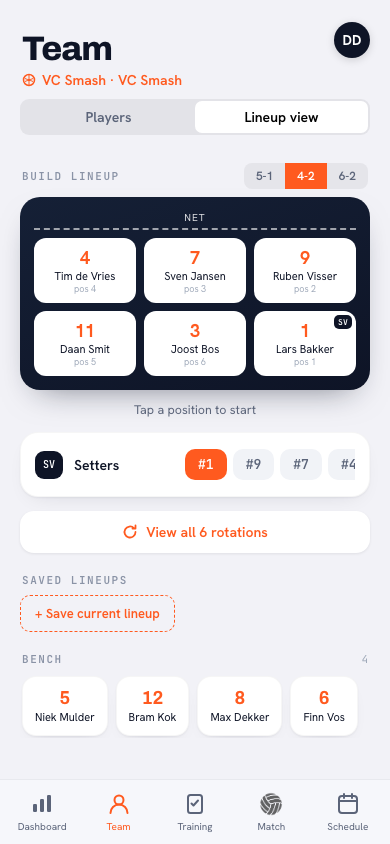
Because you are effectively running two lineups, it pays to store them both: Koach lets you save a lineup per setter, so you can switch between the two halves of your 5-2 without redrawing the court.
The 5-2 next to the other systems
| System | Who sets | Front-row hitters | Demands |
|---|---|---|---|
| 4-2 | The front-row setter | 2 | Very little: no release routes, no timing |
| 5-2 | The front-row setter | 2 | Setters who pull their weight in the back row |
| 6-2 | The back-row setter, on a penetration run | 3 | A solid pass and a fast, reliable release |
| 5-1 | Always the same setter | 2 or 3 | One setter who runs the show for six rotations |
So the difference with the 6-2 is not the number of setters — both systems use two — but which of the two sets. If the back-row setter sets, a third hitter is freed up, but somebody has to sprint from the back corner to the net before the second ball. If the front-row setter sets, that run disappears and you keep two hitters. The 5-2 is therefore the system for teams that do not (yet) need the firepower of a 6-2 but do want to keep the simplicity of a 4-2.
What makes it strong — and what does not
Strong: there are no penetration runs, so no timing problems and no panic on a poor pass. The setter is already at the net and can handle any pass, including the bad ones. Two players share the setting load, which spreads the workload and leaves you less exposed when one of them is ill. And because every rotation looks the same, you only have to teach your hitters two patterns instead of six.
Weak: you only have two front-row hitters in every rotation, and your tallest player spends three rotations setting instead of blocking. Against a team with a real block you feel it: two hitters are easy to read. Setting quality is also bound to fluctuate, because two different pairs of hands are running the offense. So agree on fixed set heights, or your hitters will be re-timing their approach every three rotations.
Which team is this the right choice for?
The 5-2 suits teams with two players who can set reasonably well but where neither is the obvious full-time setter — very common in lower adult divisions and in the older junior age groups. It also suits teams where you want to develop one of those setters: she sets for three rotations, and in the other three she simply learns to pass and defend, which a pure setter in a 4-2 never learns. If you have one clearly better setter, run a 5-1. If you have two setters who can genuinely attack and a stable serve receive, take the next step and run a 6-2.
Do not let your setters swap sides. Set them opposite each other once when you build the team and keep that order all season. Coaches who shuffle starting positions from match to match make their players work out who sets in which rotation all over again every week — and that is exactly the confusion this system was supposed to prevent.
Frequently asked questions
What is the difference between a 5-2 and a 4-2?
Structurally nothing at the net: in both systems the front-row setter sets and you have two front-row hitters. The difference is in the back row, where the 5-2 setter is a full passer, defender and server instead of a half player.
Is a 5-2 a good stepping stone to the 6-2?
Yes. The roles are identical — two setters opposite each other — so all you have to move is the setting job, from the front setter to the back setter. Train the penetration run without a ball first, then switch over one rotation at a time.
May the setter attack in a 5-2?
In the front row hardly at all: she is playing the second ball, so the most she does is dump the second ball when the defense falls asleep. In the back row she may do everything, including attacking from behind the ten-foot line.
How many substitutions does this system cost?
None at all. That is the gain over a 4-2 in which many teams sub their setters out in the back row: in a 5-2 both setters simply stay on the court.