
Topspin serve in volleyball: technique and how to teach it
The short answer
For a topspin serve in volleyball you toss the ball higher and slightly in front of your hitting shoulder, contact the back of it with a full arm swing and snap your wrist so your hand rolls over the top. The ball spins forward and dives into the court after the net. You teach it in steps: wrist snap, wall, net, end line.
A topspin serve in volleyball is the hard serve you hit without a jump: the ball spins forward, travels flat over the net and then drops steeply into the court. This article covers how the technique works, which errors send it into the net or past the end line, and how to teach it in six steps.
What is a topspin serve?
With a topspin serve you put forward rotation on the ball: the top of the ball turns in the direction it is flying. A ball that spins like that drops faster than a ball without rotation. That lets you hit harder and still land the ball inside the lines. The passer sees a ball that comes flat over the net and then dives away, often shorter than expected. Why a spinning ball bends down like that is explained in the physics of volleyball.
This article is about the standing topspin: from a stationary start, behind the end line, without an approach. Add an approach and a jump and it becomes the jump serve, which has its own progression in learning the jump serve. All the serves side by side are in types of volleyball serves. The difference from the float in short:
| Element | Float | Standing topspin |
|---|---|---|
| Toss | Low, straight above the hitting shoulder | Higher, a hand's width in front of the hitting shoulder |
| Contact | Middle of the ball, firm wrist | Back of the ball, hand rolls over the top |
| Follow-through | Short, stops after contact | Full, the arm swings through past the body |
| What the ball does | Floats and moves unpredictably | Spins forward and dives on a steady path |
The float makes life hard for the passer with an unsettled flight, the topspin with speed and a late drop. How to hit a ball with no rotation at all is covered in the float serve.
Topspin serve technique in five parts
The description is for a right-handed player. If you are left-handed, swap left and right.
1. Stance
Left foot forward, right foot half a step behind, feet about hip-width apart. Your weight is on the back leg and your hitting shoulder is turned slightly back. Many players take a small step forward with the left foot during the toss to bring their body weight into the hit. Keep that step short: at the moment of the hit you may not touch the end line, and after the hit you may step into the court (rule 12.4.3 of the Official Volleyball Rules 2025-2028).
2. The toss: higher and in front of your hitting shoulder
Toss the ball with a straight arm, about 50 to 80 centimeters above your hand, a hand's width in front of your hitting shoulder and slightly toward the court. That way you contact it in front of your body with a straight arm. A little forward spin on the toss is fine but not needed: the rotation comes from the hit. A higher toss also goes wrong more often, and in a match you only get one (rule 12.4.2): if you let a bad toss drop, that is a service fault. Heights for each type of serve and a test for your own toss are in the toss on the serve.
3. Arm swing: like a spike
As the ball goes up, draw your hitting arm back and up: elbow high, at least at shoulder height, hand by your ear, chest open to the net. Then your hips and trunk rotate in and the arm follows like a whip: first the shoulder, then the elbow, then the hand. It is the same movement as an attack, only with your feet on the floor.
4. Contact: from behind to over the top of the ball
Contact the ball at the highest point you reach with a straight arm, slightly in front of your hitting shoulder. The heel of your hand meets the back of the ball, just below the middle. In the same motion your wrist snaps forward and your fingers roll over the top of the ball. That wrist snap creates the spin: contact starts behind the ball and finishes on top of it. Keep your hand open, with relaxed, slightly spread fingers that wrap over the ball.
5. Follow-through
Let the arm swing through completely, down past your body, and let your back leg come forward with it. If you brake the arm after contact, as you would on a float, you take the rotation back out.
You can recognize a good topspin by the ball itself: the logo visibly turns forward, and in the second half of the flight the ball drops clearly faster than in the first.
Common topspin serve mistakes
- The ball goes long. There is too little spin on it, usually because the wrist stays still or because you hit too far below the middle of the ball. The ball then does not dive and flies past the end line. Toss slightly further forward and really let your hand roll over the ball.
- The ball goes into the net. The toss is too low or too far forward, you contact the ball too late and too low, or your wrist snaps too early and your hand goes over the top of the ball. Hitting too hard for your level also puts it in the net.
- Toss behind your head. You have to lean back to reach the ball, you come in under the middle and the ball goes up into the air.
- Low elbow. The hand comes from the side instead of from behind and above. The ball gets sidespin and drifts off to one side.
- All arm. Without trunk rotation and weight transfer the shoulder does all the work. That costs speed, and after a few sets of reps the shoulder feels it.
- Braked follow-through. The arm stops just after contact, out of float habit. The spin disappears and the ball becomes a half float that is hit too hard.
How to teach the topspin serve: a six-step progression
Only start on the topspin once a player gets their regular overhand serve in reliably, for example eight out of ten from the end line. Then work in this order, and only move on when the previous step works:
- Wrist snap only. Hold the ball in your hitting hand above and slightly in front of your hitting shoulder, elbow high. Snap it with just your wrist down at an angle into the floor, so it bounces up with forward spin to a partner three meters away. Ten times, and check that the ball really spins forward.
- Throwing with topspin. Throw the ball overhand with one hand to a partner six meters away, elbow high and the wrist snapping over the ball. That gives you the feel of the arm path without having to make contact.
- Against the wall. Three to five meters from a wall, with toss, hit and full follow-through, above a line at net height. The drill Serving technique against the wall gives this a fixed format, with a step back after five hits on target.
- Over the net from the attack line. Half speed, all attention on the spin and the follow-through. When eight out of ten work, move two meters back.
- From the end line. Only now may the speed go up. If fewer than half go in, take a step forward again.
- At targets and under pressure. Put mats deep in the corners and short, between the net and the attack line, and count per set of serves. Because the topspin dives, you can also serve it short without it becoming slow. A fixed format for this is Zone serving at targets. After that, play series with a consequence, such as three in a row in or start again.
Put the topspin at the start of practice, while players are still fresh, and keep it to ten to fifteen focused serves per player. On tired shoulders you mostly groove errors. Think in weeks, not one practice: the wrist snap has to be automatic before speed can be added.
Film the contact. Put a phone in slow motion next to the server, at shoulder height. The footage shows you straight away whether the hand rolls over the ball or stops against it, and whether the ball spins forward after the hit. One clip tells a player more than hearing ten times that their wrist stays still.
When do you choose the standing topspin?
- For a player with a strong arm swing whose float does not float. Someone who naturally hits through the ball gets a serve with the topspin that fits their movement.
- Against passers who read floats well. A fast ball that dives late takes them out of their rhythm.
- As a step toward the jump serve. The contact and the wrist snap are the same. Once you master them standing, the jump serve only adds the approach and the timing.
- In a gym with little room behind the end line, where an approach for a jump serve does not fit.
The downside is the error risk: a topspin that is just a bit too hard ends up in the net or past the line. That is why many players keep a float or a regular overhand serve in reserve for the tight points. Whether the topspin earns a player anything on balance, you only see once you count it.
Measuring whether your topspin serve puts on pressure
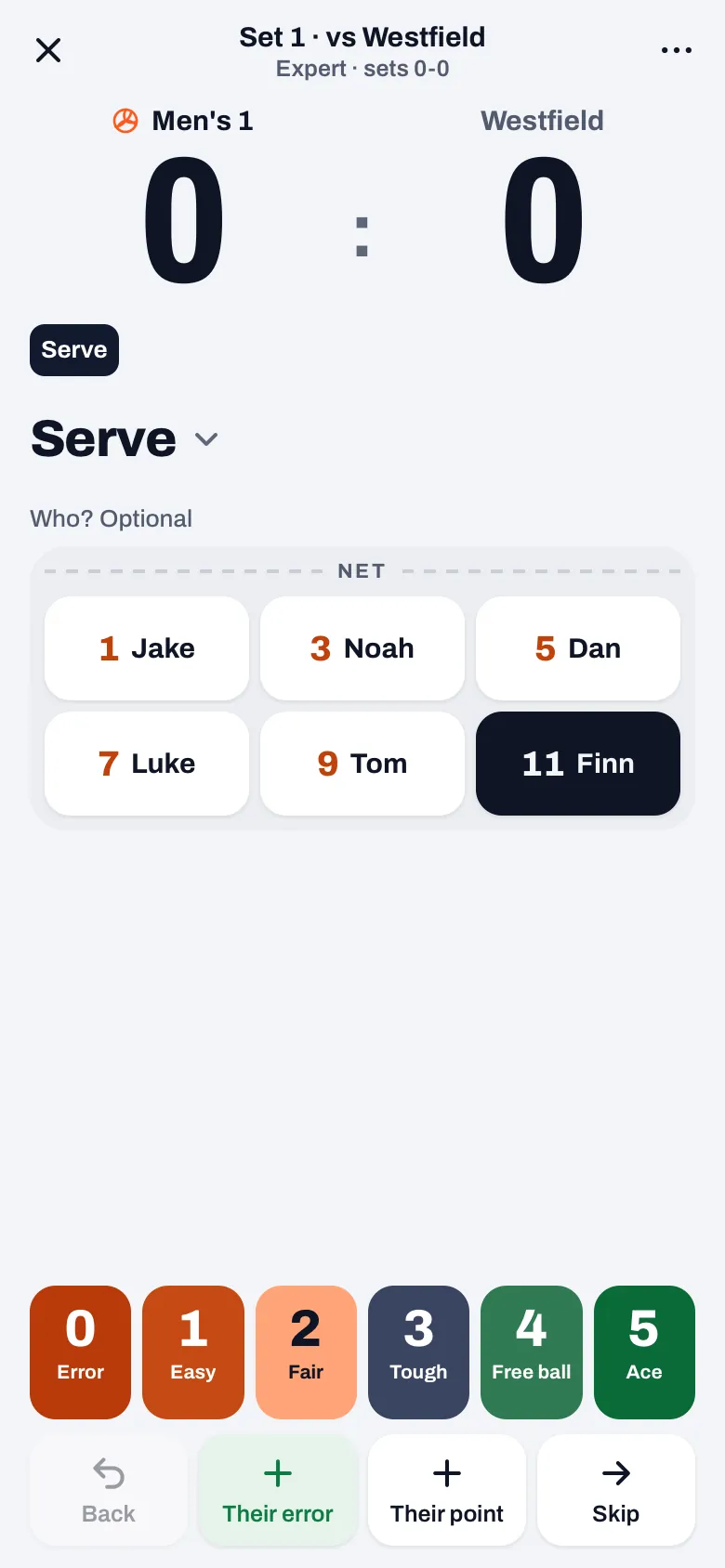
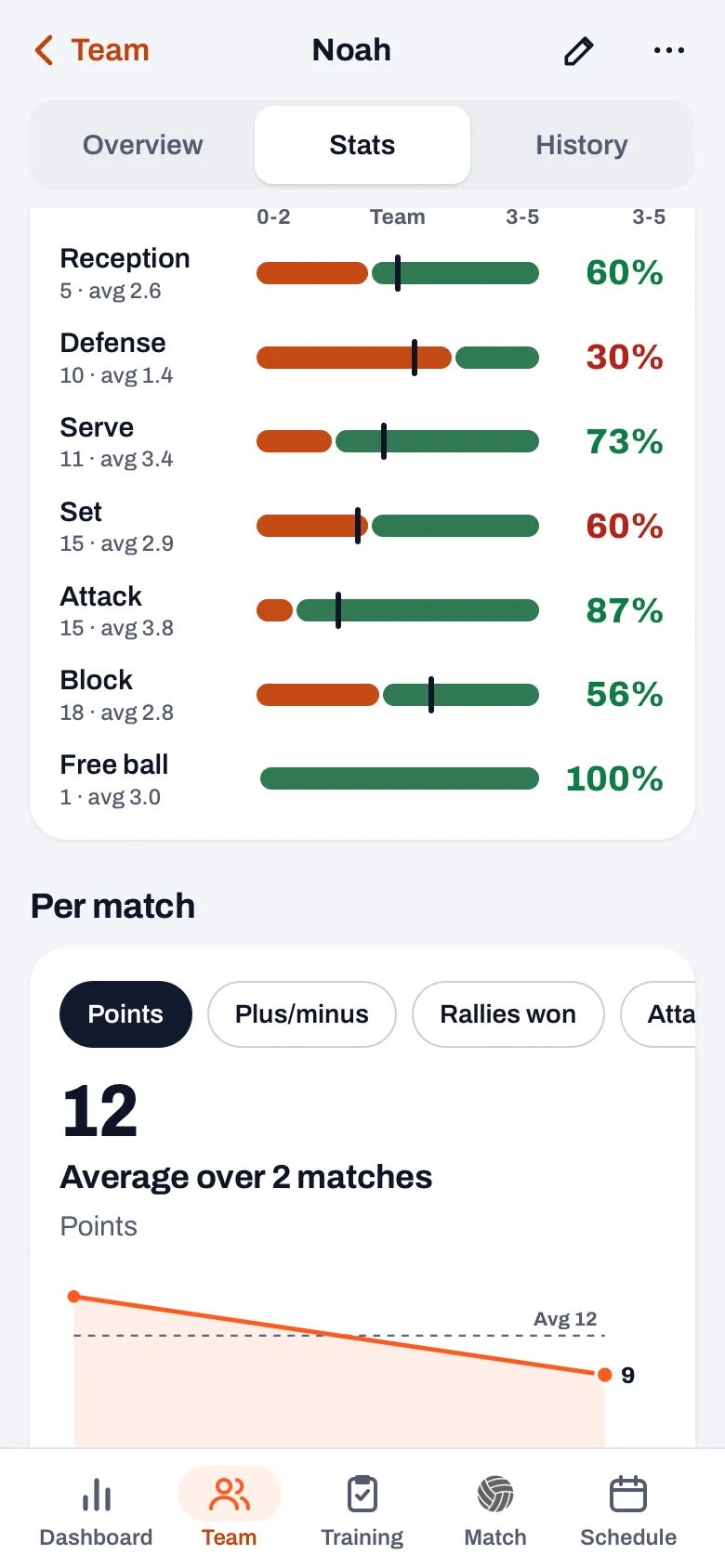
In Koach you rate every serve in Expert mode, with the server already selected: 0 Error, 1 Easy, 2 Fair, 3 Tough, 4 Free ball or 5 Ace. In the player profile, under Stats, you see per skill what share of the ratings was good (3 to 5), next to the team. If a player hits the topspin for a month, you see whether that share goes up. Every service error counts as a 0, so a topspin that often goes into the net pushes the share down by itself. Both drills above are in the app too: with + Add drill you put them in your practice plan. What Koach costs after the trial is on the pricing page.
14 days free, no credit card. Rate every serve in your next match and see whether the topspin puts on more pressure than the float.
Try Koach in your next matchHow the serve fits in with the other fundamentals, and in what order you teach them, is in learning volleyball technique.
Frequently asked questions
How do you get more topspin on your serve?
Let your hand roll over the ball instead of stopping against it: start the contact at the back, just below the middle, and finish with a wrist snap over the top of the ball. Toss the ball a hand's width in front of your hitting shoulder so you contact it with a straight arm, and let the arm swing through completely. Practice the wrist snap on its own, for example by snapping the ball into the floor with just your wrist.
Why does my topspin serve keep going out?
Usually there is too little spin on the ball. Your wrist stays still or you contact the ball too far below the middle, so it rises and does not dive. Toss the ball slightly further in front of your hitting shoulder, contact it with a straight arm and let your hand roll over the top. Hit at half speed for the first few weeks until the spin is there every time.
Do you have to jump for a topspin serve?
No. You can hit the topspin serve standing, with your feet behind the end line. With an approach and a jump you contact the ball higher and harder, and then it is called a jump serve. The standing topspin is a good intermediate step: the contact and the wrist snap are the same, and only the approach and the timing come later.
When can you learn a topspin serve?
Once a player gets their regular overhand serve in reliably, for example eight out of ten from the end line, and has an arm swing like an attack. Age says less than strength and technique. Start with the wrist snap on its own and against the wall, and only go over the net when the ball spins forward there every time.

See what your topspin serve earns you
14 days free, no credit card. After three matches you know whether it puts on pressure.
Get started with KoachOr read first what the volleyball coaching app does.