
Physics of volleyball: trajectory, spin, float and jump explained
The short answer
The physics of volleyball comes down mainly to four things: gravity pulls the ball down in an arc, topspin pushes it down further through the Magnus effect, air resistance slows it and makes a ball without spin float, and your take-off speed decides how high and how long you jump.
The physics of volleyball is in every rally: in the arc of a set, in the dive of a topspin serve, in the erratic path of a float and in your hitter's jump. This article explains how it works, with worked examples you can check yourself and without formulas you don't need.
What physics is there in volleyball?
As soon as the ball leaves your hand, three forces decide its path: gravity, which pulls it down, air resistance, which slows it, and with a spinning ball an extra force from the rotation, the Magnus effect. On top of that there is the physics of the jump, and that of the ball itself, which responds to pressure and temperature.
A volleyball is light for its size: 260 to 280 grams with a circumference of 65 to 67 centimeters (rule 3.1 of the Official Volleyball Rules 2025-2028). That gives the air more influence on it than on a heavier ball of the same size. You notice it with a float, and outdoors with every ball that drifts with the wind.
Gravity: why every ball travels in an arc
Gravity makes the ball fall 9.81 meters per second faster every second. A ball you let go of therefore drops 1.2 meters in the first half second (one half times 9.81 times 0.5 squared). That is why no ball flies straight: every set, pass and serve is an arc.
Worked example: how long does a high set hang? A ball that rises 3 meters above your setter's hands takes 0.78 seconds to go up and just as long to fall back to that height (the square root of 2 times 3 divided by 9.81). Together that is just over one and a half seconds. A set that rises only 1 meter is back at the same height in 0.9 seconds. That difference of just over half a second is the extra time the opposing block and defense get on a high ball.
Worked example: why a hard serve needs the air. Say a server contacts the ball after a jump at 3.0 meters, one meter behind the end line. The net is then 10 meters away (half a court is 9 meters long, rule 1.1) and 2.43 meters high for men (rule 2.1.1), and the end line on the far side is at 19 meters. We calculate without air and without spin, using the center of the ball.
- If they hit the ball exactly horizontally, it may drop only 0.57 meters before the net. For that it has to travel at least 29 meters per second, just over 105 km/h.
- But a ball falling from 3 meters is on the floor after 0.78 seconds. To stay inside the 19 meters, it may travel at most 24 meters per second (19 divided by 0.78).
- So both at once is impossible. If you also work through all the angles, angled up and down, the limit is about 21 meters per second, 75 km/h. Any harder and the ball goes into the net or past the end line.
Yet radar measurements of men's jump serves with topspin at the 2006 World League showed 73 to 104 km/h (Palao and Valadés, The Sport Journal, 2014; more figures in volleyball serve speed). That is possible because the air plays a part: air resistance slows the ball down, and topspin pushes it downward.
Topspin and the Magnus effect: why a spinning ball dives
A spinning ball drags a thin layer of air along at its surface. With topspin, the top of the ball turns against the airflow and the bottom turns with it. As a result the air behind the ball is deflected upward, and because the ball pushes that air up, the air pushes the ball down. That extra downward force is called the Magnus effect. The faster the ball flies and the harder it spins, the bigger the force.
In the game you see it in three places. A topspin serve can go harder than the calculation above allows and still land in, and it visibly drops faster in the last part of its flight; a spike with topspin dives more steeply. A ball with sidespin bends sideways, which is why a serve with an off-center contact keeps drifting to the same side. And a ball with backspin hangs a little longer. How to put that forward rotation into your own serve is in the topspin serve.
Air resistance: slowing down and floating
The faster the ball goes, the harder the air slows it down. So a serve is slower at the passer than just after the hit. With a ball that has no spin, something else happens too: the float starts to float.
Around a flying ball the air flows past the surface in a thin layer, the boundary layer. At low speed that flow is smooth and separates from the ball early, with a lot of drag. Above a certain speed the boundary layer becomes turbulent, clings to the ball longer and the drag suddenly drops. That transition is called the drag crisis. On a ball that is not spinning, the flow does not switch everywhere at the same time: the seams and panels of the ball decide where it happens first. That creates sideways forces that change direction during the flight, and the ball swerves or drops.
In wind tunnel measurements by Hong and colleagues (ISBS, 2018), that transition for two of the four balls tested came at a Reynolds number of about 200,000 to 330,000, depending on the brand and on how the panels faced the wind. Converted with a diameter of 0.21 meters and the viscosity of air at room temperature (0.000015 m²/s), that corresponds to a speed of about 14 to 24 meters per second, 50 to 85 km/h (the speed is the Reynolds number times the viscosity, divided by the diameter). In the radar measurements by Palao and Valadés (2014), men's jump floats traveled 40 to 75 km/h and standing serves 42 to 55 km/h: partly inside and partly below that range. Using a hitting robot, Hong and colleagues also found that a float landed in a different spot for each type of ball and each panel orientation. The technique that keeps the ball still is in the float serve.
The jump: take-off, height and hang time
How high you jump is fixed the moment your feet leave the floor: it depends only on your upward speed. For 60 centimeters you need 3.43 meters per second (the square root of 2 times 9.81 times 0.6). You are then in the air for 0.70 seconds. After take-off nothing you do changes how high your center of mass gets; with your arms and legs you only shift how your body hangs around that point.
Worked example: the force of the take-off. Say you weigh 75 kilos and your take-off lasts 0.25 seconds, an assumption for this example. To reach 3.43 meters per second upward in that time, you have to push into the floor with an average of 75 times 3.43 divided by 0.25, about 1,030 newtons, extra, on top of your own weight of about 740 newtons. Together that is around 2.4 times your body weight. An approach and an arm swing help you build up more upward speed at take-off; what that gives you in reach is in how high volleyball players jump.
Why a hitter seems to hang. At the top of your jump you move slowly. Of those 0.70 seconds you spend half, 0.35 seconds, in the top quarter of your jump, the last 15 centimeters. That is true for every jump: half of your time in the air is spent in the top quarter. That is why a hitter at the top can still look where the block is, and why it pays to contact the ball there.
On landing the same speed comes back. If you give at the knees and hips, you absorb that speed over a longer time, and then the force on your body is smaller than when you land with straight legs.
Check it yourself with your team. Film a jump from the side with a phone in slow motion and count the frames between take-off and landing. At 240 frames per second, 168 frames are 0.70 seconds, which goes with a jump of 60 centimeters: the height is 9.81 times the time squared divided by 8. That turns physics into a jump test.
Pressure and temperature: why a cold ball is softer
The air in a ball pushes harder the warmer it is. The pressure in the rules, 0.30 to 0.325 kg/cm², is the gauge pressure: how much the ball is above the surrounding air pressure, and that is less than a quarter of the total pressure in the ball. If a ball cools from 20 to 5 degrees Celsius, that total pressure drops by about one twentieth (278 divided by 293 kelvin). But that whole drop comes off the gauge pressure, and because that is only a small part of the total, the ball loses more than a fifth of its gauge pressure. That is how a ball that was fine in the gym drops below the minimum after a night in a cold car. When it warms up again, the pressure comes back. The worked example and how to measure and pump up a ball are in volleyball air pressure.
From physics to your practice
Three things follow directly from all this, even without formulas: a hard serve needs topspin to land in, a float only floats if the ball does not spin, and a hitter contacts the ball at the top of their jump. How those techniques work, and in what order you learn them, is in learning volleyball technique.
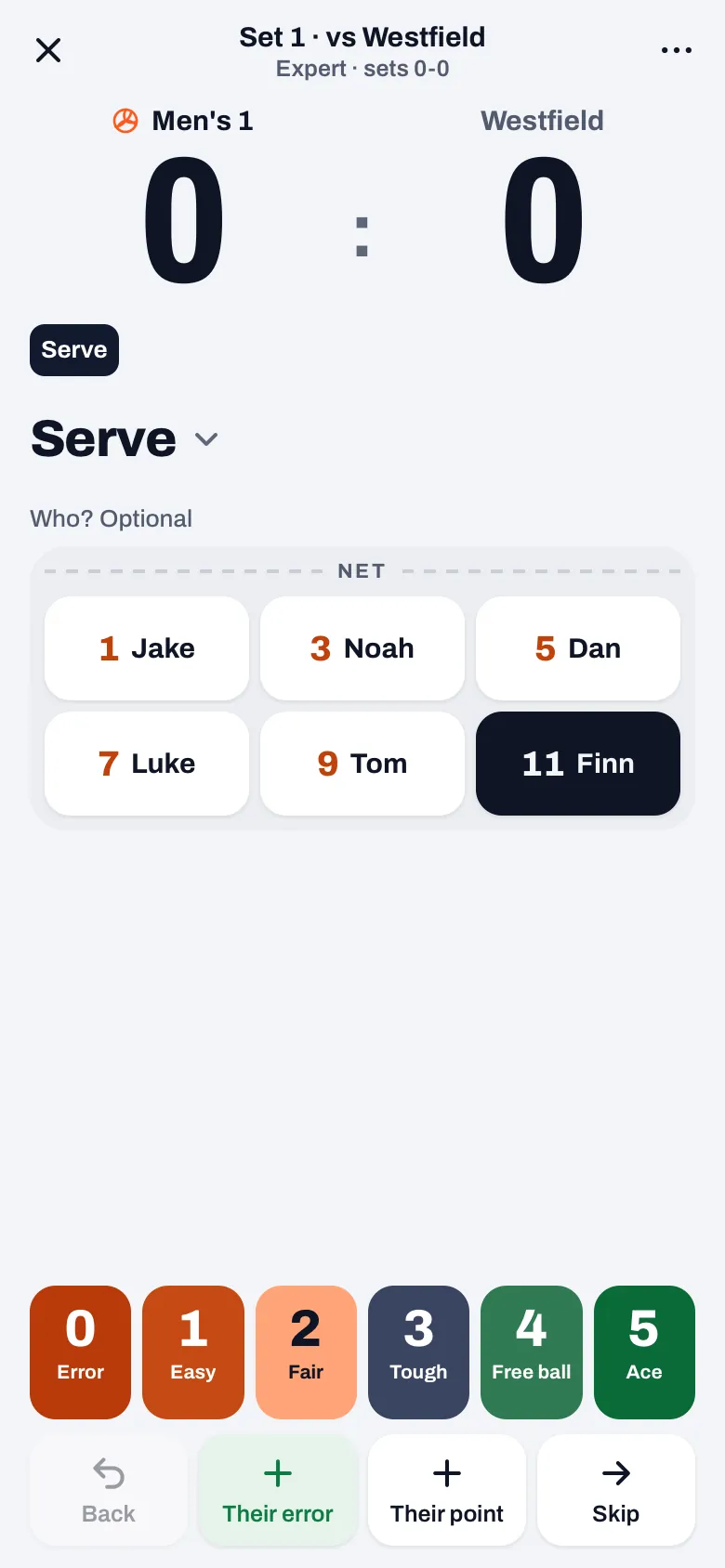
Koach does not measure speed, spin or jump height. What the app does show is what a serve earns you. In Expert mode you rate every serve, from 0 Error through Easy, Fair, Tough and Free ball to 5 Ace, with the server already selected. Which type of serve it was, the app does not record; so have a player hit their topspin for a few matches and then their float, and their ratings show which one gives the passer more trouble. What Koach costs after the trial is on the pricing page.
14 days free, no credit card. Rate every serve in your next match and see which flight gives your opponent trouble.
Try Koach with your teamFrequently asked questions
What is the Magnus effect in volleyball?
The Magnus effect is the force a spinning ball gets from the air. With topspin the air behind the ball is deflected upward and the ball is pushed down, so it drops faster than a ball without spin. That is why a topspin serve can be hit hard and still land inside the lines. A ball with sidespin bends sideways, and a ball with backspin hangs longer.
How can a serve over 100 km/h land in?
Not through gravity alone. If you calculate without air and spin, with a ball contacted at 3 meters one meter behind the end line, the limit is around 75 km/h: any harder and it goes into the net or past the end line. A real serve lands in at higher speeds because air resistance slows it on the way and topspin pushes it down further.
How long does a volleyball player hang in the air?
That depends on how high they jump. With a jump of 60 centimeters they are in the air for about 0.70 seconds, with 40 centimeters about 0.57 seconds. Half of that time is spent in the top quarter of the jump, because that is where they move slowly. That is why a hitter seems to hang for a moment.
Why is a volleyball softer when it is cold?
Cooled air pushes less hard. If the temperature drops from 20 to 5 degrees Celsius, the total pressure in the ball falls by about one twentieth. Because the gauge pressure is only a small part of that total, the ball loses more than a fifth of its gauge pressure, and then it feels clearly softer. When the ball warms up again, the pressure comes back.



See which serve gives the passer trouble
14 days free, no credit card. After three matches you know which serve earns points.
Get started with KoachOr read first what the volleyball coaching app does.