
Volleyball serve speed: averages and how to measure it
The short answer
Volleyball serve speed depends mainly on the type of serve. In radar measurements during matches (Palao and Valadés, 2014), a float by top men went 40 to 75 km/h and a jump serve 73 to 104 km/h; by top women the jump serve reached 66 to 89 km/h. You can measure it yourself with a radar or slow-motion video.
Volleyball serve speed is a number players often ask about. Here are the measured speeds for each type of serve in men, women and youth players, with the source, the fastest serve ever measured in the Nations League, how to measure it yourself and why fast is not the same as good.
How fast is a volleyball serve?
A large set of match measurements comes from Palao and Valadés (The Sport Journal, 2014). They used a radar to measure more than four thousand serves in real matches: just over two thousand by men in the 2006 World League and just over two thousand by women in the Spanish cup competition for top teams. These are the speeds as the researchers state them in their conclusions:
| Type of serve | Men, World League | Women, Spanish top teams |
|---|---|---|
| Standing float | 42 to 55 km/h | 43 to 61 km/h |
| Jump float | 40 to 75 km/h | 40 to 61 km/h |
| Jump serve with topspin | 73 to 104 km/h | 66 to 89 km/h |
If you think in miles per hour, divide by 1.6: a jump serve of 100 km/h is about 62 mph.
Two things stand out. A float is about as fast for men as for women: the danger lies in the unsteady flight, not in the power. And the jump serve is the only type that is really faster: for the women, even the slowest jump serve measured is above the fastest float. The mix differed too: in the same study just over half of the men's serves were jump serves, against about one in six for the women. What each type of serve is and how it works is covered in types of volleyball serves.
The fastest serve in the Nations League
In the 2021 Volleyball Nations League, Poland's Wilfredo León hit a serve of 135.6 km/h. According to Volleyball World it was the fastest serve measured in that competition up to then; the previous record, 134 km/h, had belonged to Italy's Ivan Zaytsev since 2018. Speeds like that are outliers from a handful of players in the world. Higher numbers also circulate online; only take a speed at face value if there is an official measurement behind it.
How fast do youth players serve?
There are fewer measurements for youth players. A study by Zahálka and colleagues (Studia Sportiva, 2011) measured 169 boys with an average age of 16 with a radar, three serves per player in a test. Those who hadn't mastered the jump serve yet served from a standing position. On average the ball went 79.4 km/h; the slowest serve reached 56.3 km/h, the fastest 105.9 km/h. A difference of almost 50 km/h within one age group: at that age, technique still varies widely.
For younger children and recreational players, hardly any reliable measurements have been published. Numbers you see online for those groups usually have no source. If you want to know where your players stand, measure it yourself and above all compare a player with themselves.
Is a faster serve also a better serve?
Not automatically. Moras and colleagues (2008) used a radar to measure 377 serves at the 2004 men's Olympic qualification tournament. The jump serve averaged 23 meters per second (about 83 km/h), the float with and without a jump about 12 meters per second. Yet they found no meaningful relationship between the speed of a serve and what it produced. The jump serve and the jump float did have a better ratio of good to poor outcomes than the standing float.
Speed takes time away from the passer. Palao and Valadés calculated how long a passer has: against a men's jump serve about half to three quarters of a second, against a standing float about 1 to 1.3 seconds. But a fast serve that goes into the net or out costs a point. So you judge whether a serve works by its effect: aces, pressure on the pass and errors. How to track that is covered in serving statistics: measuring aces and serve pressure.
Measuring your own serve speed
- With a radar. A handheld radar like the ones used for baseball or tennis measures the speed in the direction of the device. So stand directly behind the server, in line with the ball. If you stand at an angle, it reads too low: at an angle of 30 degrees by more than an eighth.
- With slow-motion video. Set a phone to 240 frames per second at the side, level with the net and far enough away to have both the server and the net in the picture. Count the frames between contact and the moment the ball passes the net. Say the server hits the ball 1 meter behind the end line: that is 10 meters to the net. If your video counts 120 frames, the ball took 0.5 seconds. 10 divided by 0.5 is 20 meters per second, times 3.6 is 72 km/h.
- With an app. There are apps that estimate speed from video or sound. Check such an app once against the video method before you trust its numbers.
The video method gives the average speed over that distance; a radar measures the peak speed just after contact, and the ball slows down on the way. So only compare measurements made with the same method. If you film at 30 frames per second, one frame makes a difference of about 5 km/h in this example; at 240 frames per second less than 1 km/h. Measure five to ten serves per player, write down the average and the fastest, and also write down how many went in.
Never measure speed without a target. Have a player hit ten jump serves at a zone and note for each ball the speed and whether it landed in. If the speed goes up a month later while the number of balls in stays the same, the player has really improved. If fewer balls go in, all you've bought is risk.
Where the speed comes from
In the jump serve, speed comes from the chain of toss, approach, jump and arm swing, not from the arm alone. In the youth study above, speed was related to how high a player jumped after an approach, and the researchers put the large difference between players mainly down to how well they had mastered the technique. A toss that goes too far back or too close to the body costs speed, however strong the player is. So work first on a consistent toss and a contact point high and in front of the hitting shoulder; the progression is in learning the jump serve. With a float, speed is not the goal: what counts there is a firm contact surface without spin.
Measure speed in practice, the effect in the match
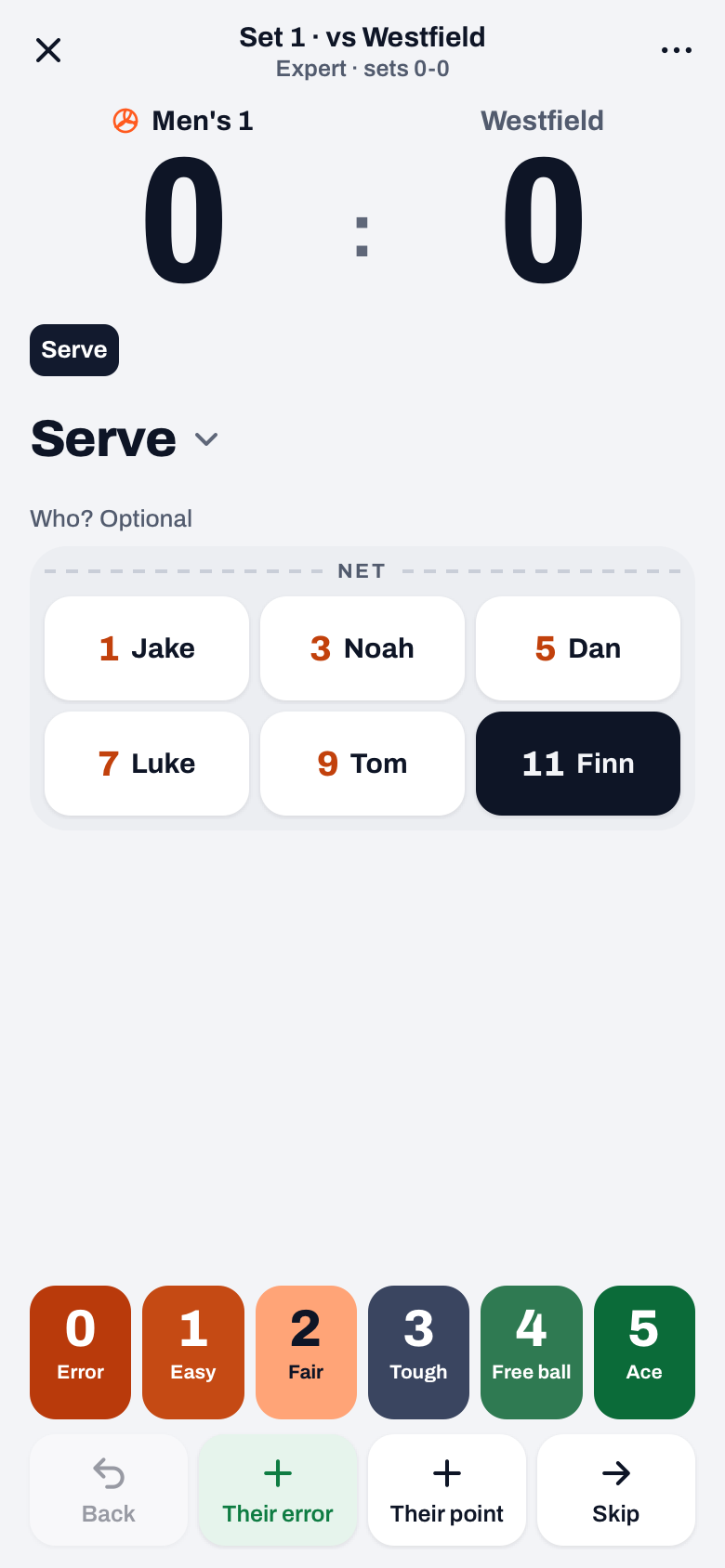
Koach does not measure speed. What the app does do is track what a serve produces. In Expert mode you give every serve a rating: 0 Error, 1 Easy, 2 Fair, 3 Tough, 4 Free ball or 5 Ace, with the server already selected. In Simple mode you count aces and serve errors per player. Which other numbers exist and how to read them is covered in understanding volleyball statistics.
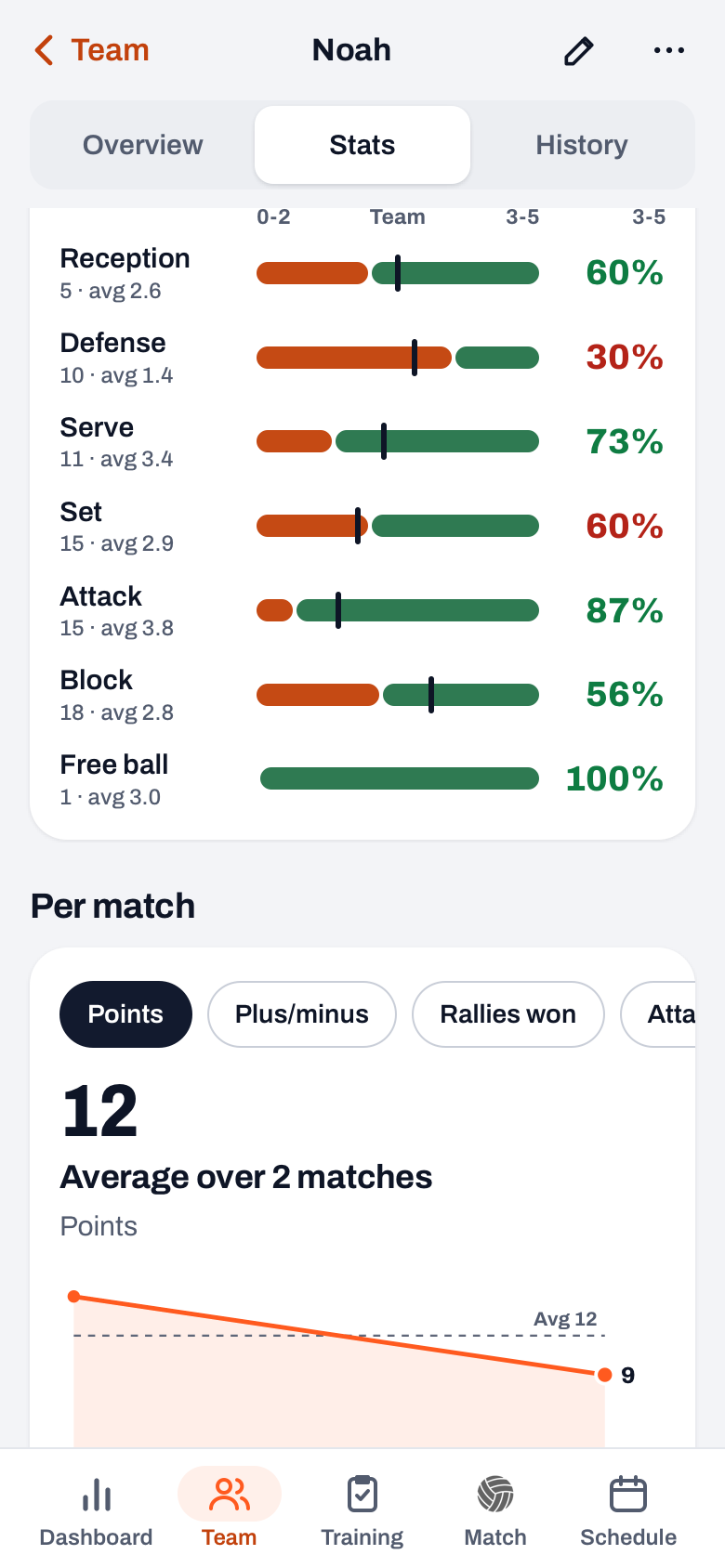
In the player profile you see, for each skill, what share of the ratings was good, next to the team average. Put the radar or video measurements from practice next to those numbers and you see whether a faster serve also creates more pressure. What Koach costs after the 14 free days is on the pricing page.
14 days free, no credit card. Rate every serve in your next match and see who really puts pressure on the pass.
Measure your serves in KoachFrequently asked questions
What is the average speed of a volleyball serve?
That depends on the type of serve and the level. In radar measurements during matches (Palao and Valadés, 2014), a standing float by top men went 42 to 55 km/h and a jump serve 73 to 104 km/h; for top women the jump serve was 66 to 89 km/h. For 16-year-old boys, a radar test (Zahálka and colleagues, 2011) came out at an average of about 79 km/h.
What is the fastest volleyball serve ever?
Speeds are measured per competition, with their own equipment, so numbers from different competitions are hard to compare. The best-known number comes from the Volleyball Nations League: in 2021 Wilfredo León hit 135.6 km/h there, according to Volleyball World the VNL record. The previous record, 134 km/h by Ivan Zaytsev, dated from 2018. Only trust higher numbers if an official measurement comes with them.
How do you measure serve speed without a radar?
Film the serve from the side in slow motion, for example at 240 frames per second, and count the frames between contact and the net. Divide the distance in meters by the time in seconds and multiply by 3.6 for km/h. That gives you the average speed over that distance, a bit lower than a radar shows.
Is a fast serve better than a float?
Not automatically. At the 2004 Olympic qualification tournament, Moras and colleagues (2008) found no meaningful relationship between the speed of a serve and what it produced. A float is dangerous because of its unsteady flight, a jump serve because of its speed; which works better depends on the player and on how many balls go in.



See which serve really creates pressure
14 days free, no credit card. After three matches you know who should hit which serve.
Get started with KoachOr read first what the volleyball coaching app does.