
Volleyball block and defense: playing in the shadow of the block
The short answer
In volleyball, block and defense meet in the block shadow: the part of the court behind your block where a hard attack cannot land, because the blockers' hands are in the way. Your defenders stand at the edge of that shadow, where they see the ball come past the block, and one player takes the tip that falls inside it.
Volleyball block and defense meet in the shadow of the block: whatever the block covers, nobody in the back court has to dig hard. This article shows how big that shadow is, what changes with a line or cross-court block, what to do when there is a hole in the block and how to train it.
What is the block shadow?
Look from the attacker's ball toward your own court. Your blockers' hands sit between the ball and part of the floor, like a post between a lamp and the ground. Behind the block that creates a strip where a hard, straight attack cannot go: the ball would have to pass through the hands first. That is the block shadow. It fans out toward the back, because the further from the net, the wider the area the block covers.
The shadow only applies to the hard ball. A tip, a roll shot or a ball lobbed over the block often lands right inside the shadow, just behind the hands. So the shadow is not an empty spot but a spot with a different job: inside it you defend the soft ball, along its edges the hard one.
A useful rule of thumb: if you can't see the ball, you're in the shadow. A defender who cannot see the attacker's hitting arm past the block just before the attack is standing where the hard ball will not come. One step to the side, until they see the ball again, and they are at the edge of the shadow, where the hard balls do come. Defensive systems build on this; how perimeter and rotation defense split up the six spots is explained in defensive systems in volleyball.
How big is the shadow behind the block?
Three things decide how far the shadow reaches into the court:
- How high the attacker gets above the block. If they contact the ball well above the hands, they can hit steeply down and the shadow is short. If the block reaches almost as high as their contact point, the shadow is long.
- How far the ball is from the net. A ball hit far from the net has to travel over the block on a flatter line, so it lands deeper. The shadow gets longer.
- Where the block stands relative to the hitting arm. A block straight in front of the hitting arm covers the middle. A block that closes the line or the cross-court puts the shadow on that side.
A worked example makes it concrete. Say an attacker contacts the ball at 3.20 meters, half a meter from the net, and your blockers' hands reach 2.90 meters at the net line. Draw a straight line from the ball over the hands to the floor and it lands 4.8 meters behind the net (2.90 times 0.5 divided by 3.20 minus 2.90). Everything in front of that, across the width of the block, is in the shadow. If the hands only reach 2.60 meters, it is 2.2 meters.
A real ball does not fly straight: gravity, and with topspin also the Magnus effect, bends it down, so the real shadow is shorter. Say the ball leaves the hand at 25 meters per second (90 km/h). With gravity alone it then lands at around 4.4 instead of 4.8 meters (our own calculation, without air and spin): not much of a difference. With a set far from the net it matters a lot. If the set comes one meter off the net, the straight line gives 9.7 meters, past the end line, but the same ball lands at around 7.7 meters. The shadow still covers most of your half of the court across the width of the block; whatever comes in hard over the top of the block lands deep.
What you do with this: after a tight set to an attacker who gets above your block, your defenders stand closer to the block. After a set far off the net they drop deeper, and the hard ball comes mainly along the edges of the block.
Line block or cross-court block: which part of the court does the block cover?
Take the attack from their outside hitter, on their left side. They are opposite your position 2, so your blocker at 2 sets the block and your middle closes. A line shot goes down your right sideline to zone 1, a cross-court shot to zone 5, and a sharp cross-court shot to zone 4, around the attack line.
| Agreement | What the shadow covers | Where the hard ball can go |
|---|---|---|
| Line block | The line, deep into zone 1 | Cross-court to zone 5, sharp cross-court, over the block |
| Cross-court block | The cross-court to zones 5 and 6 | Line to zone 1, sharp cross-court inside the block |
| Block on the ball | A strip straight behind the block | Past both sides: line and cross-court |
With a line block the defender at 5 plays deep cross-court, at the edge of the shadow: they see the hitting arm next to your middle's inside hand. The middle back stays deep, for the ball over the block and through the seam. The off-blocker at 4 drops off the net for the sharp cross-court. The player at 1 is in the shadow and gets no hard ball. They take the tip behind the block or the ball that goes over the block down the line; which of the two depends on your defensive system.
With a cross-court block it flips. Now the player at 1 plays deep on the line, because that is where the hard ball comes. The middle back shifts toward the line side. The player at 5 is mostly in the shadow and comes forward for the tip and the short ball, and the off-blocker covers the sharp short cross-court. What exactly the off-blocker does is in the off-blocker.
Which agreement you choose depends on the attacker: block the shot they like best and let your defense dig the other one. How to make that plan for each attacker is in organizing the block against a strong attacker. The block does have to do what was agreed. A blocker who is supposed to take the line but drifts toward the ball moves the shadow, and then five defenders are in the wrong spot.
What happens when there is a hole in the block?
- A seam between the blockers. If your middle is late or two blockers jump too far apart, the shadow splits in two. A hard ball through the seam goes to the middle back, exactly where everyone thought it was covered. Agree that the middle back slides to the line of the seam as soon as they see light between the hands. How the block keeps that seam closed is in the double block.
- A late or low block. Then there is hardly any shadow. Defend as if there were no block: everyone reads the attacker themselves. What to watch for then is in reading the hitter.
- Hands that don't get over the net. A block that only reaches up and not over the net often touches the ball but sends it up and back. The deep defenders then have to expect a ball that comes off the hands toward them. Reaching over the net is allowed, as long as the block does not interfere with the opponent's play and only touches the ball on their side once they have executed their attack hit (rule 14.3 of the Official Volleyball Rules 2025-2028).
- A ball off the hands and out. If the attacker deliberately hits the outside hand, the ball flies off sideways out of the court. The shadow plays no role; the off-blocker and the defender on the line chase the ball.
See the ball, or slide. Have your defenders answer one question just before every attack: can I see the attacker's hitting arm past the block? No means: I'm in the shadow, so I watch for the tip, or I take one step to the edge. With that one question they get into position faster than with a drawing on the whiteboard.
How to train block and defense together
- Make the shadow visible. A coach hits from a box on the other side, two blockers hold their hands above the net in the agreed position. The defenders pick their spot and check that they can see the ball in the coach's hand. Then hit ten hard balls and put a cone wherever each ball lands. The empty strip behind the block is the shadow.
- Changing agreement. Before the set the blocker calls line or cross-court, the defense shifts and the coach hits into the open zone. A dig that goes high to the middle is a point.
- Practicing the hole. Now and then have the middle close deliberately late. The middle back has to see the seam and slide over, without anyone calling it.
- In a scrimmage. Six against six, where a dug ball after a block touch counts double. That way you reward the teamwork, not just the block point.
Two set drills from the drill library connect to this: Block against hitting lines 4-3-2, where a blocker has to choose which attacker to take, and Defending behind the block, where the court defense reads the angle behind the block and plays the dig out to a counterattack.
Tracking block and defense in a match
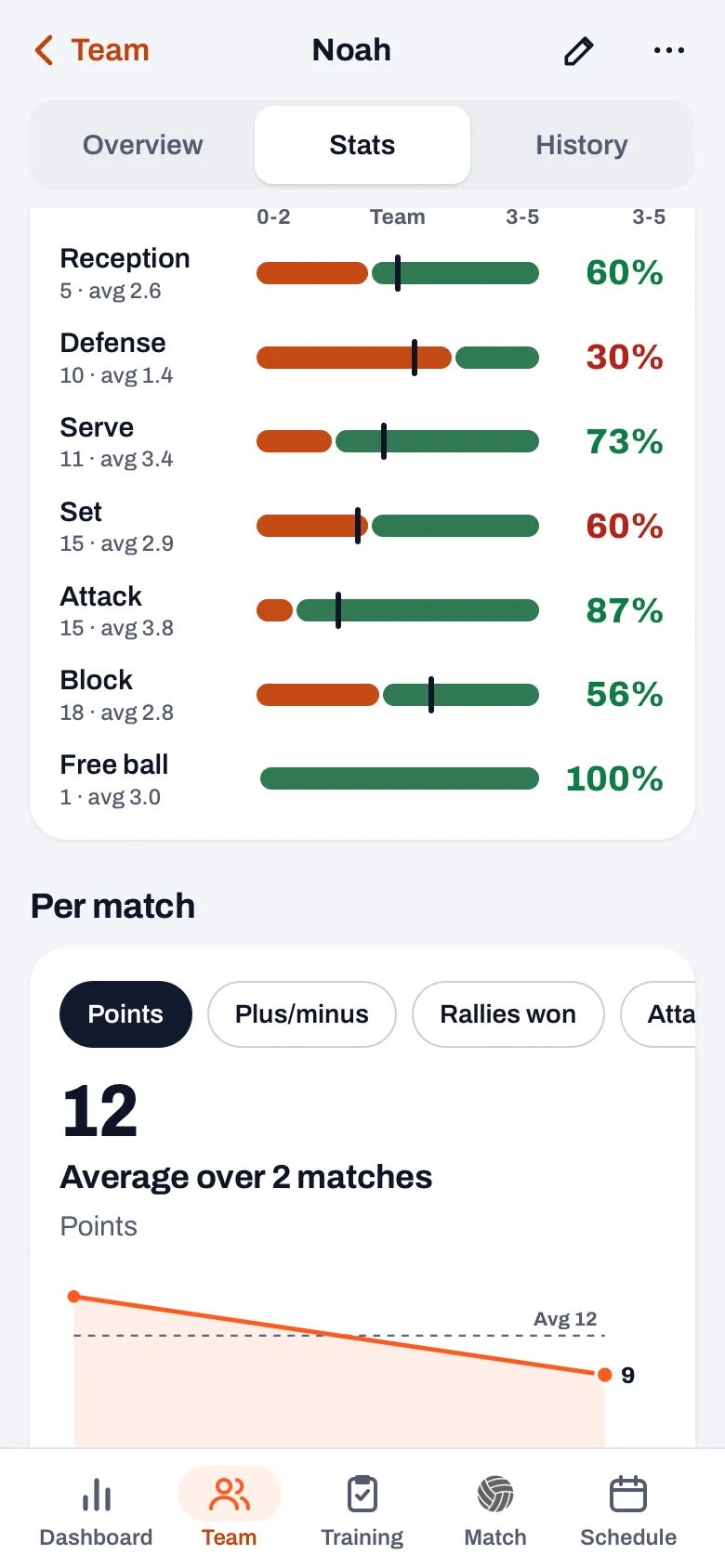
Whether block and defense fit together, you only see when you track both. In Koach's Expert mode, after the opponent's attack comes the Block step and then the Defense step, each with a rating from 0 to 5. For Block the ratings run from Their point and No block through Weak, Usable and Good to Block point, for Defense from Their point and Back over through No attack and No quick to Good and Perfect. If you tap the player as well, their player profile shows under Stats, per skill, what share of their ratings was good, next to the team. Play a month with a fixed blocking agreement and you see whether the defense behind the block goes up with it. What Koach costs after the trial is on the pricing page.
14 days free, no credit card. Track block and defense in your next match and see which side of your block does the work.
Try Koach in your next matchHow block and defense fit in with serve, serve receive and attack is in volleyball tactics.
Frequently asked questions
Where does the libero play against a line block?
That depends on their position and your system. If the libero is at 5, against a line block on their outside hitter they usually defend the deep cross-court, at the edge of the shadow. If they are at 6, they take the deep ball over the block and through the seam. Agree on it for each rotation, so they do not stay in the shadow while the hard ball lands next to them.
Should anyone stand in the block shadow?
Yes, but not for the hard ball. The tip, the roll shot and the ball that glances off the hands land in the shadow. Assign one player per rotation to take that soft ball, often the player on the block side or the off-blocker. Without that agreement two players look at the same tip and nobody takes it.
What is the difference between blocking line and blocking cross-court?
With a line block the outside blocker puts their hands on the line, so the ball cannot go down the sideline. The hard ball then goes cross-court, and that is where your defense stands. With a cross-court block the block closes the cross-court and the line is open, so the back-row player on that side defends deep on the line. You take away what the attacker likes to hit most.
Why do so many balls fall between block and defense?
Usually the block is not where it was agreed, or there is a seam between the blockers. Then the shadow moves and the defenders are in the wrong spot. A second cause is a defender who stays in the shadow and only sees the ball once it is already over the block. So train block and defense together, with one agreement per attacker.
Track block and defense together
14 days free, no credit card. After three matches you see whether the defense behind your block works.
Get started with KoachOr read first what the volleyball coaching app does.