
Volleyball drills PDF: why that free collection never gets used
It is sitting on your phone somewhere: a PDF with two hundred volleyball drills, downloaded free one evening when you had a moment to spare. You leafed through it once. Ever since, Thursday still means the same five drills you know off by heart. That is not down to your discipline, and it is usually not down to the collection either.
What is out there, and what it is worth
Go looking for drills as a PDF and you will run into roughly five kinds of material. They differ less in quality than in intent, and that is exactly why one file suits you and another does not.
- Course material from federations and coaching qualifications. The best thought-out material circulating for free: there is a learning line underneath it, and it usually tells you why a drill is there. The drawback lies in where it comes from — it belongs to a course day, where a tutor filled in half of it out loud. What you are left with is the summary, not the lesson.
- Material for PE lessons and beginner groups. Written for big groups, few balls and players who still catch the ball. Excellent if you are starting out with adult beginners or with children, far too light the moment your team plays real rallies.
- A book or a paid PDF by a single author. One hand, one drawing style, a build-up from easy to hard and variations with every drill. Often the best choice you can make, and there is no shame in paying for it.
- Mega-collections with hundreds or a thousand drills. Cut and pasted together from all sorts of sources: shifting drawing styles, the same drill three times under three names, no order to any of it. They are not bad — they are unsorted, and that is a different problem.
- Video. The only material that already contains the movement, which gives it a head start. The catch: you cannot search it for what you need tonight, and a lot of the footage comes from the elite game, which does nothing for a group of twelve recreational players.
You do not have to read a collection to know what you are holding. Open one drill and check whether three things are there: an aim, a number of players and at least one variation or progression. If they are, it was written by somebody who has stood in front of a group. If all you get is a diagram with a name on it, you have a picture book — useful as a memory jogger, not as a source.
It is not a reading problem but a search problem
Look at the moment you actually need those drills. It is the evening of practice, you have half an hour before you have to leave, three players have just pulled out, and you only have half the gym. In that half hour you are not going to leaf through two hundred pages. You reach for what you know.
That is not laziness. In the run-up to a session you answer five questions, and only when all five check out can you use a drill:
- How many players will I have, and what is the minimum and the maximum at which this drill still runs?
- Can my group do it? A drill in which the ball has to go over three times dies two seconds in with beginners.
- What is this drill for — reception, attack, blocking, the link between two players?
- What do I need: how many balls, how many nets, cones, a ball cart that may not be there?
- How many minutes does it take, explanation included?
A PDF answers at most one of them: the aim, by way of the chapter heading. The other four you have to dig out yourself by leafing through, every single week. That is the whole explanation for the collection that never gets opened — and for the backwards result that a fatter document stands a smaller chance of ever being used.
Five fields make a collection usable
You do not have to throw anything away. You have to put a way in on top of it, and that is one evening of work. Go through the collection with exactly one question per drill: would I do this with my group? If no, turn the page. If yes, write one line in a list, with five fields and a page reference.
A line like that then reads: Passing under serve pressure — 6 to 10 players — advanced — reception — 1 net, 6 balls — 12 minutes — p. 84. That is all it is, and it is enough.
Two of those fields usually go missing. The first is the maximum number of players. Everybody notes down whether a drill still works with too few players; almost nobody notes what happens with too many. Yet that is the more common disaster: fourteen players in a drill designed for six means a queue of eight standing and watching. How to solve that is covered in twenty players on one court and in stop standing in line; if you are the one with a handful of players, practising with a small team is the one you want.
The second forgotten field is the minutes. A practice is a sum: if your blocks are not written down in minutes, every programme is a guess and you will overrun on the last game-play block as a matter of course — precisely the part your team learns the most from. How to stack those blocks is covered in building your session like a programme.
What you end up with is not a two-hundred-page collection but a list of twenty or thirty lines that fits on one sheet. That list is searchable with your eyes, and that was the only property you were missing.
A still diagram is half a drill
Something honest needs saying here about diagrams, including the ones in the good books. There are arrows on a little court: an arrow for a player running, an arrow for the ball, sometimes a squiggle for a hit. The person who drew it knew which arrow meant what. You have to reconstruct that, and only once you have seen it move in your head can you explain it to twelve people.
Skip that translation step and you will end up doing it in the gym. It costs you a few minutes of standing around, most of which goes on one player asking whether he does or does not follow his ball. So do the translation at home, using three moments:
- The opening picture. Where is everybody standing when the first ball is tossed in, and who is holding a ball?
- The turning point. The moment the ball first crosses the net, or the moment the task changes.
- The closing picture. Where is everybody when the rally is over, and how does the next one start — same players, or has everyone moved on?
If you cannot name those three, there is a hole in the diagram rather than in your understanding. If you can name them, the second test follows: can you explain the drill in three sentences and demonstrate it once? If not, it is not ready for this group yet, however good it looks on paper.
While you are at it, count the contacts. A diagram often shows you at a glance how many players are standing waiting, and whether the drill actually resembles volleyball at all — a separate question, dealt with at length in game-like drills.
Twelve drills are enough for a season
The quiet assumption behind the hunt for more drills is that variety is the point. For a team it is not. A drill everybody knows costs no explaining, starts straight away and can be made harder without going back to the beginning. Every new drill costs you time instead: explaining, correcting, one restart. Four new drills in one evening and mostly what you have done is give instructions.
A workable set of your own is small, and looks roughly like this: two warm-up drills, two for passing and reception, two for attack, two for defence and blocking, two game-play drills to finish on, and two for when things go wrong — half a gym, half a group. Twelve. You do not need more than that in a season, provided you can make them harder.
Because that is where your variety lives: not in new drills but in the dials on the same drill. Increase the distance, throw the ball in faster, take a ball out of play, change the scoring, or lay a task over the top of it (the rally only counts if the ball is played three times). That way one drill also serves several levels at once, as described in one practice, six levels.
Let the set grow, but with a brake on it: at most one new drill a month, and then one goes out. A collection that only grows is, a year from now, exactly what you started with — a pile you cannot find anything in. Which way of sorting them works is covered in categorising drills.
You choose the night before, not in the gym
The last step is a habit rather than a tool. Pick three drills the evening before, put the minutes behind them and leave that next to your keys. In the gym you no longer choose; there you run the session and watch your players instead of your phone. Afterwards, write one line: which drill ran, which one died and why. After ten sessions you have something no collection can give you — a list that belongs to your group.
Where you keep that list matters less than that you keep it up: a notes app, a shared document, a folder with five good PDFs in it. One thing does matter: that your fellow coach looks in the same place, or the two of you are running separate programmes with the same team. That is what sharing drills between coaches is about.
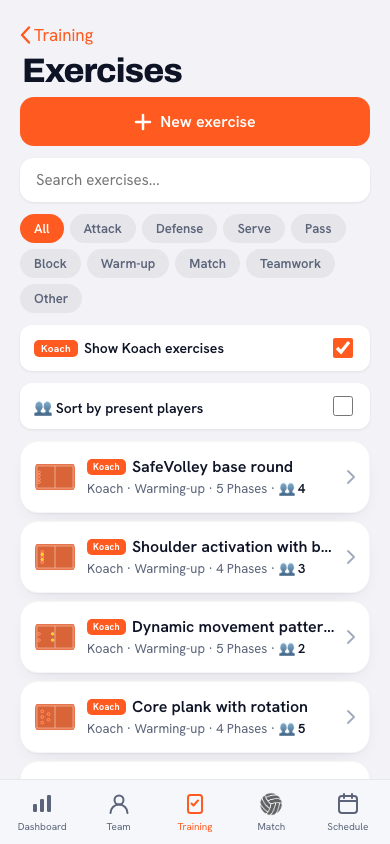
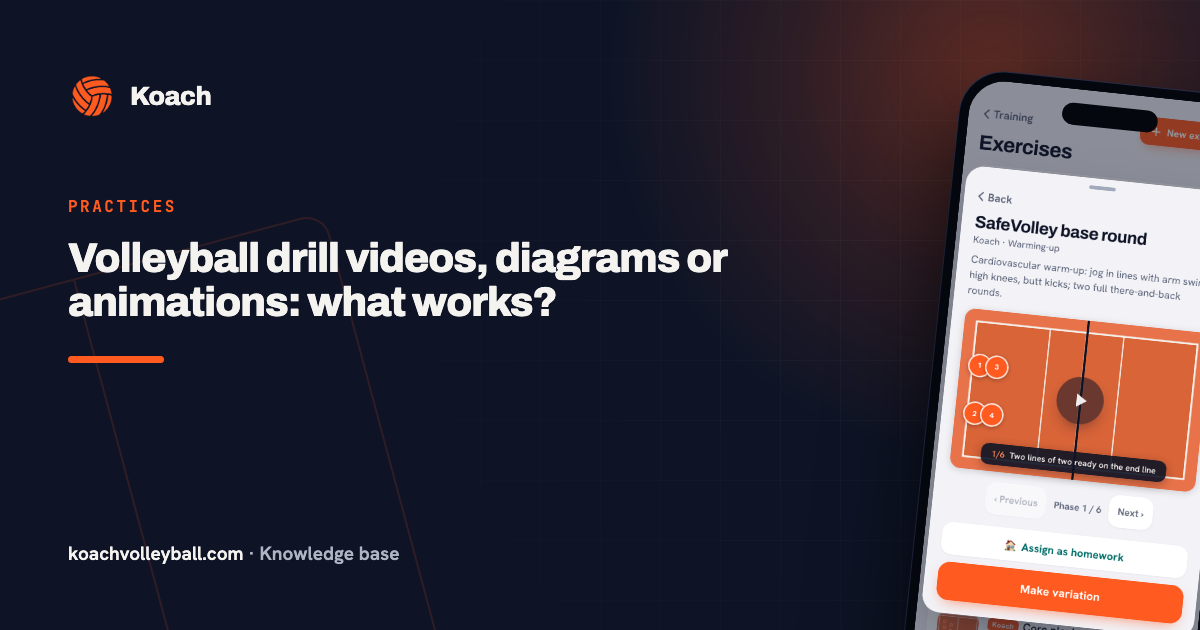
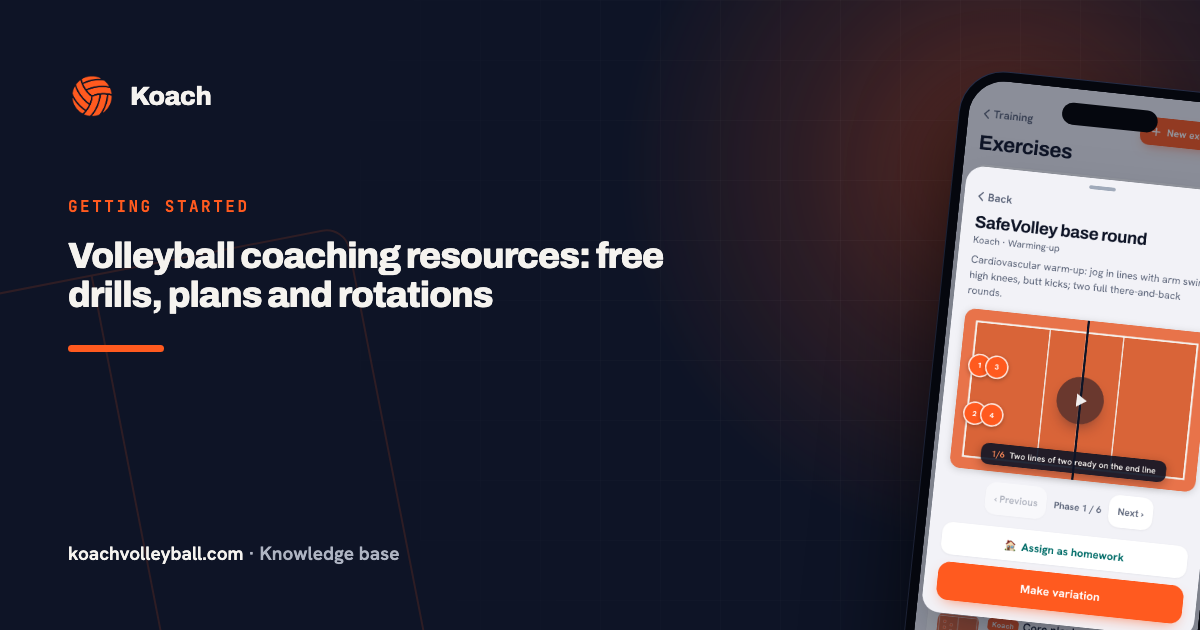
And then there is Koach, the app this knowledge base belongs to — mentioned because it is built on precisely the two objections above, not because it is the only answer. The two hundred drills in it filter by nine categories and by search term, and they are not in there as diagrams but as phases that play one after another, so you see the movement instead of having to reconstruct it. Under Filter and sort you can also choose Present players first: you set the number coming tonight and whatever fits that number sits at the top of the list. What the app does not do is choose — those twelve are still yours. What that looks like in practice is in the drills app, and you draw your own drills alongside them with the drill editor.
In short: the problem is not that you have too few drills, it is that you cannot find anything among them. Put five fields behind the drills you would genuinely run — players, level, aim, equipment, minutes — pick three of them the night before, and keep your standing set small enough to know by heart.
Frequently asked questions
Can I copy drills from a free PDF into my own list?
For your own practices you will rarely run into trouble: you use the idea, and you write it down in your own words. It becomes a different matter as soon as you copy diagrams or whole pages and pass them around outside your own team — then it is the author's work, and what is allowed varies from country to country. The safe line is always the same: your own words, redraw it yourself if need be, and name the source when you pass something on to a colleague. Check the first page of the collection as well; that is usually where the author sets out what is and is not permitted.
Is a paid drills book better than a free PDF?
Usually, but not because it has a price on it. What you are buying is editing: one author, a build-up from easy to hard, variations with every drill and diagrams that all speak the same language. A free course pack from a coaching qualification can have exactly the same qualities. Test it against the material itself: if every drill comes with an aim, a number of players and a progression, it is good material, free or not.
How many drills do I really need for a whole season?
Count on a dozen drills you know by heart, provided you can make them harder. A season consists of dozens of practices, but those do not call for dozens of drills — they call for the same drills growing with the group in distance, tempo, scoring and pressure. Work with a lot more than that and more of every session inevitably goes on explaining and less on playing.
I never know in advance how many players will turn up. How do I choose then?
Pick two versions of your evening instead of one programme. Write the minimum and the maximum behind every drill in your list, and make sure your core drill scales: a drill with two lines becomes one line with few players and three lines on both sides of the net with a lot of them. Keep one emergency drill ready for half a team and one for an overcrowded gym, and you will never have to improvise in the gym again.
Try it yourself in Koach
Less admin, more coaching.
Get started with KoachOr read first what the volleyball coaching app does.