
Volleyball Drills to Assess Skill Level: First Practice
The first practice of the season is your one moment with a clean slate: you know nothing yet, so you still see everything. A coach who uses that evening to watch instead of to train has a head start for the rest of the year.
Why a test backfires
The temptation is to run a measurement protocol: count ten serves, score twenty passes, measure the vertical. The problem is that you then measure how someone performs in a test situation on the first evening of the season — with nerves, unfamiliar team-mates and three months of summer in the legs. That number says very little about what the player is worth in March.
It also costs you something. New players who feel judged on day one start playing safe: serve gently, stay out of the way, take no risks. Precisely the behaviour you do not want to see, because then you still do not know what they can do. So pick drills that sort themselves and say nothing about it. What you eventually write down belongs with the player, as described in keeping player notes.
Four drills that sort themselves
1. Pairs, building up (12 min). Overhand back and forth, then forearm, then hitting and digging at each other. Within five minutes you see who has a stable platform, who dares to use their fingers and who has lost the ball after three contacts. Walk around and watch the feet, not the arms: anyone who stands still and reaches is at the beginning.
2. A set of ten serves (10 min). Everyone serves ten from the end line, counting out loud how many land in. No zones, no pressure. This is the only element that gives you a hard number, and it is a usable one: under six out of ten means serving technique is on the programme for the rest of the season.
3. Hitting off a toss (15 min). A fixed, high toss from position 3, everyone takes five swings from position 4. You watch three things: is there a three-step approach, is there a jump, and does the hand meet the ball above the head. Three clean yes-or-no questions. The technique underneath is in the three-step approach.
4. Three on three on half a court (25 min). The most important of the four. In a small game you see what no drill will show you: who calls, who claims the ball, who hides, who makes a decision under time pressure and who lets their shoulders drop after an error. Rotate the teams every five minutes so you see everybody playing alongside everybody.
What exactly to write down
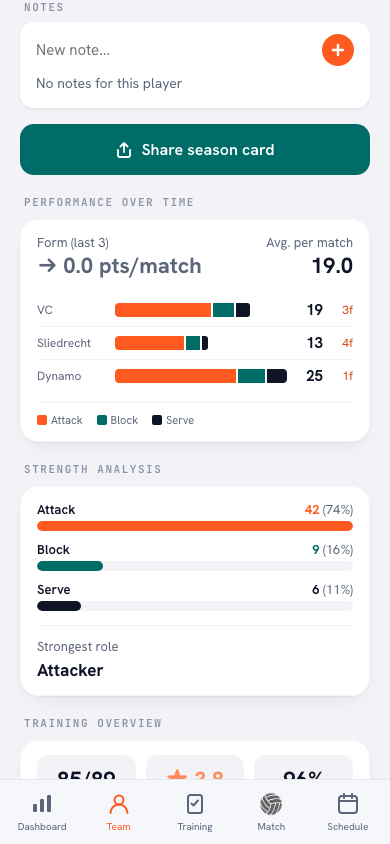
Keep it short and keep it identical for everyone, otherwise you cannot compare it in four months' time. Three lines per player is enough:
- Technique: a 1 to 3 per skill (pass, set, serve, attack, defence) — 1 is still learning, 2 works when relaxed, 3 works under pressure.
- Playing trait: one sentence about what you saw in the 3-on-3. "Does not call, but reads the game well" is more useful than a number.
- Question: what you do not know yet. "Can she hit from the right as well?" or "how does he react to an opponent who is better?"
That third line is the most useful of the three. A first practice never answers everything, and the questions you write down steer what you look at in the second and third session.
Revisiting the baseline
A baseline you never open again is wasted effort. Put a moment in your calendar halfway through the season — around the winter break is logical — to lay the three lines per player next to your current picture. It nearly always surprises you: players you thought had stalled turn out to have moved two skills up, and the player who shone in September is sometimes exactly where they were. For the wider conversation that follows, the player evaluation is the place, and for putting your groups together there is selecting a squad.
Three traps when judging
- The height illusion. Tall players look better than they are on a first practice, short players worse. Look at the technique of the contact, not at the reach.
- The position trap. Someone who looks poor as a setter can be an excellent passer. Do not fix anyone to a position on the first evening.
- The first impression that sticks. A player who has a bad night on day one carries it for months if you never revise your judgement. Hence that third line with the open question.
Just say that you are watching. "Tonight I am going to talk less and watch more, so I know what we work on in October" is more honest than pretending it is an ordinary session — and it takes the tension out instead of building it up.
Frequently asked questions
Should I grade players at the first practice?
Grades for yourself yes, grades for the players no. A 1-to-3 scale per skill helps you compare later; sharing those numbers on day one mostly produces tension and not a better session.
How many sessions do I need to really know the level?
Three or four. The first gives you a rough sorting, the next two correct your first impression and show how someone responds to correction — and for a coach that last part is often more valuable than the technique itself.
Does this work at a tryout with a lot of unfamiliar players?
Yes, but keep the groups small and let everyone play in changing combinations. At a real tryout you also want a second pair of eyes, so you can test your judgement against someone else's.