
Volleyball preseason training: what to give players before summer and how to restart without starting from zero
Volleyball preseason training often opens with a first practice full of familiar faces that feels like a different team: the pass lands two metres wide, the hitters arrive at the ball too early and after half an hour half the group has their hands on their knees. Two weeks later the first player is out with a shoulder or an ankle. This piece is about both halves of that problem: what you give your players before the summer break, and how you build the preparation afterwards without the first weeks becoming your most expensive ones.
What disappears over a summer, and what stays
The feeling that you are starting from zero is wrong, and that is the good news. An overhead pass, an approach and a block step are movements that stay for years; nobody forgets how to set in a few weeks. What does fade are three other things: the understanding between players, endurance, and the conditioning of tendons and muscles to jumping and hitting.
That last one is the dangerous one, because you cannot see it. Technique that is still there lets a player go at full speed in the first practice — they hit just as hard as before the break, except their knees and shoulder have not done that for weeks. Injuries in the first weeks back rarely happen because players cannot do enough; they happen because they do too much of something their body has been away from.
Something else disappears that is easy to forget: the agreements. Who calls a ball in the middle, who takes the short serve, which signal the setter uses. Those are not skills but habits, and in the first practices you simply have to say them out loud again instead of hoping they are still there.
A break in the middle of the season works differently: it is shorter, you have half a league behind you and you can make targeted adjustments. How to use a break like that is covered in making the most of a mid-season break. The summer break is longer, and that asks something of both sides: of you before the break, and of the build-up afterwards.
Before the summer: the conversation and a personal summer goal
The last two practices of the season are the cheapest ones you have. There is no match pressure any more, the atmosphere is relaxed and you can take each player aside for two or three minutes while the rest keep playing. That conversation needs three sentences: what improved this year, what is the one point for next year, and what will you do about it over the summer.
The summer goal comes out of that third sentence. Keep it small and make it a behaviour, not a number. "Pass against a wall for ten minutes twice a week" is a goal; "pass better" is a wish, and "train for an hour every day" is a goal nobody reaches and that a player feels guilty about after two weeks. One goal per player is enough.
On top of that, one small assignment can go home with them — one drill, one sentence of explanation, nothing more. No ten-week fitness plan: it will not be done, and if it is done it is usually too heavy. Drills a player can do alone and without a net are in volleyball drills against a wall.
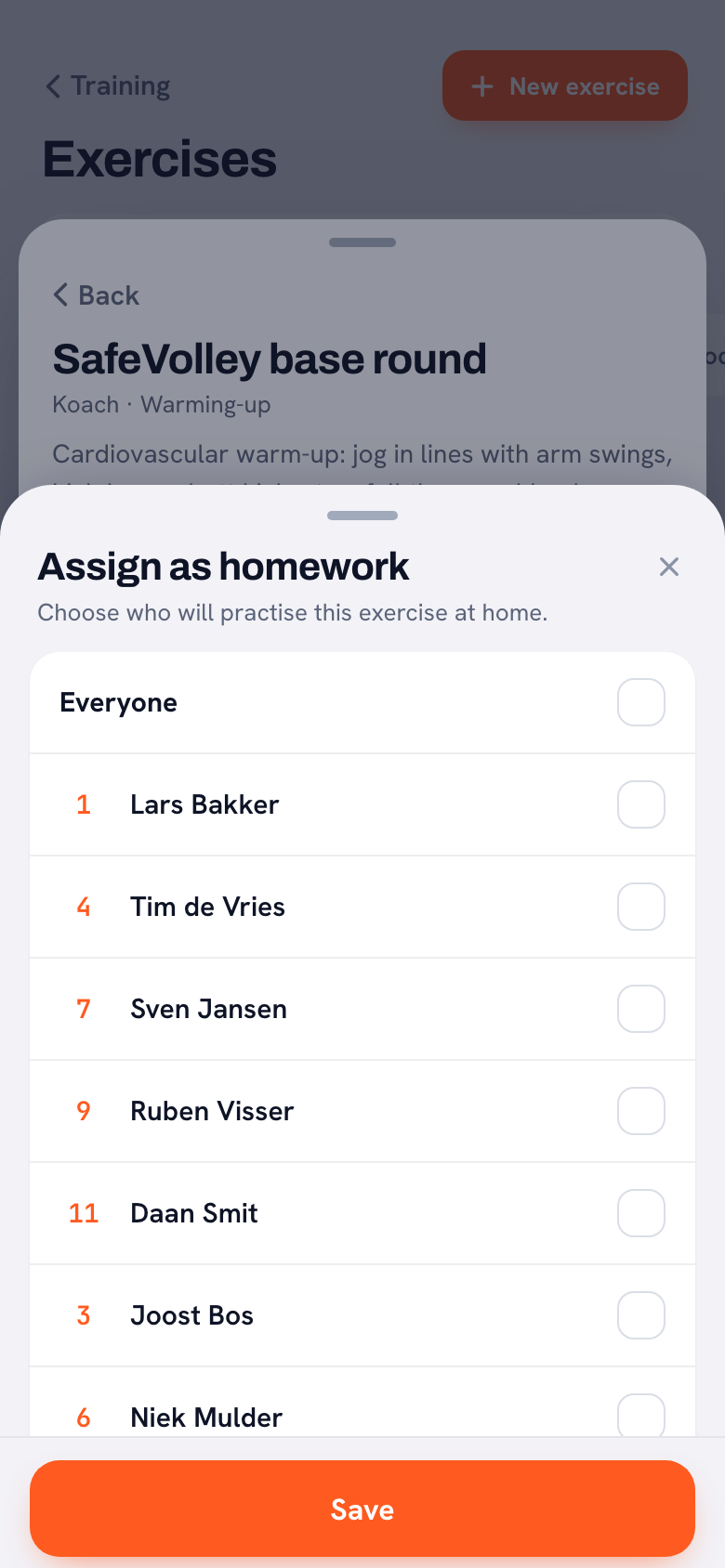
An assignment and a goal like that get lost if you only mention them at the last practice. In Koach you set the drill up as homework for the player — a player with an account sees it in the app, and so does the parent — and you record a personal goal for each player. The homework stays in place across the end of the season. Whether someone actually did it is not something you can see; you hear about it at the first practice, and that is also where that conversation belongs.
Players who did nothing over the summer: scale, don't punish
Every group that comes back contains three kinds of players. There is a group that kept moving — beach volleyball, another sport, the gym. There is a group that did nothing for the entire break. And there is almost always someone who comes back with an injury, a growth spurt or a summer that went differently than planned.
The temptation is to make the first practice hard, so that "everyone knows it has started again". That mainly produces two things: muscle soreness that lingers for days and cancellations for the second practice. Scaling works better than punishing, and you can do it without building three different practices.
- Adjust the volume, not the drill. Everyone does the same form; anyone who has done nothing for a long time does two sets instead of four and spends the rest feeding balls or counting.
- Make pairs by load, not by level. Two players who both did nothing push each other less than a pair in which one is in top form.
- Just ask. One round as players come in: who has played, who hasn't, who has a niggle somewhere. That takes two minutes and determines what you do and do not do that evening.
Players who played beach volleyball often come back reading the ball and the court better and with worse timing at the net: the net is different, the approach is different and the surface gives way. That usually sorts itself out once they have played indoors a few times. Beach forms are useful in indoor preparation too, by the way — see beach volleyball drills.
Volleyball preseason training after the summer break: the first three practices
The rule for the build-up is simple: first get lots of touches on the ball again, and only then jump and hit hard again. Below are three practices you can spread over one week or over two weeks, depending on how often you train. The times assume ninety minutes; if you train for less, shorten the game, not the warm-up or the landing work.
- Practice 1 — contact, not power. 15 minutes of warm-up with running and arm work, 25 minutes of passing and setting in threes, 25 minutes of serve receive against a gentle underarm serve or a soft overhand one, 20 minutes of a game in which you may only finish from the floor or with a tip, 5 minutes of cool-down. Ninety minutes in total, and nobody has jumped at full effort.
- Practice 2 — the jump back into the system. 15 minutes of warm-up with jump activation, 15 minutes of approach and landing without a ball, 25 minutes of attacking at three-quarter power with placement as the requirement, 25 minutes of game play, 10 minutes of back and shoulder work. Ninety again.
- Practice 3 — volleyball again. 15 minutes of warm-up, 20 minutes of serving and serve receive, 20 minutes of full attacking in series of six balls per player, 30 minutes of match play, 5 minutes to finish.
Two things keep this on track. In these weeks, do not end a practice with a line of hitters and a cart of balls: the last swings of a long series are the ones in which the technique collapses and the risk goes up. And have players land properly — on two feet, knees over the feet and not caving inwards — because in the first weeks back that is the cheapest gain there is. The explanation is in landing technique, and what else to keep an eye on in terms of load is in injury prevention.
If you want to build up the jumping load step by step, use a fixed sequence instead of "a few extra jumps", for example Jump program basics. A strength or conditioning programme is outside the scope of this piece: there are separate articles on strength training for volleyball players, conditioning and learning to jump higher. And how the preparation fits into your season as a block, with the weeks that follow, is in the season plan.
Does a player keep having pain in a shoulder, knee or back in the first weeks that has not gone after a few days? Have it assessed by a doctor or physiotherapist instead of waiting it out with 'just hitting a bit less hard'. A complaint that develops during the build-up rarely disappears by simply playing on.
When to test again, and why not in week one
The urge to measure straight away at the first practice is understandable: you want to know where you stand. Except that then you are measuring the summer, not the player. A jump test in the first week back tells you something about the break; the same test after the build-up tells you something about the team you are going into the season with.
In practice: do your measurement after the build-up above, so from the fourth or fifth practice. Keep the test identical to last year's — same exercise, same number of attempts, same way of counting — because only then is the difference worth anything. And record it as a starting point, not as a report grade.
If you mainly want to know what players can do rather than how fit they are, a test is not the best tool anyway. How to do that during normal play is in assessing skill level at the first practice. A pre-season tournament is also a fine moment for it: you see more in half a day than in two practices, provided you write down beforehand what you are looking for.
Youth, adults and recreational players: what to expect from each group
Youth. With players between roughly 11 and 16, more changes over a summer than with adults, because they can grow a lot in a short time. Coordination that was right before the break is sometimes off for a while after a growth spurt — an approach that ends too close, a pass taken too low. That looks sloppy and it isn't. Give those players extra time for timing, pay extra attention to landing and reduce the jumping volume until it runs smoothly again. The first practice with a new youth group also calls for something different from a practice with a team that already knows each other; see the first practice with a youth team.
Adults. Here time is the scarce factor, not motivation. Expect players with holidays, work and house moves behind them and a half-complete team on the first evening. So plan the first practices so that they also work with eight players, and do not put the heaviest jumping session on the very first evening.
Recreational players. This group comes for the game. Build up the load through the game itself: smaller court, more contacts, less attacking pressure in the first weeks. A jump programme in a recreational practice is rarely a success; a game form with a constraint is.
When the first league match falls differs by country and by competition; which moments a volleyball season contains is covered in when the volleyball season starts. Count back from that date in weeks and set up the first three practices of the preparation in advance. In Koach you do that as a recurring series with a template, so you only build them once; the reminder forty-eight hours beforehand automatically asks who is back after the summer, and on the day itself you know how many players you have for that build-up.
Frequently asked questions
Should you have players train over the summer?
Not as an obligation, and certainly not with a schedule. One small goal and one assignment a player can do in ten minutes work better than a programme that grinds to a halt after two weeks. Players who play beach volleyball or another sport over the summer keep enough of it anyway; players who do nothing you build up more gently in the first three practices.
What do you give youth players to take into the summer?
Something that works without a net, without a teammate and without supervision: passing or setting against a wall, keeping a ball up, a few series of overhand serves against a wall or a fence. One drill with one sentence of explanation is enough. With younger players it helps if the parent sees the assignment as well, so that three different versions of the story are not going round at home.
How do you prevent injuries in the first weeks after the summer?
Build up the jumping and hitting volume over the first three practices instead of putting it at match level straight away, and do not end those practices with a long line of hitters and a cart of balls. Spend five minutes per practice on landing on two feet. Complaints in the shoulder, knee or back that have not gone after a few days belong with a doctor or physiotherapist.
When do you start jumping and spiking again in the preparation?
Jumping without a ball and approaches can already come in the second practice; attacking at three-quarter power too, provided you put the requirement on placement rather than on hitting hard. Full attacks in series belong from the third practice onwards, and then in blocks of a handful of balls per player rather than a quarter of an hour in one go.
What do you do if half the team is still on holiday in the first week?
Run the build-up with whoever is there, in forms that work with six to eight players: threes, half courts, a game with a fixed feeder. Anyone who joins later starts at their own first practice and does less jumping and attacking the first few times than the rest, even if the team is already further along. So a player who comes in during week three does not go straight into the full attacking block.



Try it yourself in Koach
Less admin, more coaching.
Get started with KoachOr read first what the volleyball coaching app does.