
Volleyball drills without a ball: a 15-minute warm-up for the gym
The short answer
Volleyball drills without a ball can make a full warm-up: running forms, footwork along an imaginary net, shadow technique for the approach, block and defense, a tag game and a build-up of jumps. That gets your team warm in fifteen minutes. The ball still comes afterward: ball feel and the hitting arm do not warm up without one.
You need volleyball drills without a ball more often than you think: the court is still taken, you are waiting in the hallway before an away match, or the ball bag is still in someone's car. Here are ten drills that work in a corner of the gym, a 15-minute plan and a short version for the hallway.
When do you need a warm-up without a ball?
Three situations keep coming back. The match or practice before yours runs late, and you are standing on the sideline with twelve players. You are playing away and the gym only opens once the match before yours is over, so you have the hallway or a locker room. Or the balls are not there: the bag is in your assistant's car, or the ball cart is locked. Waiting until you can start costs ten minutes you never get back.
A warm-up without a ball does the physical part: heart rate and temperature up, hips, ankles and shoulders loose, the first jumps. What it does not do is touch the ball. The feel in your hands and forearms, and a hitting arm that builds calmly toward a full swing, only come with the ball. Why a warm-up rises in phases is explained in the RAMP method. Below is the practical side: what you do without a ball, and in what order.
Ten volleyball drills without a ball
The order runs from easy jogging to footwork and shadow technique, with the jumps at the end; the rotations fit wherever you want a calmer moment. Each drill says how much space you need.
- Running forms in lines (a 9-meter strip). Two lines side by side: easy jogging with forward arm swings, high knees to past the three-meter line, turn at the net and butt kicks on the way back. In the Koach library this is SafeVolley base round: four players, six phases, two rounds there and back. With more players, the lines start in turns.
- Lunge with trunk rotation and crossover step (a 9-meter strip). Three big lunges forward, turning the trunk toward the side of the front leg on each one, then crossover steps sideways to the outside and skipping back along the sideline to the start. In the library this is Dynamic movement patterns: two players, six phases.
- Line tag (half a court or an area with lines). Everyone may only move along the lines on the floor. Two taggers chase; whoever gets tagged does a short task and then joins in again. In the library: Line tag, six players and six phases; in the animation the tagged player does five sit-ups. With a big group, use three taggers.
- Footwork along an imaginary net (a 9-meter line). A line on the floor is the net, two cones are the antennas. Shuffle steps from one antenna to the other, a block jump there without a ball, crossover steps back and another block jump at the first antenna. That is also how it appears in Footwork along the net: three players, six phases, there and back.
- Shadow approach (a strip of a few meters). The three-step approach without a ball: start slowly, make the last two steps fast, swing the arms back on the second-to-last step and take off straight up. First at half speed without a jump, then with a low jump. In the library this is Three-step approach: two players, six phases, with cones at the take-off point.
- Shadow defense (a square of 3 by 3 meters). From a low defensive stance, two steps forward, two to the left, two to the right and back, each time finishing with the arms in a platform. Staying low is the task, not speed. Ten seconds of work, twenty of rest, four rounds.
- Arm swing without a ball (on the spot). Big arm circles forward and backward, then the hitting motion in the air: elbow high, first at a quarter of full speed, then half, then three quarters. Leave out a full swing without a ball: without a ball the shoulder has to brake the whole swing on its own, and you take the last step to a full swing with the ball. If you have a resistance band, add the library drill Shoulder activation with band: three players, five phases.
- Side plank with rotation (a strip of floor per player). Support yourself sideways on one arm, rotate the trunk open with the free arm toward the ceiling, come back, and switch sides after a few reps. In the library this is Core plank with rotation: five players, five phases. It also works in a narrow hallway.
- Building up the jumps (on the spot). Start with small hops on the balls of the feet, then two-footed jumps sideways over a line, then five block jumps, then three jumps from a short approach. Every landing on two feet, soft through the knees, knees not caving in. Jumps always come at the end, when everything else is warm.
- Walking the rotations (half a court, or an area marked with cones). Six players stand in their starting lineup. You call out what happens: our serve, their serve, rotate, and everyone moves to the spot where they should be. It is light movement and a review of what you agreed on at the same time. Before a match it saves confusion in the first rotations.
Two things are deliberately missing. Reacting to a signal as a goal in itself has its own progression in volleyball reaction drills. And long static stretching does not belong in a warm-up for a sport with jumps; save it for afterward.
Let your captain lead the warm-up without a ball. Give them the order of this plan on a card or in the team group chat. If you are still at the scorer's table or talking to the referee, the team simply starts. After a few times everyone knows the order without the card.
A 15-minute warm-up without a ball
This is an example for a practice or match when the court is still in use. You need a strip along the side of the gym and a few cones.
| Minutes | What | Drills |
|---|---|---|
| 0 to 4 | Getting going | Running forms in lines, then one round of lunges and crossover steps |
| 4 to 7 | Game | Line tag with three taggers |
| 7 to 10 | Footwork | Along the imaginary net, and the shadow defense |
| 10 to 12 | Trunk and shoulders | Side plank with rotation, arm circles and the arm swing at rising speed |
| 12 to 15 | Jumps | Shadow approach and building up the jumps |
If you have more time, extend the game and the footwork, not the jumps. If you have less, cut the game and keep the jumps; they are the bridge to the first attacks. How a block like this fits into the rest of your evening is in running a volleyball practice.
The hallway version: about eight minutes in a space two meters wide
In a hallway or locker room you cannot run or play tag. What does fit:
- Running on the spot with high knees, two minutes, with arm swings.
- Lunges with trunk rotation in a single file, there and back.
- Side plank with rotation against the wall, a short set per side.
- Arm circles and the arm swing in the air, with enough room between players.
- Small hops and a few block jumps on the spot, only if the floor is not slippery and the ceiling is high enough.
When you go into the gym afterward, do not start hitting right away: your body is warm, but your shoulder is not ready for a full swing yet.
What you do with the ball afterward
As soon as the balls arrive or the court is free, skip the physical part of a normal warm-up and go straight to the ball. Start with a few minutes of passing in pairs, overhead and forearm, so hands and forearms get the feel of the ball again. Then build up the swing: first easy hits that bounce off the floor, only then harder, and only at the end attacking over the net. Before a match you then continue with the pre-match warm-up at the net, which has its own timeline. On a practice night you can also switch to a game after three minutes with the ball; games with a ball are in volleyball warm-up games.
Two mistakes to avoid. Do not treat the warm-up without a ball as a replacement for the build-up with the ball: a player who attacks at full power after ten minutes without a ball is hitting with a cold shoulder. And do not let the team stand still for ten minutes after the warm-up because the court turns out to be taken after all; keep them moving with the rotations or a second round of footwork. If a player feels pain in a knee or ankle on landing, they skip the jumps; if that pain keeps coming back, have it checked by a doctor, sports physician or physiotherapist.
Putting a warm-up without a ball in your practice plan
In Koach you put the warm-up as the first part of the plan for a practice. With + Add drill you open the Add drill sheet. Tap the Warm-up chip and you see the warm-ups from the library, each with the number of players and the number of phases. Many of them need no ball, such as SafeVolley base round, Dynamic movement patterns and Core plank with rotation. You can also search: type a word like footwork or approach in Search drills. The Fits chip shows only drills that suit the number of players coming that night.
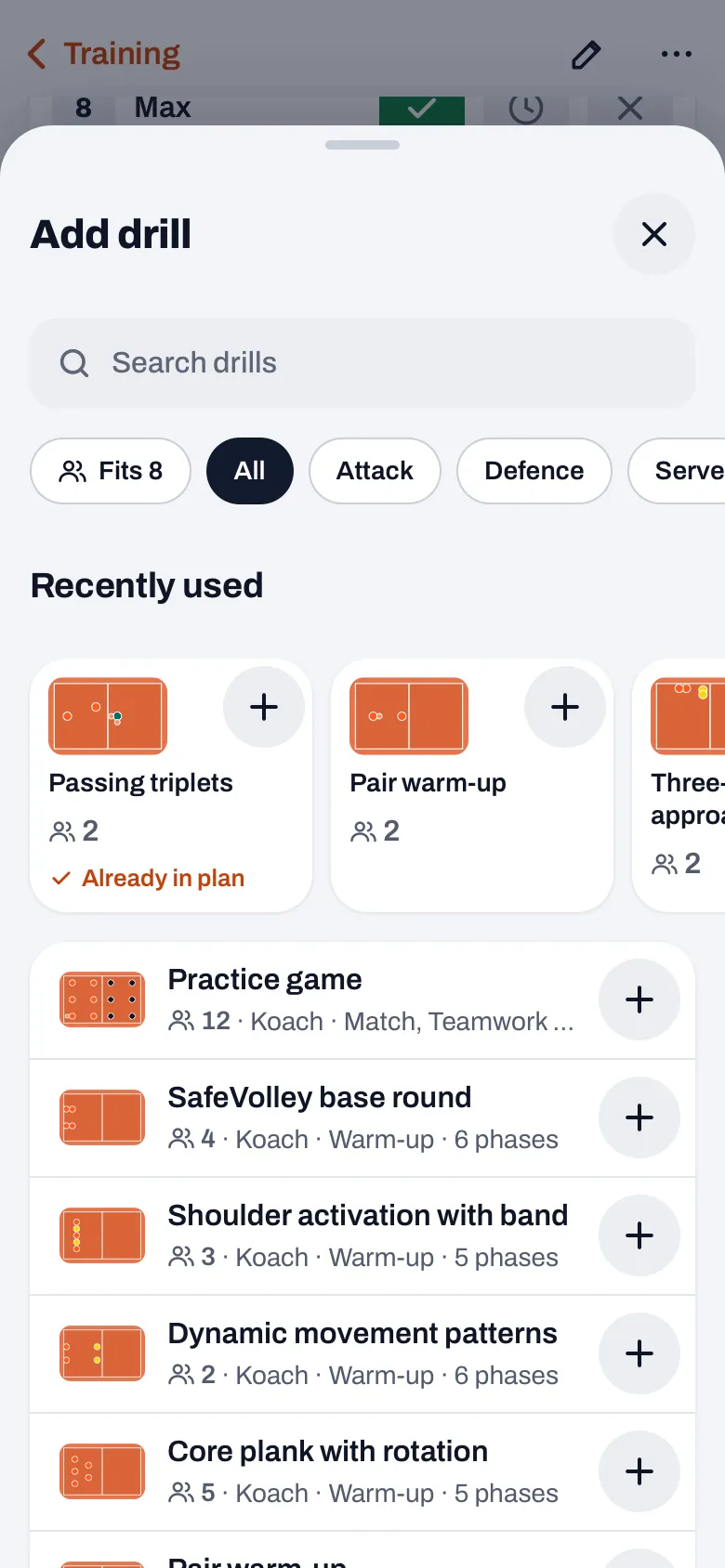
Every drill from the library plays phase by phase on a court, so your players can see beforehand where they will move. Add your own exercise, such as walking the rotations, with + Add section: a name, the minutes and a short description. What Koach costs after the 14 free days is on the pricing page.
14 days free, no credit card. Have a warm-up without a ball ready for the nights the court is still taken.
Plan your warm-up in KoachFrequently asked questions
Which volleyball drills can you do without a ball?
More than you think: running forms, footwork along a line that serves as an imaginary net, the three-step approach, block jumps, a low defensive stance with short movements, core exercises such as a side plank, and a build-up of jumps. Walking the rotations also works without a ball. What you do not train without a ball is ball feel and the full swing; for that you still need a ball afterward.
Is a warm-up without a ball enough before a match?
No. It warms up the body, but hands, forearms and the hitting arm still need to get used to the ball. So after the warm-up without a ball, go straight to passing in pairs and a build-up from easy hits to attacking. Before a match, the pre-match warm-up at the net follows, with serving as the last part.
How do you warm up in a hallway or locker room before a match?
Choose exercises that fit on the spot or in a single file: running on the spot with arm swings, lunges with trunk rotation, a side plank, arm circles and the arm swing in the air, and if the floor is not slippery, a few small hops. Leave out running and tag games. Once you are in the gym, start with the ball, not with hard hitting.
How do you do a warm-up without a ball with kids?
Turn as much of it as you can into a game. A tag game where everyone may only move along the lines, animal walks and a race with different ways of moving all work well. Keep turns short and do not let anyone get knocked out, because a child who stands still cools down. Do the jumps at the end, with attention to a soft landing on two feet.

Have your warm-up without a ball ready
14 days free, no credit card. Your team gets going, even when the court is still taken.
Get started with KoachOr read first what the volleyball coaching app does.