
Volleyball warm up games: 8 games for ages 12 and up
The short answer
Volleyball warm up games raise the body temperature and give touches on the ball at the same time: a tag game for the heart rate, a throwing or partner game for hands and shoulders, and a game at the net for jumping and reaction. Three five-minute games with a rising tempo make a complete warm-up.
Volleyball warm up games turn the start of practice into more than a few laps: players move, touch the ball and have their heads in the gym. This article is for teens and adults, with eight games, the order to put them in and three complete fifteen-minute warm-ups.
Why a warm-up as a game works
Players walk in with their heads still at school or work. A game has their attention within ten seconds, and the tempo rises by itself as soon as there is something to win. On top of that they touch the ball, which does not happen during two laps of jogging. But a game is not automatically a good warm-up. It has to build in intensity, keep everyone moving, prepare the shoulders before anyone hits hard, and knock nobody out.
What a warm-up has to do physically is in volleyball warm-up drills and in the RAMP method. This article fills that in with games. For children aged 8 to 11 there are simpler games in volleyball games for kids.
How to build a warm-up from games
Put three games in a row, each in its own block:
- Loosening up (4 to 6 minutes). A running or tag game with the ball in the hands. Heart rate and temperature up, eyes up, calling.
- Ball contact (4 to 5 minutes). A game with passing or throwing. Fingers, platform and shoulders get warm without hard hitting.
- At the net (4 to 6 minutes). A game with movement, jumping and the first attacks at a rising tempo.
Four rules keep it workable. Explain in a minute at most; anything that takes longer, players only get by playing. No elimination games: whoever is out cools down. Use the same small groups in all three games, so you switch in seconds. And do not start with sprints or full jumps; the first minute is easy. Adults coming straight from work often need a few extra minutes in the first block.
Eight volleyball warm up games for teens and adults
1. Safe with the ball
Setup: one court, two taggers in a pinnie, three balls for twelve players. Rules: whoever holds a ball cannot be tagged, but may hold it for three seconds at most. Passing it on is a two-handed throw over the head, in the shape of a set. Whoever gets tagged takes over the pinnie. Progression: after two minutes the ball has to be set and the receiver catches it; then one ball fewer. The game forces players to look up and call to each other.
2. End zone ball
Setup: two teams of four to six on one court; the end zone is the space behind each end line. Rules: no running with the ball, pass it on with a throw, catch it above your head. A point is a ball caught in the other team's end zone; if the ball drops, it goes to the other team. Progression: first two-handed throws, then one-handed only with the arm swing of an attack. That warms up the hitting shoulder with a force that builds by itself.
3. Partner sets on command
Setup: pairs four to five metres apart, one ball. Rules: set the ball back and forth. The coach calls a command for the next contact: "Floor" (touch the floor, then play), "Turn" (spin once), "Under" (pass with your forearms), "Line" (sprint to the nearest line and back while your partner sets themselves high). Scoring: how many contacts without an error in one minute. The winning pair chooses the commands for the next round.
4. Two balls in the circle
Setup: circles of six players. Rules: keep the ball in the air and call the name of the player who gets the ball before every contact. After a minute the coach throws in a second ball. Scoring: the group's record in contacts without a ball touching the floor. It trains talking and looking, and it works at any age, including a group of recreational adults.
5. Three-contact race
Setup: groups of three on the end line. Rules: the three run to the net and back and play pass, set and catch on the way, each contact by a different player. If the ball drops, back to the start. The first group of three to go there and back twice wins. Progression: in the second round the third contact goes over the net to a teammate on the other side, who takes over the race.
6. Over-the-net carousel
Setup: a line of players on each side of the net. Rules: whoever plays the ball sends it over the net and joins the back of the line on the other side, with a running route well around the net post. Scoring: how many balls the group gets over in a row. After an error the count starts again, but nobody is out. Progression: throw and catch, then setting, then passing, then two contacts required: set yourself first and then send it over.
7. Mirror at the net
Setup: pairs facing each other at the net. Rules: player A moves along the net with shuffle steps or a crossover step, B follows as a mirror image. When the coach claps, both jump and touch hands above the net. After thirty seconds they switch roles. Progression: first without a jump, then with a block jump. Land on two feet on your own side of the net.
8. Throw-volley three v three
Setup: three against three on half a court, lengthways, with the regular net. Rules: the first contact is catch and throw to the setter, the second is a set, and on the third the attacker jumps and throws the ball over the net with the arm swing of a spike. Progression: round one throwing, round two hitting at half speed, round three free. That way shoulder, approach and landing build up together, in a format with a score.
| Game | Block | Prepares for |
|---|---|---|
| Safe with the ball | Loosening up | Looking up, calling, setting shape |
| End zone ball | Loosening up | Hitting shoulder, catching above the head |
| Partner sets on command | Ball contact | Ball control after moving |
| Two balls in the circle | Ball contact | Communication, awareness |
| Three-contact race | Ball contact | Pass, set and playing on the move |
| Over-the-net carousel | Ball contact | Ball control under light pressure |
| Mirror at the net | At the net | Block footwork and jump |
| Throw-volley three v three | At the net | Approach, arm swing and landing |
Three complete fifteen-minute warm-ups
- Practice with a focus on passing and defence: Safe with the ball (5 minutes), Partner sets on command (5), Over-the-net carousel with passing as the last level (5).
- Practice with a focus on attack and block: End zone ball with the one-handed throw (5), Mirror at the net (4), Throw-volley three v three (6).
- Cold gym or a tired group: Safe with the ball with an extra minute (6), Two balls in the circle (4), Throw-volley at half speed (5).
After the warm-up, practice carries on into your technique block; how to build that whole session is in running a volleyball practice. Before a match it works differently: a short warm-up is followed by the pre-match warm-up at the net, with its own schedule and without games that eat up time.
Change the games, not the structure. Keep the same three blocks every week, but pick a different game per block. Players know what is coming and how fast it builds, and still no warm-up feels like a repeat.
Putting warm up games in your practice plan
A game that worked is one you want to find again next month. In Koach you put the warm-up as the first section in the plan of a practice. With + Add drill you choose a warm-up from the library, where Warm-up is a category of its own, and with + Add section you create your own block with a name, a duration and a description where you can write down the rules of your game. You change the order of the sections by dragging them. If the warm-up worked, you bring it back at the next practice with Copy plan.
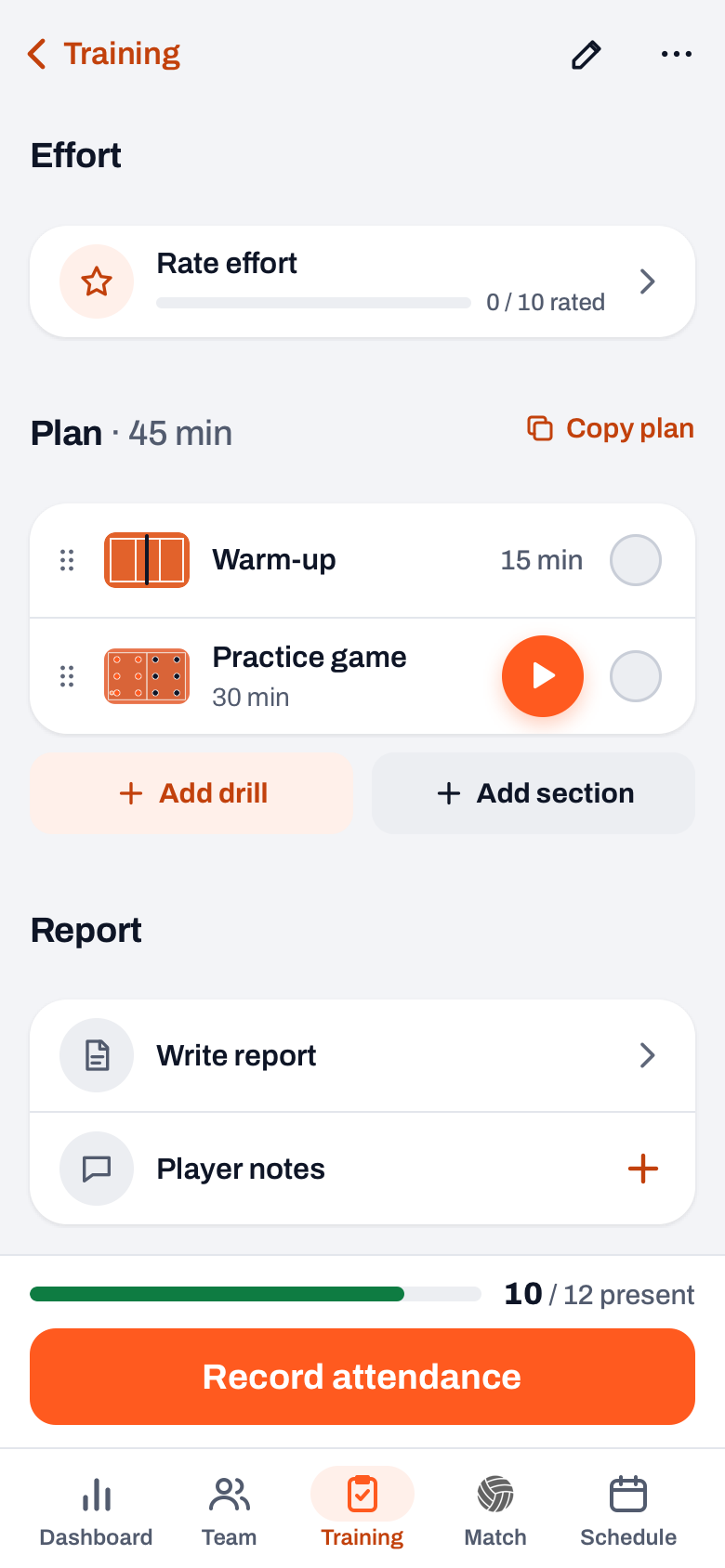
After practice you mark for each section whether it was done, and what you noticed goes into the report. What Koach costs after the 14 free days is on the pricing page.
14 days free, no credit card. Put Tuesday's warm-up as the first section in your plan and copy it to Thursday.
Plan your practice in KoachFrequently asked questions
How long should a volleyball warm-up with games last?
Count on twelve to twenty minutes: three games of four to six minutes each, from easy to intense. Less than ten minutes is too short to prepare the shoulders for the first attacks. In a cold gym or with a group that has just come from work, make the first block a few minutes longer.
Is a tag game enough as a volleyball warm-up?
No, a tag game only covers the first part: heart rate and temperature up. Volleyball also needs ball contact and a build-up for shoulders and jumping. So follow it with a passing or throwing game, and finish with a game at the net in which jumping and hitting build up gradually.
Which warm up games work with only a few players?
With six players or fewer, Partner sets on command in pairs, Two balls in the circle with one group, Mirror at the net and Throw-volley two v two on a smaller court all work. Tag games quickly get too tiring for the tagger with few players; switch taggers every thirty seconds.
Can players lead the warm-up themselves?
Yes, and games lend themselves well to that. Give the captain or a regular player three games and the order: loosening up, ball contact, at the net. After a few weeks players can start the warm-up themselves while you set up the gym or talk to a player.

Put your warm-up in your plan tonight
14 days free, no credit card. Next week you copy it with one tap.
Get started with KoachOr read first what the volleyball coaching app does.