
Fun volleyball drills: 12 games for teens and adults
The short answer
Fun volleyball drills have a score or a record, lots of ball contacts without a line, an element of surprise and still a clear training goal. For teens and adults, games like Serve Battleship, Volley Bowling, Blind Volley with a sheet over the net and Joker Cards in a scrimmage work well.
Fun volleyball drills are not a way to kill time: put a score on it and players work harder and touch more balls than they would in a line in front of the coach. Here are twelve games for teens from age 12 and adults, with the setup, the rules, what they train and how to make them harder.
What makes a volleyball drill fun?
A drill becomes fun through four things: there is something to win, everyone touches the ball often, there is a surprise in it, and players get to choose something themselves. Teens mostly want the first: a score, a record, a winner. Adults also come for the fun and for playing together, and enjoy a format that is just a little different. A game without a training goal is just a fun quarter of an hour. That is why each game below says what it trains, so it fits into your plan as described in running a volleyball practice.
This article is for teens from age 12 and adults. Games for children aged 8 to 11 are in fun volleyball games for kids, games to warm up with in volleyball warm-up games, and scrimmages in which you only change the scoring in volleyball scrimmage games. A classic with waiting teams, Queen of the Court, has its own article.
Fun drills for technique
1. Serve Battleship
Setup: two teams, each with four mats or hoops spread over their own court as ships. Rules: a player from each team serves in turn. If the serve hits a ship, it sinks and the mat is removed. The first team to sink all the other team's ships wins. Trains: aiming under pressure. Variation: younger players serve from a few meters inside the end line; advanced players get smaller ships, such as a towel.
2. HORSE
Setup: groups of two to six at a target, for example a mat in the setter's spot or a zone for the serve. Rules: the first player announces a task and does it, such as "jump float into the corner" or "pass onto the mat after a spin". If it works, everyone has to copy it, and anyone who misses gets a letter. The first player to spell HORSE ends the round and the next round starts; nobody sits out. Trains: precision, and players come up with difficult balls themselves.
3. Laundry Basket Pass
Setup: the setter stands in position with a laundry basket or a large box; on the other side the coach or a line of servers serves. Rules: a pass into the basket is three points, a pass the setter catches without taking a step is one point. Two teams take turns passing ten balls each. Trains: a high, soft pass to the right spot, because a flat, hard ball bounces out of the basket. Variation: real serves for adults; a tossed ball for younger players.
Fun drills at the net
4. Survive the Coach
Setup: three defenders in the back row in 1, 6 and 5; the coach hits from a sturdy platform on the other side. Rules: every ball that comes up high and playable in the middle of the court is a point for the players; every ball on the floor is a point for the coach. The players have to reach fifteen points before the coach has five. Trains: defensive posture, reading and courage. Variation: add a setter and an attacker who put away the dug ball; with younger players the coach throws instead of hitting.
5. One-on-One Net Duel
Setup: pairs along the net, each pair with a three-meter-wide section of net; the court is only the front zone on both sides. Rules: one against one, you may play the ball up to yourself once and then send it over; attack only with a tip or a soft open-hand ball, blocking is allowed. First to seven, then a new opponent. Trains: ball feel, reading a tip, blocking a soft ball and landing on your own side of the net.
6. Volley Bowling
Setup: six to ten plastic cones on the other side; a setter or the coach sets the ball. Rules: each attacker hits one set, and every cone knocked over is a point. Two teams take turns; the team that is not hitting sets the cones back up. Trains: attack direction and hitting deep. Variation: put the cones only along the line or only on the cross-court angle; younger players hit from the ground. Use plastic only, never glass.
Fun scrimmages with a twist
7. Two Balls at Once
Setup: four against four up to six against six. Rules: the coach puts a ball into play on both sides at the same time. Each ball is its own rally, and only when both balls are dead does the next one start. Trains: awareness, calling the ball and making choices. Variation: require three contacts per ball; then it really gets chaotic.
8. Blind Volley
Setup: hang a sheet or tarp over the net so you cannot see the other side. Fasten it securely and do not let it hang down to the floor. Rules: a normal scrimmage. Trains: reacting to a ball that only becomes visible above the net, and talking, because nobody can see what is coming. Variation: start with an underhand serve and a catch rule for the first contact.
9. Joker Cards
Setup: a scrimmage of four against four up to six against six; each team gets three cards per set. Rules: before a rally the captain may play one card: "this point counts double", "the opponents play this rally with five" or "the opponents may only play overhand". Once used, it is gone. Trains: tactical thinking: do you play the card at 10-10 or wait until 22-22? Variation: let players invent cards themselves.
10. Called Shot
Setup: five against five or six against six. Rules: before the serve, the receiving team calls how it will score the point: "through the middle", "through the opposite" or "with a tip". If it works exactly like that, it is worth three points; an ordinary won rally is one point. Trains: making a plan and carrying it out, and for the attacker, hitting against a block that knows what is coming.
Fun finishers for a whole group
11. Sitting Volleyball Set
Setup: the net as low as your posts allow, ideally around the height used in sitting volleyball (1.15 meters for men and 1.05 meters for women, according to World ParaVolley), on half a court. Rules: on every contact with the ball you are sitting with your bottom on the floor; you move by sliding. Trains: hands, reaction and ball feel, and it introduces players to a Paralympic sport.
12. Switching Pairs
Setup: two against two on small courts, with new partners every five minutes according to a schedule. Rules: each player keeps track of their own points; a game won counts for both partners. After five rounds the player with the most points wins. Trains: everything, with lots of ball contact; strong and weaker players all play together at some point. Variation: give strong players a task, such as playing only overhand.
| Game | Players | Mainly trains |
|---|---|---|
| Serve Battleship | 6 to 16 | Aiming the serve |
| HORSE | 2 to 6 per group | Precision, creativity |
| Laundry Basket Pass | 6 to 12 | Height and direction of the pass |
| Survive the Coach | 3 to 6 | Defense, reading |
| One-on-One Net Duel | In pairs | Ball feel at the net, block |
| Volley Bowling | 6 to 14 | Attack direction |
| Two Balls at Once | 8 to 12 | Awareness, communication |
| Blind Volley | 8 to 12 | Reaction, talking |
| Joker Cards | 8 to 12 | Tactical thinking |
| Called Shot | 10 to 12 | Making and executing a plan |
| Sitting Volleyball Set | 6 to 12 | Hands, reaction |
| Switching Pairs | 8 to 16 | All skills, teamwork |
How a fun drill stays a practice
- One game per evening, ten to twenty minutes. As a finisher, as a reward after a hard block, or as an opener after a long workday. A whole evening of games feels like it does not matter after three weeks.
- Keep the coaching point. Even in Volley Bowling the approach still matters. During the game, call out one technical point, not ten.
- Let players choose. Give the captain three games and let the team pick one. A game they chose themselves, they play harder.
- Stop at the high point. The game you stop while it is exciting is the game they ask for next week. Change the game each week and keep a fixed list of five favorites.
For recreational groups that mainly come to play, volleyball drills for recreational players shows how to build technique into the game without losing the fun.
Keep records, not just winners. For Laundry Basket Pass, Survive the Coach and Serve Battleship, write down the best result of the season. A group that wants to break its own record works harder than a group that only wants to beat the other half, and nobody feels like the loser.
Putting fun drills in your practice plan
A game that went down well is one you want to find again in three weeks. In Koach you add it as your own section in the plan of a practice: with Add section you give it a name and a duration, and you put the rules in the description. If the evening worked, bring back the whole plan at a later practice with Copy plan.
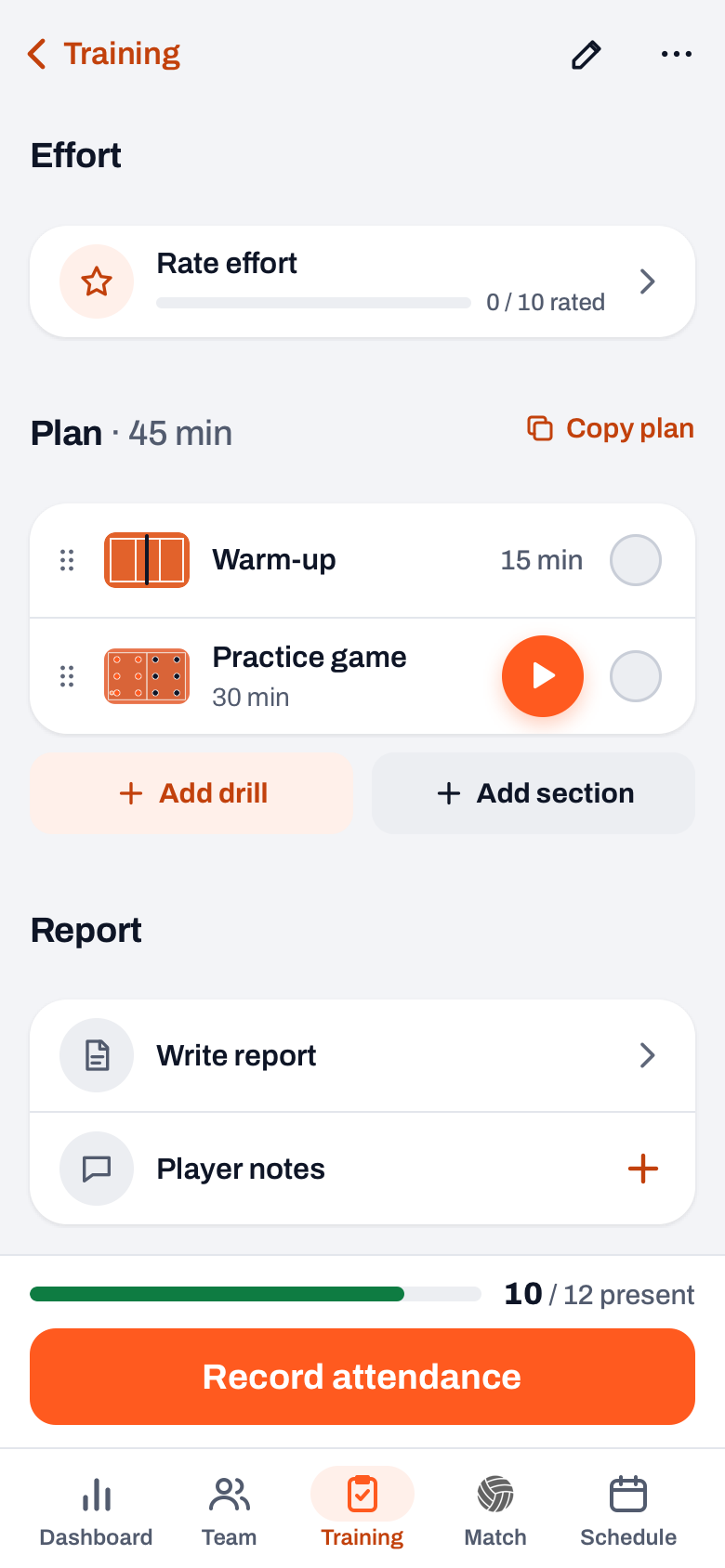
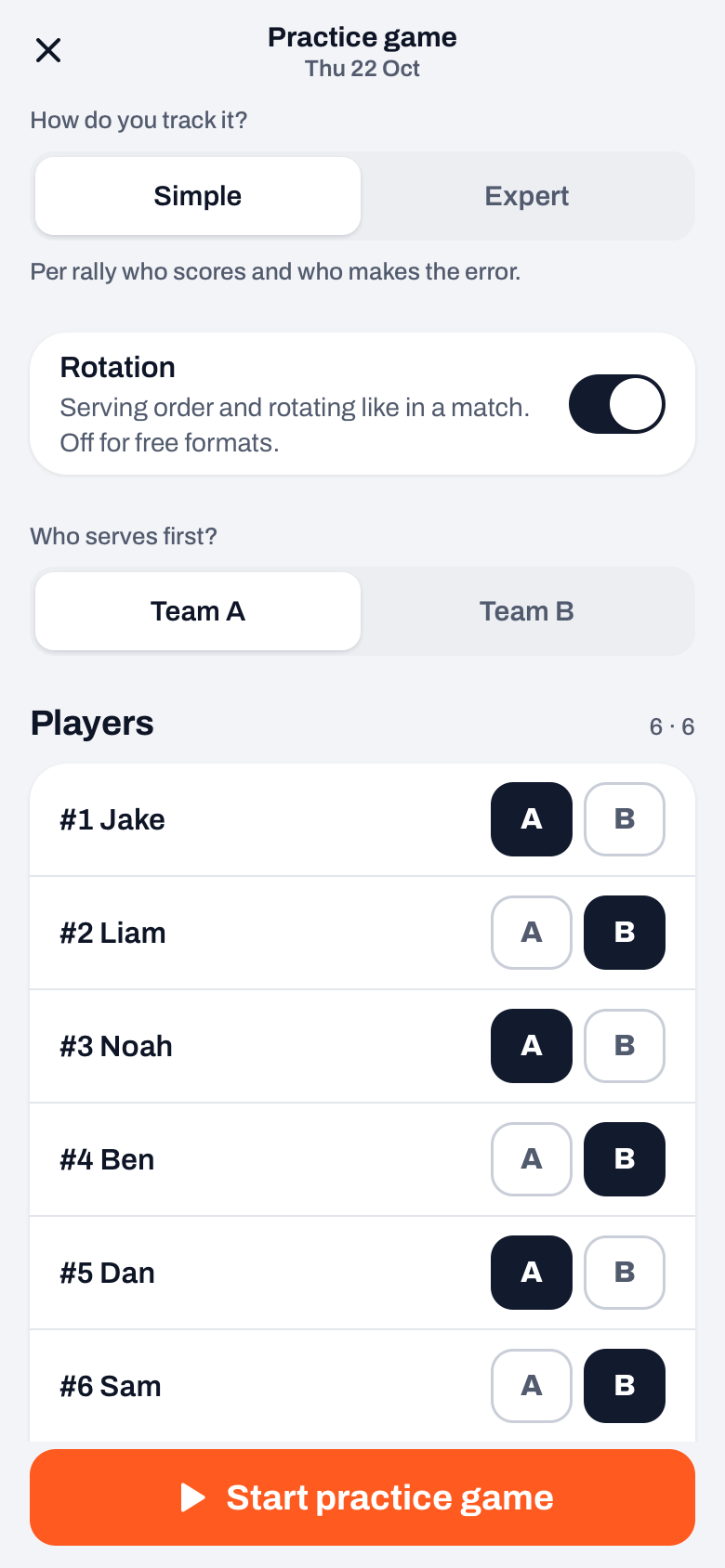
For the scrimmages with one ball and two fixed teams, such as Blind Volley, Joker Cards or Called Shot, you can start a Practice game. You put each player in team A or B, turn Rotation off for a free format, and teams smaller than six are allowed too. With New round you start again at 0-0, while the score of the previous round is saved, and you can move players to the other team in between. Afterwards you see points and errors for each player. Bonus points, such as those from a joker card or a called shot, are not counted by the app; you keep track of those yourself.
What Koach costs after the 14 free days is on the pricing page.
14 days free, no credit card. Put your favorite game in your plan as a section and play Thursday's scrimmage as a practice game.
Plan your practice in KoachFrequently asked questions
What are fun volleyball drills for teenagers?
Teens want a score, a record or a winner, and a bit of a challenge against each other. Games like Serve Battleship, HORSE, the One-on-One Net Duel and Volley Bowling work well for that reason: they have a clear score, lots of ball contact and a technical goal. Let the group choose now and then, and stop when the game is at its most exciting.
How do you make volleyball practice more fun without it becoming too casual?
Put one game per evening in your plan, ten to twenty minutes, and choose a game that trains what that evening is about. Stick to one coaching point during the game and count points or records. That way it stays a practice, and players only notice that it is more fun.
Which fun volleyball drills work for adults or recreational players?
Adults and recreational players like formats with a wink and lots of playing: Blind Volley with a sheet over the net, Joker Cards, Switching Pairs and a Sitting Volleyball Set are favorites. Build up the pace gradually, especially with a group that has just come from work, and skip formats with a lot of jumping if the group is not used to it.
How many players do you need for a fun volleyball drill?
That depends on the game. HORSE and the One-on-One Net Duel already work with two players, Serve Battleship and Laundry Basket Pass from six, and the scrimmages with two balls or joker cards work best with eight to twelve. If you have a small group, choose games in pairs or on small courts, so nobody waits for their turn.

Put your favorite game in your plan
14 days free, no credit card. Next month you find it again with one tap.
Get started with KoachOr read first what the volleyball coaching app does.