
Volleyball hairstyles: hair that stays put for the whole match
The short answer
Good volleyball hairstyles keep your hair out of your face and stay put when you jump and dive: a French braid, two braids, a low bun or a ponytail with a second hair tie. Use hair ties without metal and no hard hairpins. With short hair, a headband is often enough.
Volleyball hairstyles mainly have to do one thing: stay put, from the warm-up to the last point. Hair in your eyes on a set, or a ponytail that whips into your face with every jump, costs you points. Here are hairstyles for each hair length, including short hair and curls, and what the rules say about hair.
What does a volleyball hairstyle need to do?
- Keep your hair out of your eyes. When you set you look up, when you attack you look at the block. A strand in front of your eyes or bangs that keep slipping down get in the way at the wrong moment.
- Stay put. Jumping, landing, diving and rolling: after the first set, everything is still where it was.
- No hard parts. In a dive your head sometimes hits the floor, and at the net your head now and then bumps into someone else's. Leave out hairpins, clips and jewelry with hard or sharp parts.
- Not too tight. You wear it at every practice, so it still has to feel comfortable after an hour and a half.
- Quick to do. A hairstyle that takes fifteen minutes gets skipped on a busy Saturday morning.
Hairstyles for long hair
- The French braid. One braid from your forehead to the nape of your neck, picking up hair from the sides with every crossover. Loose strands at the sides get braided in, and it stays put the whole match, even after a dive. The downside: you have to be able to do it, or someone has to do it for you.
- Two French braids. The same, but with one braid on each side. Handy with a lot of hair or thick hair, and the weight does not all hang on one side.
- The ponytail with a second hair tie. The quickest: a ponytail at the back of your head, with another hair tie halfway down, or with the ponytail itself braided. That way it swings around less when you turn quickly or jump.
- The low bun. A bun at the nape of your neck or halfway up the back of your head, secured with hair ties instead of pins. A high bun on top of your head gets in the way when you roll over your back.
Hairstyles for medium-length hair
- A short ponytail with small braids at the front. Strands that will not stay in a ponytail you braid back from both sides of your forehead into the ponytail.
- Two low pigtails or two short braids. Medium-length hair often slips out of a single hair tie; in two sections it stays put better.
If short strands still come loose, put a thin headband over them.
Short hair and bangs
- A headband or sweatband. A band along your hairline keeps bangs and sweat out of your eyes. Choose a soft, elastic band without hard parts. With very short hair you often need nothing, except perhaps that sweatband.
Bangs (a fringe) that are just a bit too long you can also braid back or hold in place with a thin band. Soft hair clips without metal are possible, but they come loose more easily in a dive than a band does.
Curly and coily hair
- The high puff, or what you already wear. Gather curls loosely on top of your head with a wide, soft hair tie or a scrunchie, if you like with a headband along your hairline. If you wear braids, cornrows or twists, you can usually just play in them: they are already secure and stay in place the whole match.
Not too tight, for every hair type. A ponytail, bun or braids that you pull tight at every practice put strain on your hair. The American Academy of Dermatology warns that tightly pulled ponytails, buns and braids can cause hair loss (traction alopecia) that can become permanent, and recommends alternating such styles and wearing them looser. If a hairstyle hurts, it is too tight. If you notice thinning hair along your hairline, see your family doctor or a dermatologist.
What do the rules say about hair?
The FIVB Official Volleyball Rules 2025-2028 have no rule about hairstyles. Rule 4.5.1 does forbid objects that may cause injury or give an artificial advantage. The official FIVB casebook 2025 distinguishes between hard objects that can injure others and soft, fabric materials (case 1.1). So a metal hairpin or a clip with hard points can fall under the ban, a soft headband does not, and when in doubt the first referee decides (rule 23.2.3). What else the rules say about clothing and jewelry is in volleyball uniform rules. Hair touching the net is not mentioned separately in the rules either: contact with the net by a player between the antennae during the action of playing the ball is a fault (rule 11.3.1), and whether a ponytail touching the net counts as that is for the referees to judge, who decide on net contact (rules 23.3.2.3c and 24.3.2.3).
Ready for the match fast, also for youth players
- Do it at home. Braid before you leave, not in the locker room five minutes before warm-up. A braid done in the morning usually lasts until the end of the match.
- Teach kids to do a ponytail. Almost anyone can do a ponytail with a second hair tie themselves; then nobody has to wait for a parent.
- A bag of hair ties in the team bag. Without metal, plus a few headbands. A hair tie always breaks at the worst moment.
- At an all-day tournament a braid holds better than a ponytail you redo between every match. What else to bring is in the volleyball tournament packing list.
- No comments about how someone looks. As a coach you care about vision and safety, not about style. Whether a player has long hair, short hair, curls, braids or a shaved head: the only question is whether it stays put and whether there is nothing hard in it.
What else a child needs to get started is in what does my child need for volleyball. What long nails do on a set is in can you play volleyball with long nails.
Put it in your agreements for the season. Agree once at the first practice: hair out of your face, nothing hard in your hair, hair ties in the team bag. Then the coach does not have to take anyone aside on match day.
Out the door on time, hair already done
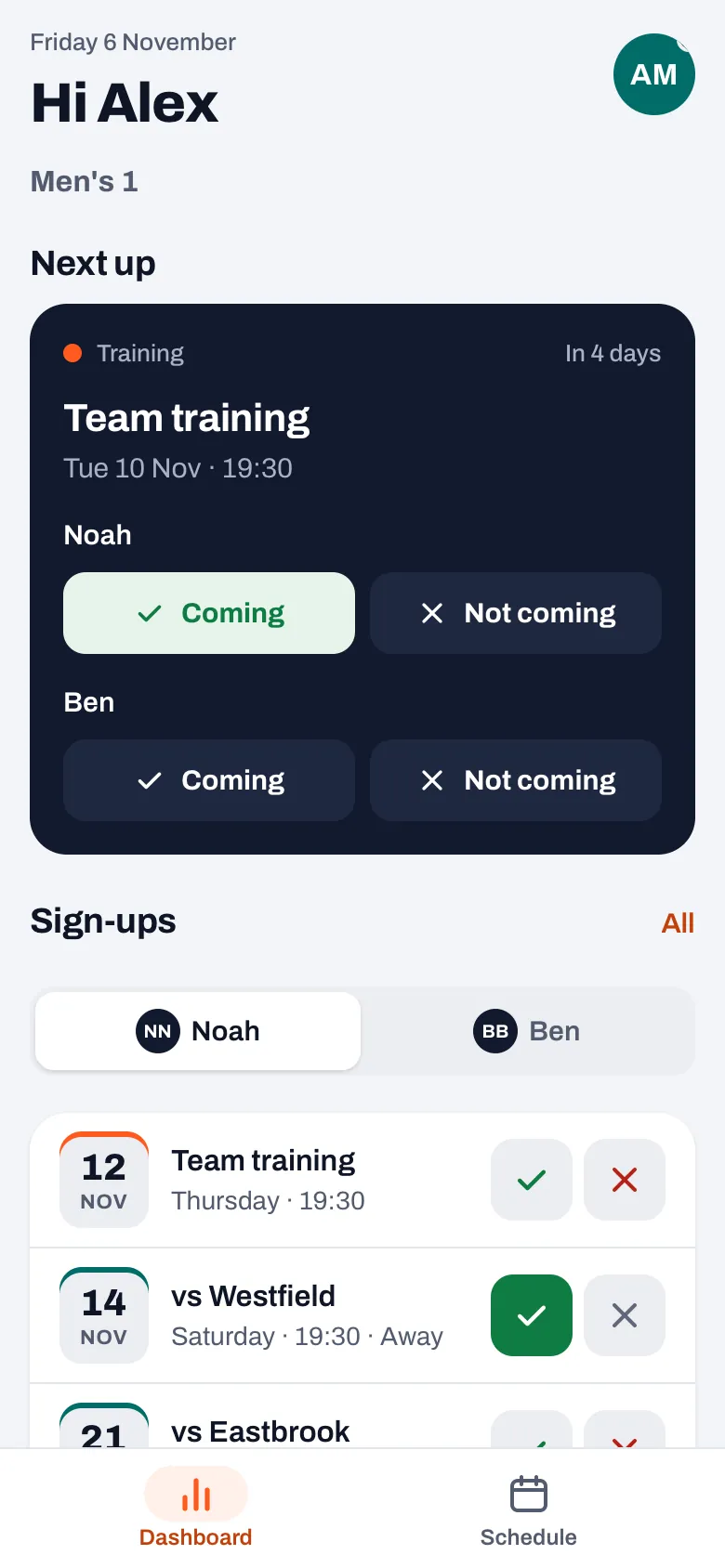
Braiding at home only works if you know what time you need to leave. If the team uses Koach, parents see the next practice or match on their dashboard with the day and the time, and sign their child up or off there with Coming or Not coming. With two children on the team, they are listed one below the other. The coach can also post a message in the announcements, such as "Saturday: meet at 8:15, hair already done". Koach does not do hairstyles, but it does handle the planning around them.
14 days free, no credit card. Add your team, and parents see from the first week when they need to leave.
Try Koach with your teamNew as a coach? Read which agreements to make at the start of the season in starting as a volleyball coach. What Koach costs after the trial is on the pricing page.
Frequently asked questions
Can you wear a hairpin in volleyball?
The FIVB rules forbid objects that can cause injury. A metal pin or a clip with hard points can fall under that, and when in doubt the referee decides. Use a hair tie without metal or a soft headband instead: they also stay put better in a dive than a pin does.
Can you wear a headband or sweatband in volleyball?
The rules do not mention headbands. A soft, elastic band without hard parts causes no injury and gives no advantage, and the FIVB casebook distinguishes hard objects from soft, fabric materials. So the rules raise no objection. If you want to be sure, for example with a band that has a striking print or hard parts, ask the referee before the match.
How do you keep bangs out of your eyes in volleyball?
With a thin headband or sweatband along your hairline, or by braiding your bangs back into your ponytail. Soft clips without metal work too, but they come loose more easily in a dive. When you get a haircut, keep your bangs long or short enough to fit one of those styles.
What do you do with long hair at an all-day tournament?
Do a French braid or two braids at home in the morning. They stay put between matches, while a ponytail comes loose after a few matches and you keep having to redo it. Bring spare hair ties without metal and a headband, and undo the braid after the tournament so your hair is not pulled tight all day.
Put your team and your schedule in Koach
14 days free, no credit card. Parents see right away what time to be there.
Get started with KoachOr read first what the volleyball coaching app does.