
Can you play volleyball with long nails? The rules and the risks
The short answer
Playing volleyball with long nails is not forbidden: the rules do not mention nails. They do forbid objects that can cause injury, and the referee decides when in doubt. It is not wise, though: long and artificial nails can tear when you set and block, and they get in the way of your technique.
Can you play volleyball with long nails? Many players wonder, and the answer has two sides: what the rules say, and what is simply sensible. Here is what long and artificial nails do to your sets and your block, what to do if one tears, and how to handle it as a player, parent or coach.
Are long nails allowed in volleyball? What the rules say
The FIVB Official Volleyball Rules 2025-2028 do not mention nails anywhere. There is no maximum length, and no rule about artificial nails or nail polish. Rule 4.5.1 does forbid wearing objects that may cause injury or give a player an artificial advantage. What that means for jewelry and clothing is in volleyball uniform rules.
Do long or sharp artificial nails fall under that rule? The rules do not say. The first referee decides on everything to do with the match, including matters the rules do not cover (rule 23.2.3). If the referee finds something dangerous to you or to others, they can ask you to deal with it first. The official FIVB casebook 2025 gives a ring as an example: it has to come off or be taped over (case 1.2). There is no case about nails. You cannot simply remove an artificial nail in the gym, so if you are unsure, ask before the match. Some federations and competitions also have their own rules; check your own federation's rulebook for those.
In short: the rule is only that you wear nothing that can cause injury. Short nails are advice, and that advice is mostly about your fingers and your technique.
What do long nails do to your game?
- Setting. In a good overhead set, the ball lands on the pads of your fingers, with your fingers slightly bent. If your nails stick out, the ball hits your nails first. You then automatically play with stiffer fingers or with your palms, and the ball comes off less cleanly. How the fingers should be positioned is in overhead setting.
- Blocking. Your fingers are spread and tense above the net. A hard attack on your fingertips pushes a long nail back, and a nail can catch in the net mesh.
- Passing. The ball hits your forearms, so you notice less there. With some grips your nails do press into your other hand.
- Defense and diving. In a dive or a roll your hands land on the floor, and nails that scrape across the floor catch and split.
- At the net. Two hands that meet in a joust above the net can leave a scratch when nails are long or sharp, on you or on someone else.
A nail tears or breaks: what now?
Stop playing and look at what happened. Do not pull on a nail that is half loose. Do not pick at gel polish or an artificial nail that is lifting either: the American Academy of Dermatology advises against peeling off gel polish or prying it off with other nails or tools. Cover the finger and have someone with first aid experience take a look; what belongs in a team's first aid kit is in volleyball first aid.
According to the same academy (its page on an injured nail, updated in July 2023), it is time to see a doctor if blood covers more than half of the area under the nail, if you cannot bend the finger, if the nail turns black or purple, if it is very painful, or if it does not get better after a few days. If you are unsure, or a finger stays painful, see your family doctor, a sports physician or a physiotherapist. How to handle fingers that get injured more often, and when tape helps, is in taping fingers in volleyball.
Acrylic nails, gel and volleyball
Artificial nails carry their own risk. According to the American Academy of Dermatology, with acrylic nails your own nail is roughened first, which makes it thinner and weaker, and gel nails are more flexible than acrylics, so your natural nail is less likely to crack (tips on artificial nails, accessed on 6 November 2026). For volleyball that means: if a hard artificial nail breaks off on a block, it can take part of your thinned natural nail with it.
The same academy recommends saving artificial nails for special occasions. If you play during that time, keep them short and rounded. Regular nail polish makes no difference to your game: it changes nothing about the length or the hardness of your nail.
Short for the season: how to go about it
- Not past your fingertip. A practical check: look at your fingers from the palm side. If you see your nails sticking out above your fingertips, the ball will hit them when you set.
- File them round. No sharp corners. The American Academy of Dermatology recommends rounding the nails slightly at the tips, because that makes them stronger (tips for healthy nails).
- Your toenails too. When you jump, land and stop, your toes press against the front of your shoe. The same academy recommends keeping toenails short to reduce the risk of injury.
- A nail clipper in the team bag. For the player who forgot, and for a torn edge you want to clip straight before it tears further.
With youth players. Mention it at the start of the season to players and parents, as an agreement for everyone: short nails, no jewelry. Then you never have to take anyone aside later. Talk about fingers and safety, not about how someone looks, and if a child wants to keep them a little longer, ask that they are rounded and do not go past the fingertip. What else a child needs to get started is in what does my child need for volleyball. And long hair? For that there are volleyball hairstyles that stay put for the whole match.
Do the fingertip check before warm-up. At the first practice of the season, have the team hold their hands up in the setting position. Anyone who sees their nails sticking out above their fingertips knows enough, without the coach having to say a word.
Reporting a torn nail in Koach
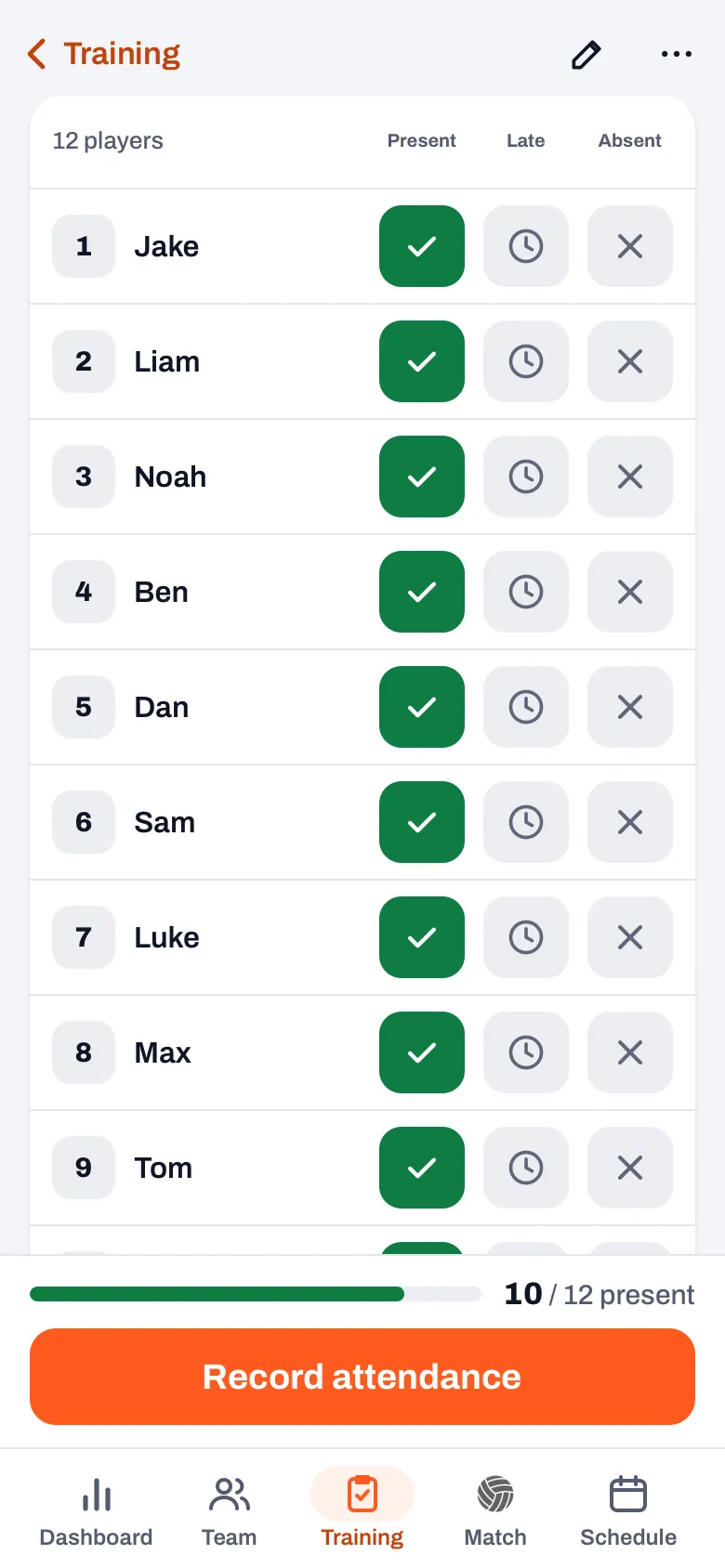
If you cannot set for a few practices after a torn nail, let your coach know in advance. If your team uses Koach and you have your own player account, you do that when you sign up for the practice. If you are not coming, say so: Koach asks for a reason right away, and there you pick, for example, Injured (you can also do it later with Add reason). If you are coming but need to adjust something, tap Add comment and write something like "torn nail, no setting this week". Below the text box it says Coaches only: your teammates do not see it. Your coach sees it in the attendance list under your name and can adjust the drills before practice starts.
14 days free, no credit card. Set up your practices and know before practice starts who is there and who needs to adjust something.
Try Koach with your teamNew as a coach and want to set up agreements like this from the start? Read starting as a volleyball coach. What Koach costs after the trial is on the pricing page.
Frequently asked questions
Can you play volleyball with acrylic nails?
The FIVB rules do not mention artificial nails. They do forbid objects that can cause injury, and the first referee decides when in doubt. It is not wise: a hard acrylic nail can break off on a block or a set and take part of your own nail with it. If you want them anyway, keep them short and, when in doubt, ask the referee before the match.
How short should your nails be for volleyball?
There is no fixed length. A practical limit: your nails do not stick out past your fingertips when you look at your fingers from the palm side. Then the ball lands on the pads of your fingers when you set, not on your nails. File the tips round, without sharp corners.
Can you play volleyball with nail polish?
Yes. Nail polish is not an object that can cause injury and gives no advantage, and the rules say nothing about it. It makes no difference to your game either: polish changes nothing about the length or the hardness of your nails. Only the length and the shape matter.
Should your toenails be short for volleyball too?
That is wise. When you jump, land and stop, your toes slide against the front of your shoe, and a long toenail takes that pressure. The American Academy of Dermatology recommends keeping toenails short to reduce the risk of injury. If a toe stays painful or the nail changes color, have your family doctor take a look.

Know before practice who needs to adjust
14 days free, no credit card. A reason or comment shows up right away in your list.
Get started with KoachOr read first what the volleyball coaching app does.