
Volleyball rules quiz: 25 questions with answers and explanations
The short answer
This volleyball rules quiz tests the rules in 25 questions, split into three rounds: the basics, rules during the match and questions for the referee. Every answer comes with the rule number from the FIVB Official Volleyball Rules 2025-2028, so you can look it up yourself.
With this volleyball rules quiz you find out in fifteen minutes how well you know the rules. Use it with your team at the end of practice, with parents at a club night or on your own before you referee for the first time. Each round starts with the questions; the answers and explanations follow below.
How to play this rules quiz
The quiz has three rounds, from the basics to the referee's decisions. Read the questions out loud, have groups of three or four write down their answers and give one point per correct answer. On your own, cover up the answers.
All answers come from the official rulebook of the international volleyball federation: the FIVB Official Volleyball Rules 2025-2028, the rules for six-player indoor volleyball. Your own federation or league may add to them for its competitions, for example lower nets for youth or a fixed number of sets. The rules themselves are explained in all the volleyball rules at a glance.
Round 1: the basics
- How many players from one team are on the court at the same time? a) 5 b) 6 c) 7
- How big is the playing court, not counting the space around it? a) 16 by 8 meters b) 18 by 9 meters c) 20 by 10 meters
- How high is the net for women? a) 2.15 meters b) 2.24 meters c) 2.43 meters
- True or false: a ball that only touches the end line is out.
- How many times may a team touch the ball before it has to go over the net, and does a block count?
- Are you allowed to play the ball with your foot?
- To how many points is a set played, and to how many the deciding fifth set?
- Which player serves? a) the player in position 1, right back b) position 4, left front c) position 6, middle back
- True or false: a serve that touches the net and then lands in the court on the other side wins the point for the serving team.
Answers round 1
- b) Six. A team must always have six players in play (Rule 7.3.1); more players may be listed on the score sheet.
- b) 18 by 9 meters, surrounded by a free zone at least 3 meters wide (Rule 1.1). All the lines and zones are in the dimensions of a volleyball court.
- b) 2.24 meters. For men it is 2.43 meters, measured at the center of the court (Rule 2.1.1). For youth, your federation sets lower heights.
- False. The lines are part of the court. If any part of the ball touches the line, it is in (Rule 8.3).
- Three times, and a block does not count (Rules 9.1 and 14.4.1). So after a block touch your team still has three contacts. The exceptions are in how many times you can touch the ball.
- Yes. The ball may touch any part of the body (Rule 9.2.1). Only the serve is hit with one hand or any part of the arm (Rule 12.4.1).
- To 25, with a lead of at least two points; at 24-24 play continues until one team is two points ahead (Rule 6.2). The team that wins three sets wins the match, and at 2-2 the fifth set is played to 15, also with a two-point lead (Rule 6.3). See how many sets a match has.
- a) The player in position 1, right back. They serve from the service zone behind the end line (Rules 12 and 7.4.1.2).
- True. The ball may touch the net while crossing it (Rule 10.2). If it does not cross the net between the antennae, or touches a player of the serving team, it is a service fault (Rule 12.6.2.1).
Round 2: rules during the match
- The receiving team wins the rally. What happens besides the point?
- How many time-outs does a team have per set, and how long does one last?
- How many substitutions may a team make per set, and may a starting player who came off return in a different position?
- Does a Libero replacement count toward those substitutions?
- What is the libero allowed to do? a) serve b) block c) play a ball over the net that is partly below the top of the net
- A back-row player takes off on the attack line and hits a ball that is completely above the top of the net over the net. Is that allowed?
- How many seconds does the server have after the whistle?
- True or false: at the serve, the serving team also has to be in its rotational order.
Answers round 2
- The team gets the serve and rotates one position clockwise: the player in position 2 moves to position 1 and serves (Rules 6.1.3 and 7.6.2).
- Two per set, of 30 seconds each (Rules 15.1 and 15.4.1).
- Six per set, and no. A starting player may leave the game once per set and come back once, and only to their own position in the lineup (Rules 15.1 and 15.6.1).
- No. Libero replacements do not count as substitutions and are unlimited, but there must be a completed rally between two Libero replacements (Rule 19.3.2.1).
- c). The libero may not serve, block or attempt to block (Rule 19.3.1.3). From anywhere on the court, they may not complete an attack hit on a ball that is entirely above the top of the net; if the ball is partly lower, it is allowed (Rule 19.3.1.2). See can the libero spike or block.
- No. A back-row player may only attack a ball that is entirely above the top of the net if they take off from behind the attack line, without touching it (Rule 13.2.2). The fault counts as soon as the attack hit is completed: the ball has completely crossed the net or is touched by an opponent (Rules 13.1.3 and 13.3.3).
- Eight seconds (Rule 12.4.4). If you serve before the whistle, the serve is canceled and repeated (Rule 12.4.5). See the 8-second rule.
- False. Since the 2025-2028 edition, only the receiving team has to be in its rotational order at the moment of the service hit; the players of the serving team may stand anywhere on their own court (Rule 7.4). The service order still applies. See positional faults.
Round 3: questions for the referee
- Your team's serve receive goes outside the antenna into the opponent's free zone. May your team play the ball back? And if it was the second ball, your setter's set?
- May a front-row player block the opponent's serve?
- A blocker touches the net between the antennae when landing, while the rally is still going on. Is that a fault?
- True or false: your foot may touch the opponent's court.
- Players of both teams commit a fault at the same moment. What does the referee decide?
- A player gets a yellow card for minor misconduct. What does it cost the team? a) nothing b) a point c) the rest of the set
- Who whistles a positional fault by the receiving team?
- When do the teams change courts in the deciding set?
Answers round 3
- The pass yes, the second ball no. A ball from the team's first contact may be played back within the team hits, if it returns outside the antenna on the same side and the player does not touch the opponent's court (Rule 10.1.2). A ball from the team's second or third contact is out as soon as it crosses the vertical plane of the net (Rule 10.1.2.3). This also changed in 2025; see the new volleyball rules.
- No. Blocking a serve is always a fault (Rule 14.5). Attacking a serve in the front zone when the ball is entirely above the top of the net is not allowed either (Rule 13.2.4).
- Yes. The action of playing the ball includes the take-off, the hit and the landing (Rule 11.3.1). See the net fault.
- True, with a condition: part of the foot stays on or directly above the center line and you do not interfere with the opponent (Rule 11.2.2.1). If the foot goes completely across, it is a fault (Rule 11.4.3).
- A double fault: the rally is replayed and nobody gets a point (Rule 6.1.2.2). See the double fault.
- a) Nothing directly. The yellow card is a formal warning: it is recorded on the score sheet, but has no immediate consequences (Rule 21.1). Only a red card, for rude conduct, costs a point and the serve (Rule 21.3.1).
- The second referee (Rule 24.3.2.2). The first referee judges the server and the positions of the serving team, including screening (Rule 23.3.2.3). See the duties of the second referee.
- As soon as the leading team reaches 8 points. That happens without delay, and the players keep their positions (Rule 18.2.2).
Start the season with questions 17 and 18. Those are two rules that changed in 2025, and players who have been playing for years may still know the old version. Five minutes at the first practice can save you a point in the first match.
How many points did you get?
- 0 to 12: you know the game, not the details. Read the rules overview and take the quiz again in a month.
- 13 to 20: enough to follow a match and coach your team. The misses are usually in round 3.
- 21 to 25: you are ready to referee a scrimmage. Do keep an eye on the extra rules of your own league.
The quiz at practice, and the rules in the app
A quiz does not have to fill an evening. Use one round to close a practice or as a break at a training camp: groups of three, one answer sheet per group, and the losers pick up the balls. In Koach, put it in your practice plan with the Add section button, for example named "Rules quiz round 2" with 10 minutes, so you can bring it back next time with Copy plan.
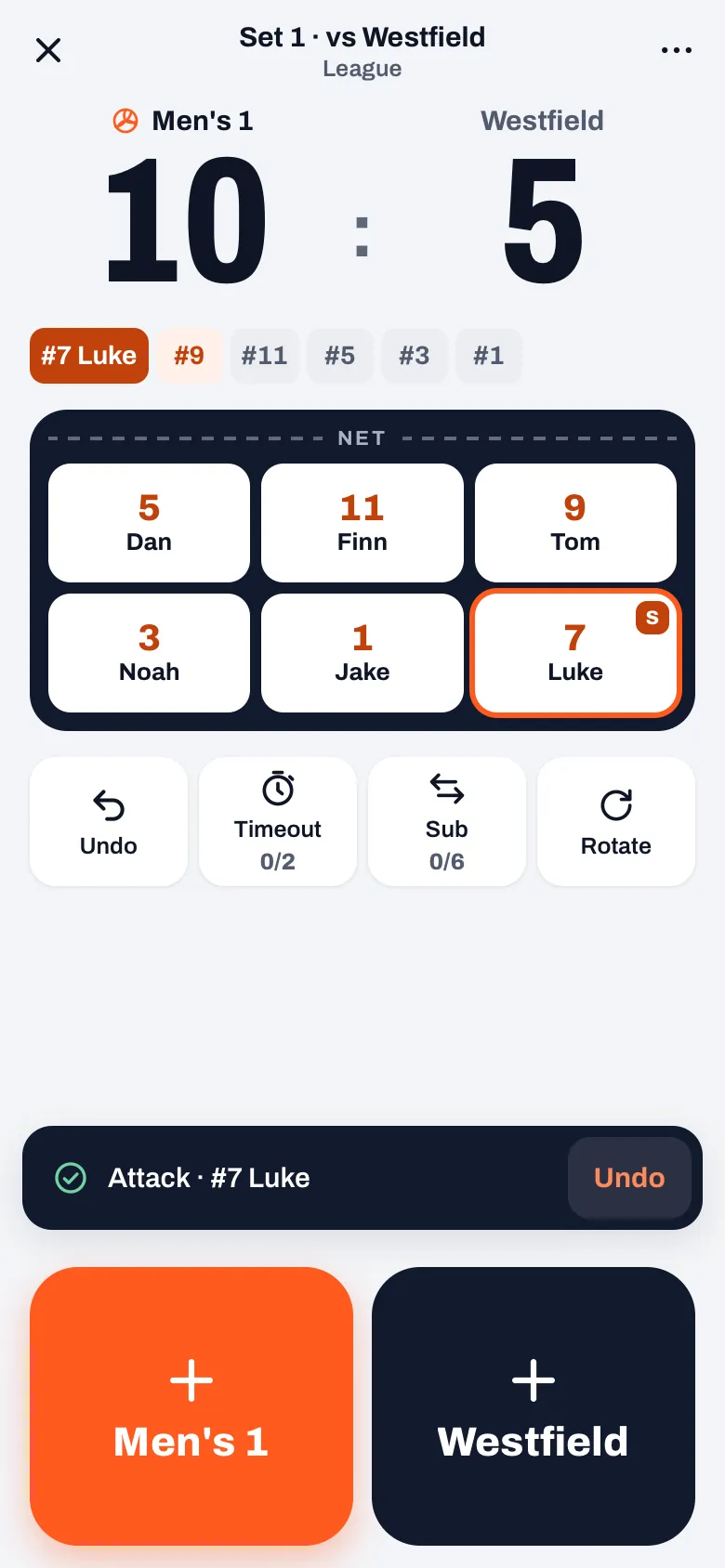
On match day Koach keeps track of the same rules as in round 2. Below the court are the Timeout and Sub counters; a third timeout or a seventh substitution in a set does not go through, a return substitution that does not add up makes the app ask Is this substitution allowed?, and with Libero auto swap on, the default, the libero does not end up in the front row or at the service line. After your team wins a rally on the opponent's serve, the lineup on the screen rotates along.
14 days free, no credit card. Score your next match live and let the app count the timeouts and substitutions for you.
Try Koach with your teamWhat Koach costs after the trial is on the pricing page.
Frequently asked questions
Where can I find the official volleyball rules?
On the website of the FIVB, the international volleyball federation, you will find the Official Volleyball Rules 2025-2028 for indoor volleyball and, separately, the rules for beach volleyball. Your national federation usually publishes the rules as well, along with its own competition regulations, covering for example the net heights for youth and the number of sets in its leagues.
Is this volleyball rules quiz suitable for kids?
Round 1 works well from about age ten, especially with the multiple-choice questions. Round 3 is more for older youth and adults who are going to referee. If kids still play mini volleyball, each federation has its own rules for the court, the net and catching, and some answers do not apply to their matches.
Do these answers also apply to beach volleyball?
Not all of them. Beach volleyball has its own FIVB rulebook: two players per team, a 16 by 8 meter court, sets to 21 with a deciding third set to 15, and there a block touch does count as a team contact. The adult net heights are the same as indoors: 2.43 meters for men and 2.24 meters for women.
How often do the volleyball rules change?
The FIVB publishes the rulebook in editions that apply for several years. The current edition, 2025-2028, applies to competitions that started after January 1, 2025, and brought among other things the free positioning of the serving team and a limit on playing the ball back from outside the antenna. Your national federation decides when a new edition takes effect in its competitions, so check with your federation.
Score your next match by the rules
14 days free, no credit card. The app counts timeouts and substitutions for you.
Get started with KoachOr read first what the volleyball coaching app does.