
Volleyball sayings: short team mottos for practice and match day
The short answer
Volleyball sayings are short lines that say what your team stands for, such as "Nobody scores alone" or "A mistake is one point, not a set". Choose one with your team for the season and put it where players see it: in the locker room, on a practice shirt or under the message before the match.
Volleyball sayings are short lines that remind your team of something: playing together, carrying on after a mistake, keeping it fun. Here are original examples by theme, the places where a saying works, how to choose one with your team and what to leave out with youth players.
What makes a good volleyball saying?
A saying is different from a cheer or a team name. You shout a cheer together in the huddle, see volleyball team cheers. A team name is on the match schedule, see volleyball team names. A saying is something you read: on the locker room wall, on a shirt, under a message. It works when you don't have to think about it. Five things make the difference:
- Short. It fits on one line. What you can't read in one go, nobody remembers.
- About what you do, not about the result. "We win everything" stops working after the first loss. "Every ball is ours until it hits the floor" also works when you are behind.
- Visible at practice. A good saying describes behavior you can point at: someone who is ready again after a mistake, a player who calls the ball.
- In your team's language. A pun in another language usually falls flat. If your team speaks several languages, choose words everyone knows.
- Yours. Your own words or a proverb everyone knows. A line the team chose itself means more than a sign from a gift shop.
If your team has agreed on values, a saying is the short version of them. How to choose those values together and turn them into behavior is in volleyball team culture.
Team sayings and mottos by theme: examples to start with
The sayings below are original examples or proverbs everyone knows. You are free to use them, adapt them or take them as a starting point for a line of your own. The proverbs are English ones; in another language the same thought often has its own proverb, and that fits better than a translation.
Playing together
- Nobody scores alone.
- Six players, one ball, one team.
- Every pass is a gift to the next player.
- Call the ball, help the team.
- There is no I in team. (saying)
Keeping going
- Every ball is ours until it hits the floor.
- One point at a time.
- Behind is not beaten.
- Nothing is over until the last whistle.
- Where there's a will, there's a way. (proverb)
After a mistake
- A mistake is one point, not a set.
- Missed it? Head up, hands ready.
- Be brave: missing is allowed.
- We make mistakes together, and points too.
- Nothing ventured, nothing gained. (proverb, for anyone trying a tough serve)
Fun and practice
- What you practice on Tuesday, you play on Saturday.
- One thing better every practice.
- Fun first, the points will follow.
- Laughing is allowed, even when we're behind.
- Practice makes perfect. (proverb)
After a mistake, a saying only helps if the team also knows what to do next. How players learn to deal with a run of errors and with pressure is in mental training in volleyball.
Where do you use a volleyball saying?
- In the locker room or the gym. On a sheet on the wall or on the board where the lineup hangs. Ask the club or the facility manager whether you may put something up.
- On a practice shirt or the bag. Small on the sleeve or on the back. Only put it on clothing once it has held up for a few weeks.
- Under the message before the match. One line below the time and the venue. Short, and the same every week.
- As the saying of the week. Each week, pick a line that fits what you are working on at practice, and say it out loud at the start.
- As a code word during the match. If the team knows the saying, one word from it is enough to remind everyone in a time-out or after a run of points against you.
Link the saying of the week to your practice. If you are working on serve receive this week, pick a line like "Ball first, then the rest". Say it at the start of practice, and at the end ask who showed it. That way a line on the wall becomes something you see on the court.
Choosing a saying for the season together
A saying the coach puts up, players read. A saying the team chose itself, they use. Set aside fifteen minutes for it at the start of the season:
- Start with a question. What does this team want to be known for at the end of the season? Let everyone think on their own first, and only then talk.
- Everyone writes one line. On a slip of paper, without a name. That way the quiet player gets their idea in too, and the loudest voice does not win by default.
- Shorten the list. The coach and the captain remove anything longer than one line, anything about others and anything that only works when you win. Leave three lines.
- Choose and test. Vote on the last three and put up the winner for four weeks. If it still stands after a lost match, it is your saying.
A saying for the season and a saying of the week go fine together. The first one sticks, the second keeps things fresh. With youth teams, let a different player choose the saying of the week each time, from a list you made together.
Which sayings don't work, especially with youth players?
- Sayings that glorify pain. Slogans along the lines of "no pain, no gain" push players to keep going while something hurts. Anyone in pain stops and says so. If the pain doesn't go away, or is severe, a doctor, sports physician or physiotherapist should take a look.
- Sayings where only winning counts. For a team at the bottom of the table, a line like that becomes a joke that works against the team.
- Anything about the opponent or the referee. Even if it is meant as a joke, the other side reads it differently.
- Anything about height, weight or looks. Not even as a joke about yourself: there is always someone on a team who takes it personally.
- Quotes without a source. A line that circulates online with the name of a famous player or coach attached often has no source. Only add a name if you can check yourself where and when that person said it, for example in an interview you can read back. Your own words are easier and fit better.
- Lines from songs or films. Those belong to the people who made them. Turn the idea into a line of your own.
Choosing and sharing a saying in Koach
Torn between three sayings? Put them in a poll. On your dashboard, tap New at Announcements, choose Poll and enter the sayings as options. As a coach you see for each option who voted for it and who has not voted yet; how that works is in see who voted in a team poll. Two things to know: parents of active players can vote too, and a player without their own account cannot. If you want only the team to choose, say so in the question, or with young players make the final choice at practice with a show of hands.
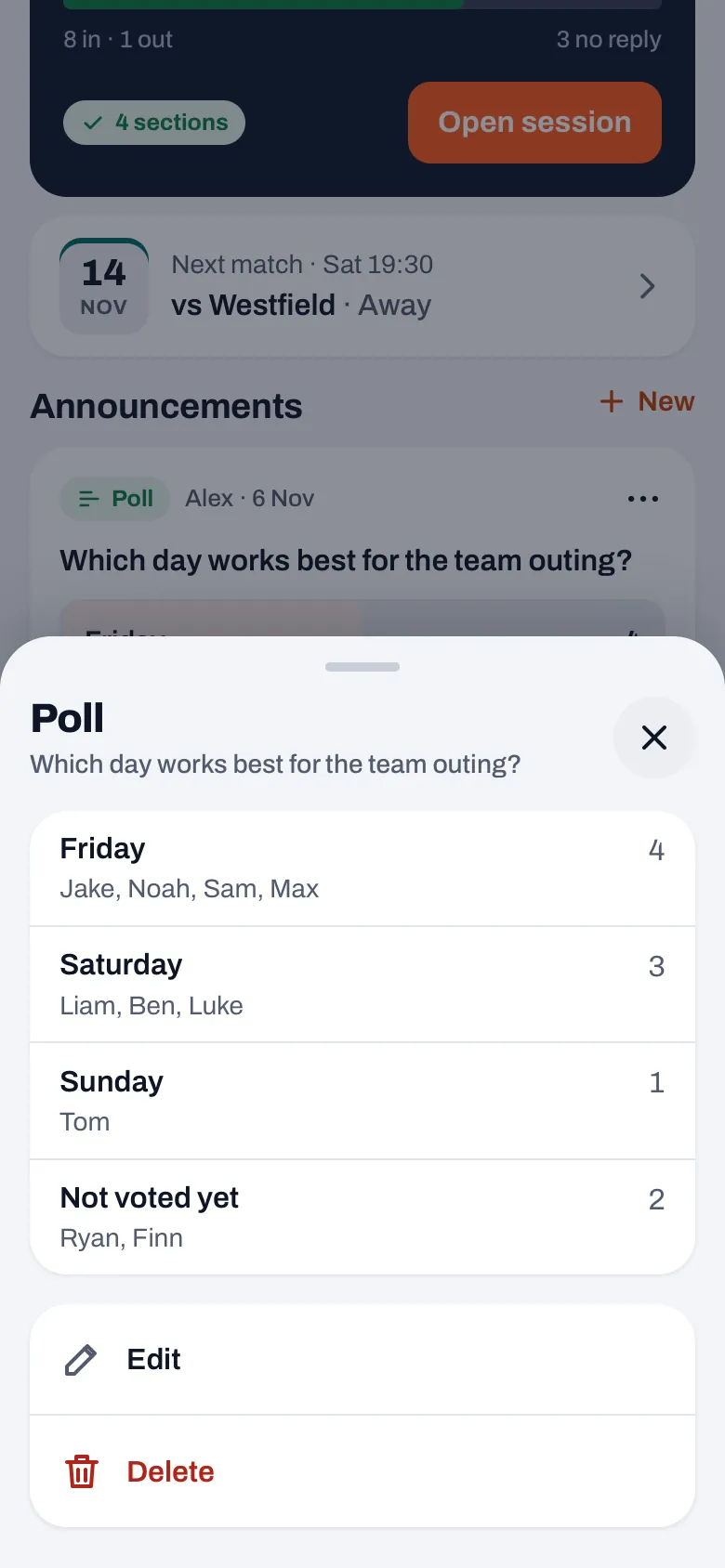
Once the saying is settled, or if you pick a saying of the week, post it under Announcements with New as a Message. Players and parents then see it on their dashboard when they open the app to say whether they are coming. More about what else managing a team involves is in managing a volleyball team. What Koach costs after the 14 free days is on the pricing page.
14 days free, no credit card. Have your team vote on a saying for the season this week, and see who hasn't chosen yet.
Try Koach with your teamFrequently asked questions
What is a good short saying for a volleyball team?
A one-line sentence about behavior rather than the result, so it still holds after a lost match. Examples are "Nobody scores alone", "One point at a time" and "A mistake is one point, not a set". Let the team choose from a few suggestions: a saying the players picked themselves gets used more than a line from the coach.
What is the difference between a team saying and a cheer?
You shout a cheer together, short and out loud, at fixed moments such as before the match or after a time-out. A saying is something you read: on the locker room wall, on a shirt or under a message. A team can have both, and a word from the saying often comes back in the cheer.
Can you use a quote from a famous volleyball player as a team saying?
Only if you are sure that person really said it. Many lines that circulate online with a famous name attached have no source. Look it up in an interview, a book or an official channel you can read back. If you can't find it, use the thought in your own words and without a name.
Which sayings suit a youth team?
Sayings about playing together, having fun and trying again, such as "Be brave: missing is allowed" or "One thing better every practice". Avoid lines about pain, about winning as the only goal, about the opponent or about height and looks. Let kids take turns choosing the saying of the week from a list you made together.



Choose your team saying with a poll
14 days free, no credit card. You see right away who has already voted.
Get started with KoachOr read first what the volleyball coaching app does.