
Volleyball team cheers: how to make one together that sticks
The short answer
Good volleyball team cheers are short, easy to shout along with and about your own team, never about the opponent. Make yours together with your players, keep it under five seconds and use it at fixed moments: before the match, after a time-out or after the last ball.
Volleyball team cheers are more than noise: a cheer is the moment when six players turn from individuals into a team. Here you read when a cheer works, how to make one together with your team, examples to start with and what to avoid with youth teams and toward the opponent.
Why a team cheer works, and when it does not
A cheer is a short, fixed ritual. Everyone stands in the huddle, everyone shouts the same thing, and then the work begins. That helps in three ways: it marks a transition (from warm-up to play, from time-out to the next rally), it makes a quiet team audible, and it gives new or shy players a moment where they belong without having to do anything special.
A cheer does not turn a group into a team. How players treat each other when things go wrong and when someone makes a mistake is something you see at practice, not in the huddle. If you are working on that, read volleyball team culture. A cheer is the short, audible side of that culture, not a replacement for it.
On adult teams a cheer sometimes feels childish. That is no reason to skip it, but it is a reason to choose a low-key version: hands in the middle and one word, or just the team name. What counts is that the whole team does the same thing at the same moment.
The quick huddle after every point is something else again: that is short communication within the match itself. Why volleyball players do that is in why volleyball players do that. This article is about the cheer at fixed moments.
When do you use your team cheer?
- Before the match. After the warm-up, when the starting lineup is known and the team is in the huddle. This is the fixed moment; if you only have one cheer, it belongs here.
- After a time-out. Under the rules a time-out lasts 30 seconds (FIVB rule 15.4.1). A three-second cheer at the end fits; a long song does not. When the referee whistles to resume play, you go back on court. Prolonging an interruption after being instructed to resume the game counts as a delay (rule 16.1.2), and delays carry sanctions. What you do say in that half minute is in using time-outs.
- Before a new set. Short, in the huddle, when the team needs to reset after a lost set.
- After the match. First you shake hands with the opponents and the referees, then your own huddle. After a loss that can be a quiet version: the same ritual, a different tone.
How to make a team cheer together in four steps
A cheer the coach makes up gets shouted along with for a few weeks. A cheer the team makes itself sticks longer. Set aside twenty minutes at a practice for it, for example at the start of the season.
- Choose the format. Call and response (the captain calls, the team responds), a countdown with a final word, a rhythm of claps or stomps with the team name, or one word that means something to the team.
- Have pairs come up with ideas. Ten minutes, one idea per pair. The captain collects them and reads them out. If your team has its own name, the cheer is often halfway there; ideas for a name are in volleyball team names.
- Test the ideas. Is it shorter than five seconds? Can everyone shout it, including players who are shy or less fluent in the language? Is it about us and not about them? Is it still fun after ten times?
- Choose and rehearse. Vote, and use the winner right away at the end of that practice. Agree on who starts it: the captain, or whoever serves first that day. That way it does not depend on one person.
After a month, check whether it still works. A cheer nobody shouts with conviction anymore can be replaced. When new players join, have the captain explain it before their first match.
Cheer examples to start with
These examples are meant to be adapted. Put in your own team name or a word that belongs to your team, and it becomes yours.
| Format | Example | When |
|---|---|---|
| Call and response | Captain: "Who are we?" Team: "(team name)!" Captain: "And what do we get?" Team: "Every ball!" | Before the match |
| Countdown | "One, two, three: together!" | After a time-out |
| Rhythm | Three claps, two stomps, then the team name | Before the first set |
| About the game | "Pass, set, point!" | After the warm-up |
| Fresh start | Hands in the middle: "Next ball!" | After a run of points against you |
| For kids | Coach: "Who keeps the ball up?" Kids: "We do!" | Start of practice or of the tournament |
Let different players start the cheer. A player who gets to lead the cheer once stands differently in the huddle. Especially with youth teams, it gives a quiet player a moment when the team listens to them.
What to avoid, especially with youth teams
- Nothing about the opponent. The FIVB rules ask participants to behave respectfully and courteously toward the referees, the opponents, teammates and spectators (rule 20.2.1). Insulting words or gestures count as offensive conduct (rule 21.2.2), and the very first time is already sanctioned with an expulsion for the rest of the set (rules 21.3.2.1 and 21.3.2.2). Even a cheer meant as a joke sounds different to the opponent. More on sportsmanship is in fair play in volleyball.
- No swear words and no double meanings. With youth teams there are parents, little brothers and sisters and a fifteen-year-old referee right next to the court.
- No joke that only a few players get. A cheer with a backstory that new players do not know ends up shutting people out.
- Not too long. A cheer that takes ten seconds gets old on a tournament day with five matches.
- No existing song. Fan chants and stadium songs are for the crowd. Your own words suit your team better and belong to nobody else.
- Nobody forced to lead it alone. If a child does not want to start the cheer, someone else does it. Shouting along with the group is enough.
If you are a new coach looking for more structure in your first season, starting as a volleyball coach helps you get going.
Pick your team cheer with a poll in Koach
Three ideas left and you do not want the loudest player to decide? Put them in a poll. In Koach, as the coach, you tap New under Announcements on your dashboard, choose Poll and enter the ideas as options. Players see the number of votes per option, and below the poll it says "The coach sees who picks what": since version 3.1 you see the names for each option under the three dots of the poll, plus who has not voted yet. How that works is in poll: who voted and who has not.
Two things to know. Parents of active players can vote too, and there is no setting for players only. And a player without their own account cannot vote. If you want only the team to choose, say so in the question, or let the players choose between the last two ideas with a show of hands at practice.
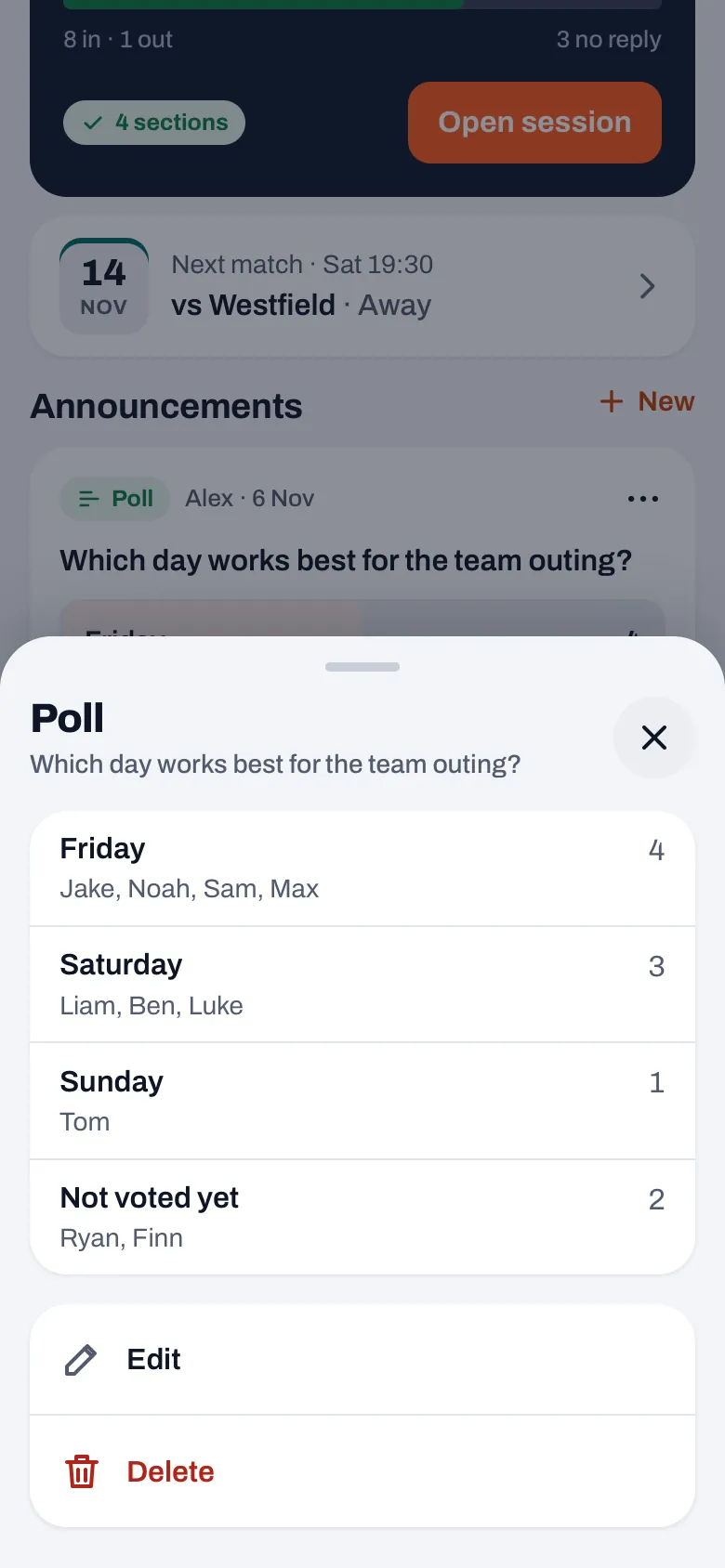
Once the winner is settled, post it as an announcement on the dashboard, so a new player can look it up before their first match. What Koach costs after 14 free days is on the pricing page.
14 days free, no credit card. Let your team vote on the cheer, and see right away who has not chosen yet.
Try Koach with your teamFrequently asked questions
What is a good cheer for a volleyball team?
A cheer that is short, that everyone can shout along with and that is about your own team. Call and response works well: the captain calls out a question, the team answers with the team name or a shout like Every ball. Keep it under five seconds, so it also fits after a time-out.
Can you do a cheer during a volleyball match?
Yes, as long as it does not delay the game and is not about the opponent. Communication between teammates is allowed under the rules. A time-out lasts 30 seconds; when the referee whistles to resume play, you go back on court. Insulting words aimed at the opponent or the spectators can lead to a sanction.
How do you make up a cheer with kids?
Keep it short and let the kids help come up with it. A question from the coach with an answer from the group works well with young children, as does clapping in a fixed rhythm with the team name. Let a different child start the cheer every week, but do not force anyone to shout alone up front.
How often do you do a cheer during a match?
Choose a few fixed moments: before the match, after a time-out and possibly before a new set. After the match you only do it once you have shaken hands with the opponents and the referees. Shouting it too often makes it ordinary, and then it loses its function as a signal.


Let your team choose
14 days free, no credit card. A poll is ready in a minute.
Get started with KoachOr read first what the volleyball coaching app does.