
Volleyball scholarship in the US: the steps and your coach's role
The short answer
A volleyball scholarship in the US comes from a college that wants you on its team: the coach offers an athletics scholarship, full or partial. You also have to be admitted and meet the requirements of the NCAA or the NAIA. Start about two years ahead with video, stats and contact with coaches.
A volleyball scholarship in the US sounds like a dream: study, play at a high level and have part of the cost covered. It is possible, but it takes planning. Here is how college volleyball is organized, when to start, what college coaches want to see and what your club coach can do for you, whether you live in the US or apply as an international student.
How does a volleyball scholarship in the US work?
In the United States, colleges and universities have their own teams that compete within an athletics association, and the coach of such a team can offer athletes a scholarship: a contribution to tuition, housing, food or books. In return you train and compete for that school alongside your studies. Women's volleyball is a fall sport and men's volleyball a spring sport; women's beach volleyball is a spring sport. That is in the NCAA's Guide for the College-Bound Student-Athlete 2026-27, the source of most facts below (accessed on 6 November 2026).
The largest association is the NCAA, with three divisions. There is also the NAIA, with about 250 schools according to its own site and its own Eligibility Center where every athlete has to register. And there are two-year colleges, with their own associations such as the NJCAA; from there you can transfer to a four-year school. According to the guide, the NCAA divisions differ like this (figures for 2025-26), with the NAIA and two-year colleges below them:
| Association | Athletics scholarships |
|---|---|
| NCAA Division I | Yes, including multiyear scholarships; according to the NCAA, 70% of athletes receive athletics aid |
| NCAA Division II | Yes, usually a partial scholarship; according to the NCAA, 77% receive athletics aid |
| NCAA Division III | No; according to the NCAA, 80% do receive other aid, such as an academic scholarship |
| NAIA | Yes; according to the NAIA guide, each school sets the amount, within a limit per sport |
| Two-year college | Its own rules; ask the college |
How many scholarships does a volleyball team have?
That changed in 2025. After the settlement in the House v. NCAA lawsuit, the Division I rules no longer set a maximum number of scholarships per sport, according to the NCAA's question-and-answer document (updated on 29 May 2026). Instead, schools that take part in the settlement have a maximum number of players per roster: 18 for volleyball, for women and for men, and 19 for women's beach volleyball (NCAA proposal 2025-11, in effect since 1 July 2025). A scholarship can be full or partial. Schools that do not take part stay under the old scholarship limits; if they give more, the settlement rules apply to them too.
So a roster of 18 is not the same as 18 full scholarships. Ask every coach exactly what they are offering: which part of the cost, for how many years, and what happens if you get injured. According to the NCAA guide, in many cases the head coach decides who receives a scholarship and whether it is renewed. If a school wants to reduce, not renew or cancel your scholarship, it must notify you in writing by 1 July, with details on how to appeal.
Note: these rules can change every year, and since the settlement a lot is in motion at the NCAA. Everything here was checked on 6 November 2026. Check it yourself with the NCAA or the NAIA before you decide anything.
When should you start?
Earlier than you think. According to the NCAA guide, the recruiting process can begin as early as ninth grade (year nine of secondary school, around age 14 or 15), but in most cases it starts in 11th grade, your junior year (outside the US: the summer after year 10), around age 16. That is about two years before you would start college. An example of a timeline:
- Two years ahead: talk with your coach and your parents about which level and which field of study suit you, and start collecting video.
- A year and a half ahead: email coaches at schools that fit you. Register with the NCAA or NAIA Eligibility Center by now at the latest; the NCAA guide even recommends doing that before ninth grade.
- A year ahead: conversations, visits (on campus or virtual), applying to the school and sending in your academic documents.
- The last months: an offer and a signed agreement, your visa if you come from abroad, and the final check of your eligibility. If you start in the fall, the NCAA guide says you can request that on or after 1 April before you enroll.
What does a college coach want to see from you?
The NCAA recommends emailing coaches yourself, with your achievements, a highlight video and why you are interested in their program, plus your name, position, NCAA ID and high school graduation year. If you get no reply, do not lose heart right away: depending on the sport and your grade, Division I coaches are sometimes not yet allowed to write back. What belongs in that email and profile:
- Video. A short highlight video, plus a few complete sets without cuts. In full rallies a coach sees how you move when the ball is not coming to you.
- Your details. Height, position, your approach touch and block touch (how high you reach when attacking and blocking), and which is your hitting hand.
- Your level, explained. If you play outside the US, a college coach probably does not know your league. Write what division you play in, whether you are part of a select team and who you play against.
- Your academic results. Your grades and the diploma you expect to earn.
- A reference. The name and contact details of your club coach.
Academics, amateur status and the other requirements
- Your academic records. For Division I and II, the Eligibility Center evaluates your education. If you went to school outside the US, the NCAA page for international student-athletes says you send transcripts from ninth grade on and your diploma in the original language, with a certified, literal English translation. There is a country profile for each country with additional information.
- Tests and admission. Since January 2023, standardized tests no longer count toward eligibility in Division I and II, but a school can still ask for them for admission or a scholarship. Approval by the NCAA is also not admission: you apply to the school separately. As an international student, also ask whether they require an English language test, and which one.
- Your amateur status. Among other things, the Eligibility Center looks at whether you have played with professionals, signed a contract, been paid or received benefits for your sport, won prize money or have a written agreement with an agent. If you play on an adult team where players receive something, check first. How that works on a professional route is in becoming a professional volleyball player.
- A gap year. If you wait too long after high school before enrolling and keep playing matches in the meantime, the NCAA guide says you can lose a season of eligibility for each year you keep competing. The time limits differ per division and sport; look them up before you plan a gap year.
Earning money while you study: NIL and your visa
Athletes at an NCAA school may earn money from their name, image and likeness (NIL), for example with social media posts or advertising. For international students on an F-1 student visa, it is much stricter. The international student office of Ohio University lists advertising, appearances at events, private lessons and camps, and signing autographs as things you may not do in the US, and recommends consulting an adviser and an immigration attorney before any NIL activity. So if you come from abroad, count on your scholarship, not on extra income. What volleyball players earn elsewhere is in volleyball player salary.
What can your club coach do?
- Give an honest assessment. Which level suits you, and where will you play instead of sitting on the bench? A coach who sees you practice knows that better than a website.
- Help with video. A camera on a tripod, high up behind the end line, with the whole court in the frame.
- Write a reference. Facts instead of superlatives: position, development, effort, attendance, how you deal with mistakes and with teammates. In English, and with the coach available for a phone call.
- Provide stats. If the team keeps statistics, they support the story, as long as the coach explains how they were collected.
- Help plan your year. Tryouts, exam weeks and visits fall in the same year; how to combine school and sport is in balancing sport and school.
What a coach does not do: make promises about a scholarship, or contact college coaches on your behalf without you knowing.
Film one complete match every month. At the end of the season you then choose from six or seven matches instead of loose clips on your phone, and you also see for yourself where you have grown.
Recruiting services: what to watch for
There are agencies that, for a fee, build a profile, edit video and contact coaches. That can save time, but it is not necessary: the NCAA actually recommends emailing coaches yourself. With an agency, watch for four things:
- Nobody can guarantee a scholarship. The college coach decides. A promise of a guaranteed scholarship is a reason to walk away.
- Ask what you pay and for what. What is included, what does it cost if no offer comes, and can you stop partway through?
- Ask about experiences. Talk to players who went through that agency, not only to the examples on its website.
- Read the contract. A written agreement with an agent is one of the things the Eligibility Center looks at. Check whether a contract with an agency falls under that before you sign.
Showing your development with Koach
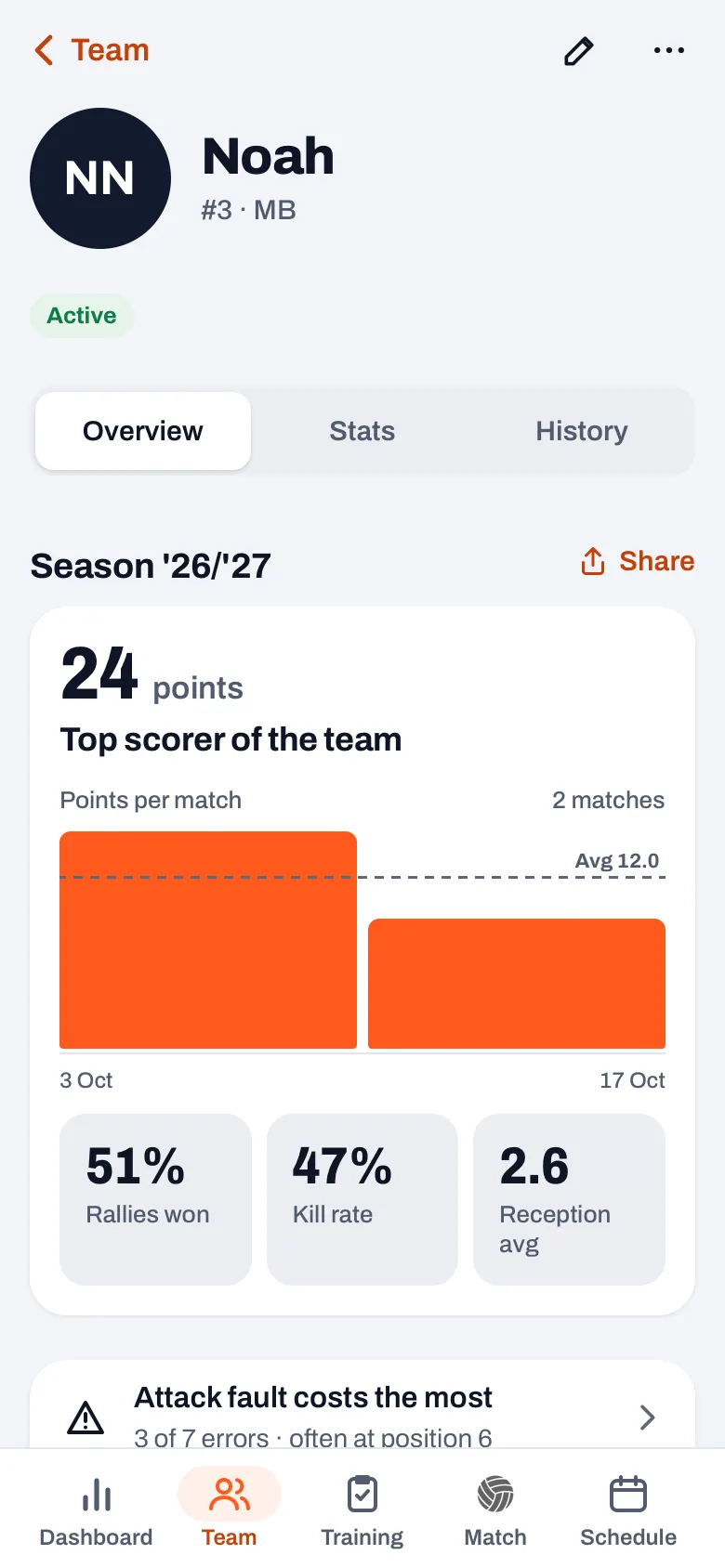
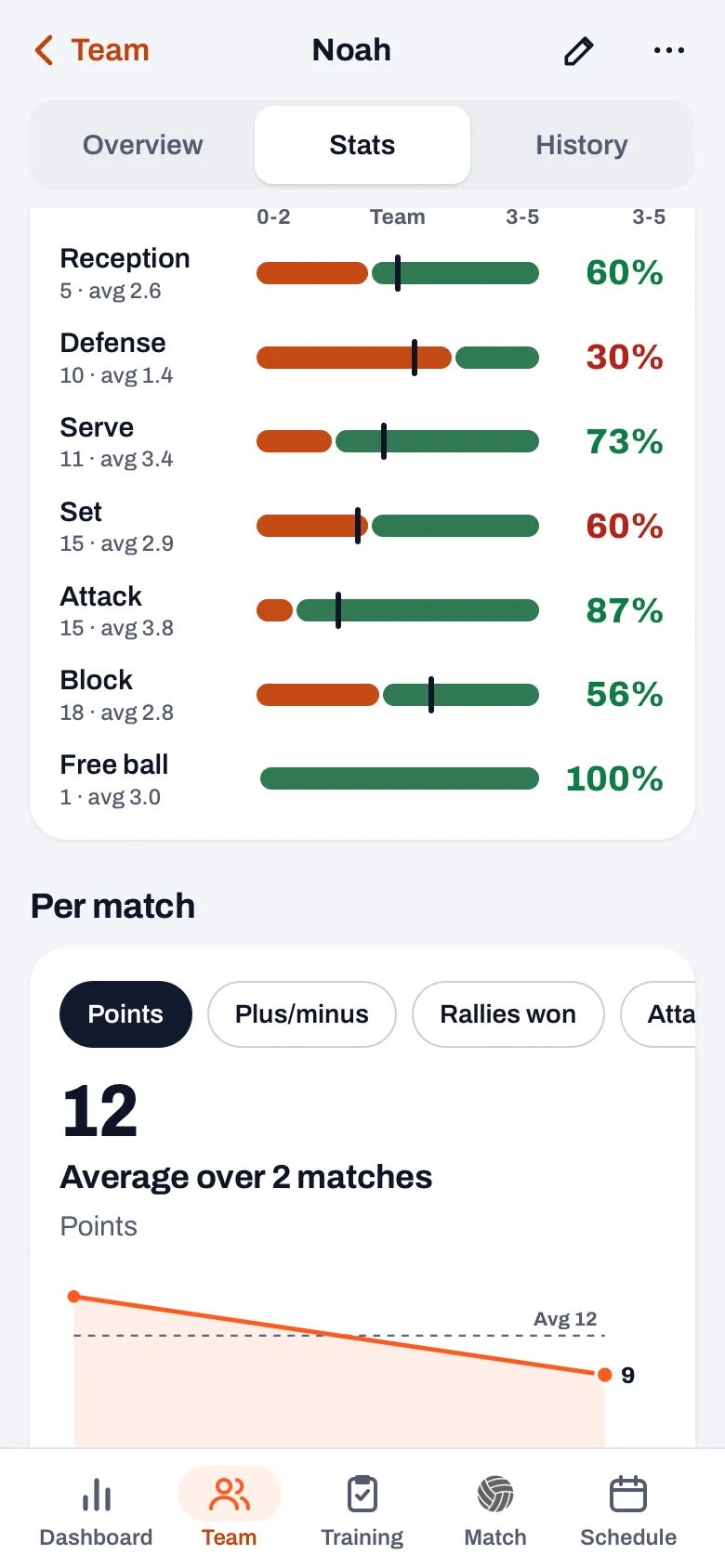
A college coach wants to know how you are developing, and a coach who tracks the season helps with that. If your team uses Koach, your coach keeps track of your season in your player profile: your points per match and the rallies won while you were on court. Under Stats you find your ratings from 0 to 5 per skill compared with the team (if your coach scores in Expert mode) and, under Per match, your points, plus/minus and rallies won per match. These are numbers from your own matches, not from an official body: they support your coach's reference, they do not replace video. Koach does not make videos itself. How coaches track development is in tracking player development in volleyball.
14 days free, no credit card. Track what your players show this season, so your reference rests on facts.
Try Koach with your teamAs a player you pay nothing: your account is covered by your team's subscription. What Koach costs after the trial is on the pricing page.
Frequently asked questions
Can international students get a volleyball scholarship?
Yes. US colleges also recruit players from other countries. You register with the NCAA or NAIA Eligibility Center, have your academic records reviewed with an English translation, and are admitted separately by the school. For your studies you need a student visa, and with it you may earn money in the US only to a limited extent.
Does a volleyball scholarship cover all costs?
Not always. A scholarship can be full or partial and can pay all or part of tuition, housing, food and books. Division III has no athletics scholarships, but it does have other aid such as academic scholarships. Ask every coach exactly what the offer covers, for how many years, and which costs you pay yourself.
What level do you need for a volleyball scholarship in the US?
There is no fixed bar. Division I is the highest level within the NCAA, but in Division II, Division III, the NAIA and at two-year colleges there is room for players of very different levels. Ask your coach for an honest assessment and show college coaches your video: they decide whether you fit their team.
Are there volleyball scholarships for men?
Yes, men's volleyball is also an NCAA sport; it is played in the spring. In Division I, schools that take part in the 2025 settlement have the same maximum of 18 players per roster for men and for women. How many schools have a men's team and what they offer is something you ask each school.

Make your players' development visible
14 days free, no credit card. Players pay nothing.
Get started with KoachOr read first what the volleyball coaching app does.