
How to become a professional volleyball player: route and age
The short answer
How to become a professional volleyball player: it is a long route through a good youth program at a club, selection for regional or national youth teams, playing at the top level of your country and often a move abroad. Height helps, but technique, game sense, coachability and the ability to handle the load decide whether you make it.
Becoming a professional volleyball player is a dream for many young players, but how to get there is vague for anyone on the outside. Here you read what the route looks like in broad lines, when the first selections happen, what you need besides height and what to watch for when you move to a club abroad.
What is a professional volleyball player?
A pro makes a living from volleyball: you have a contract with a club, and training and playing are your job. That is not the same as playing in the top league of your country. In countries where volleyball has a professional league, the top clubs are businesses with paid players and a full staff. In many other countries, players in the top division combine volleyball with study or work, and go abroad if they really want to live from it.
What a contract pays differs so much by country, club and level that figures you read online say little. Rather ask people who know it up close: players who made the move, your coach or your national federation. In beach volleyball the route is different: there you play tournaments with a regular partner, with the FIVB Beach Pro Tour at the highest level. This article is about indoor volleyball.
The route to professional volleyball, step by step
No two careers are the same, but you often come across these steps:
- Your club's youth program. Lots of practice, lots of matches, a coach who takes your technique seriously. Until your teens, a second sport is more likely to help than to get in your way; why is in early sport specialization.
- Moving up within your club. You usually take the first step up within your own club, to a higher youth team or an adult team. How coaches weigh such a step is in backing up promotion advice.
- Regional and national selections. Federations select youth players for regional and national youth teams. In some countries that comes with a training center or a school with an elite sport program. Ask your federation or your club coach how it works where you live.
- Youth national teams. The FIVB organizes world championships for teams under 19 and under 21, and since 2024 also under 17, and the continental confederations have their own championships. The national federations pick their players for those tournaments.
- The top level of your country. Playing time counts. A season of playing a lot in a team one level lower often teaches you more than a season on the bench at a top club.
- A professional contract. In your own country, or with a club abroad.
Another route runs through a university in the United States, where volleyball is played within the NCAA. There you combine study and high-level volleyball; you can still make the move to a pro club after graduating. You then have to meet the academic requirements and the sports rules of the NCAA. If you have already had a contract or money from a club, ask beforehand how that counts. The requirements for international students are at the NCAA Eligibility Center.
At what age should you start?
There is no fixed age at which it is too late. Many pros played volleyball as children, but there are also players who only started as teenagers, often after another sport in which they gained speed, jumping power or ball feel. There are, however, moments when selections happen. The youngest FIVB world championships are those for players under 17. Whoever is not on the radar by then can still break through later via the club, especially late developers: a player who is short at fourteen can be a middle blocker at eighteen.
Until about sixteen, what counts most is a broad base: master all the skills, play a lot and do not stand in only one position too early. A solid serve receive is something you need in almost every position, even if you later become a hitter.
What it takes: more than height
| Quality | Why it counts | What you do about it |
|---|---|---|
| Height | Attacking and blocking above the net | Nothing, but you choose a position that fits. Libero and setter need less height |
| Jumping power | How high you contact the ball | Strength and jump training, built up and supervised |
| Technique | Serve receive and defense are needed at every level | Lots of repetitions, also outside practice |
| Game sense | Reading and choosing in a fraction of a second | Plenty of play at a level that challenges you |
| Load capacity | At pro level you train almost every day | Build the load over years, rest, get complaints treated |
| Mental side | Pressure, criticism, less playing time, moving away | Dealing with mistakes, fixed routines, someone to talk to |
| School and languages | A plan B and a life in another country | Finish your education, learn languages |
More on height per position and the route for shorter players is in do you have to be tall to play volleyball, and on jump and spike reach in how high volleyball players jump. The rest of the table you can train. That is where you make the difference against players as tall as you.
Training like a future pro
- Ask for a plan. At the start of the season, ask your coach what you need to improve, and pick one or two points from that. How to work out such a plan, with extra reps and feedback, is in how to get better at volleyball.
- Train outside practice. A wall, a ball and twenty minutes a day give you more contacts than an extra practice a week.
- Build strength under supervision. Start jump and strength work with technique and low volume, preferably with a coach who knows the subject.
- Take pain seriously. Pain that keeps coming back in your knees, shoulders or back is not something you train away. Have it examined by a doctor, sports physician or physiotherapist before you carry on.
- Watch top-level volleyball. Do not just watch the spike, but what a player in your position does when they do not have the ball.
Choose every season the team where you will play. If you are torn between a higher team with little playing time and a team where you play every match, ask both coaches how much you will play. In a match you learn what you do not learn on the bench.
Moving to a club abroad
If you go to play for a club in another country, you need an international transfer, the International Transfer Certificate. It goes through the new club, the federations and the FIVB system. Without that transfer you are not allowed to play for your new club, so check that it is arranged before the season starts.
- Read every contract before you sign, in a language you understand, and have it checked by someone who knows the subject. Look at housing, insurance, what happens if you get injured and how you can get out of the contract.
- With an agent: choose one you can check, for example through players they already represent. Be careful with parties that ask for money up front and promise a contract.
- Talk to players who played at that club or in that league. They know what it is really like.
Making your development visible
On the way to a higher level it helps to see where you stand. If you play in a team that uses Koach, your coach can invite you to a player account with your own profile. As a player you pay nothing for it: your account falls under the team's subscription. Under Stats you find your ratings from 0 to 5 per skill, if your coach scores in Expert mode, and under Per match how your points develop over the season. On Overview you set a personal goal yourself, and drills your coach gives you as homework appear on your dashboard.
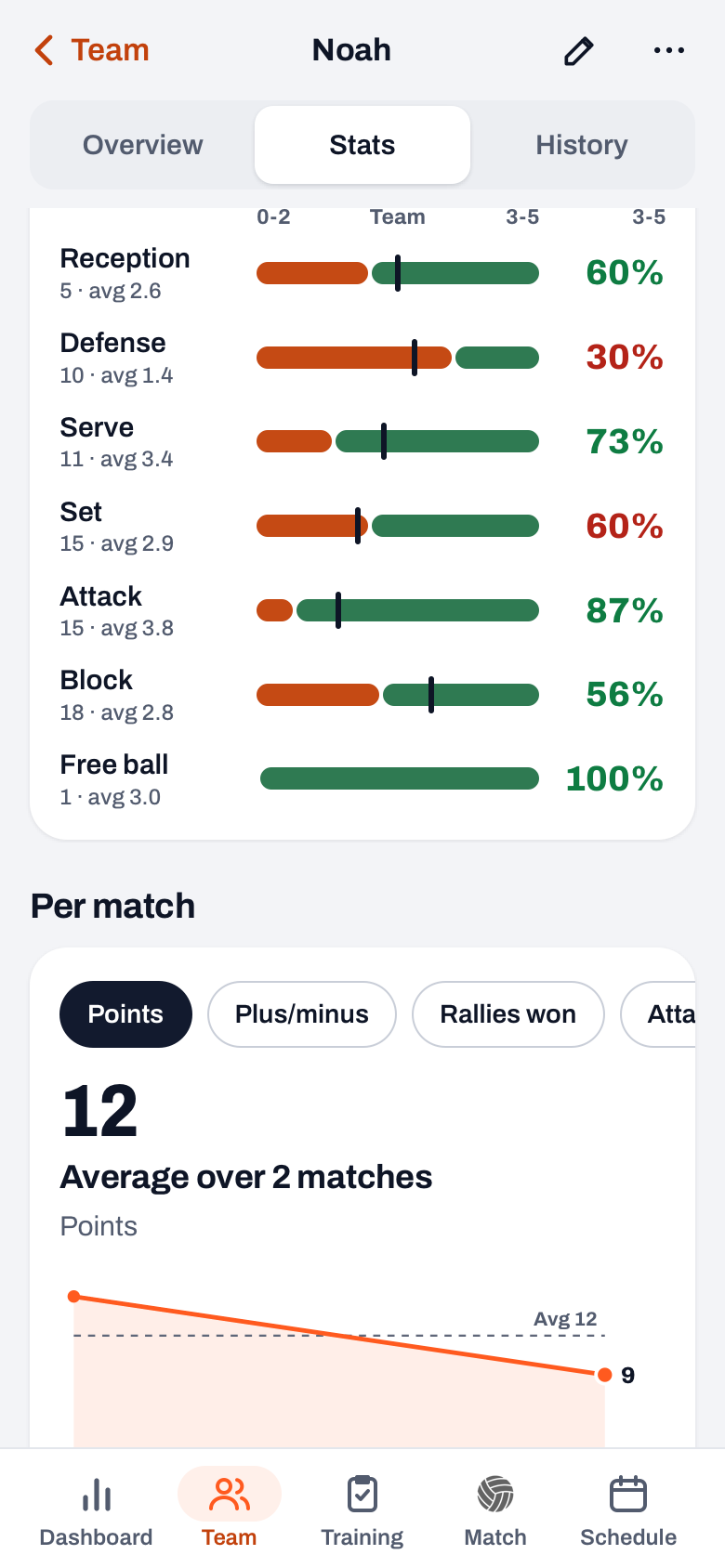
That gives you something concrete in the conversation with your coach or a selection coach: not just how it felt, but what you showed over a season. How coaches follow that development is in tracking player development in volleyball. Your coach can try Koach free for 14 days; what it costs after that is on the pricing page.
14 days free, no credit card. Let your team track the season in Koach, and see in your own profile where you are growing.
Take a look at KoachFrequently asked questions
How tall do you have to be to become a professional volleyball player?
The rules have no minimum height. At the highest level, hitters and middle blockers are usually tall, because they have to attack and block above the net. Liberos and setters are often shorter; there, serve receive, defense, vision and hands weigh more. If you are not tall, choose a position where height counts less, and work on jumping power and technique.
At what age do you become a professional volleyball player?
There is no fixed age. Some players sign their first contract as teenagers, others only after college or after a season abroad. The youngest FIVB world championships are for players under 17, but whoever was not selected for those can still break through later via the club, especially late developers.
Can you make a living from volleyball?
In countries with a professional league you can, in many other countries only at the very top or not at all. What a player earns differs so much by country, club and level that figures online say little. So finish your education and ask players who made the move how it works for them.
How do you get scouted as a volleyball player?
Selection coaches watch at federation youth selections, at tournaments and at matches in the higher divisions. Play at a level where you get playing time, take part in your federation's selection days and ask your coach to put you forward when they think you are ready. Footage of your own matches helps when a club abroad asks about you.

Make your growth visible
14 days free, no credit card. As a player you pay nothing: your account falls under your team's subscription.
Get started with KoachOr read first what the volleyball coaching app does.