
“Seven players on a Tuesday. And I found out at a quarter past seven”
On the difference between ticking boxes afterwards and knowing beforehand who is coming — and why Koach never forces anyone to answer.
Every coach knows the picture: a session drawn up for twelve, and at a quarter past seven there are seven people in the hall. Two injured, two ill, one with exams — and you hear all of it standing by the net. Most coaches track volleyball practice attendance perfectly well, but afterwards: a list that records what happened, not one that tells you what tonight will look like.
Dennis Boekhout (28) coaches a youth team and built Koach, the app where players sign themselves up or out. A conversation about knowing in advance, about the people who never reply, and about the night you are better off cancelling.
Where does this story start?
“On a Tuesday evening, two seasons ago. I had written out a session for twelve: three lines, block work, outside hitting. At a quarter past seven there were seven people in the hall. Two injured, two ill, one had exam week. And I heard all of it right there, standing by the net, already rebuilding the plan in my head.
“The annoying part isn't that seven turn up. Seven can be a brilliant evening. The annoying part is that I hear it at a quarter past seven instead of at four in the afternoon. At four I still have three hours to think of something else.”
But you were already tracking attendance, weren't you?
“Yes, afterwards. I ticked off who had been there once it was over. That's bookkeeping, not a tool. At the end of the season I knew precisely that someone was sitting at 68 per cent, and on that Tuesday itself it did nothing for me at all.
“Recording attendance and knowing who is coming are two different jobs. The first is history, the second is a plan. I only had the first, and for years I thought they were the same thing.”
How do those sessions get into the app in the first place?
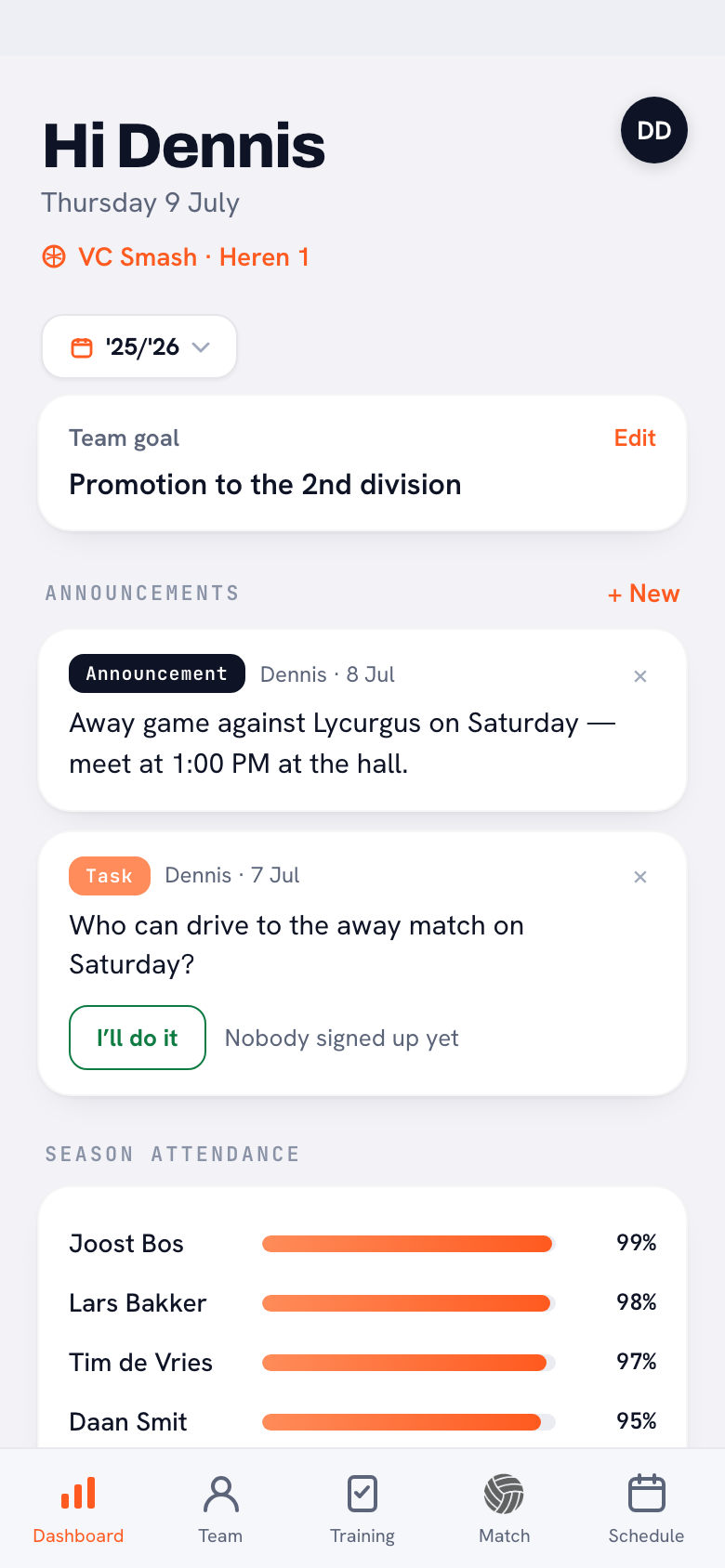
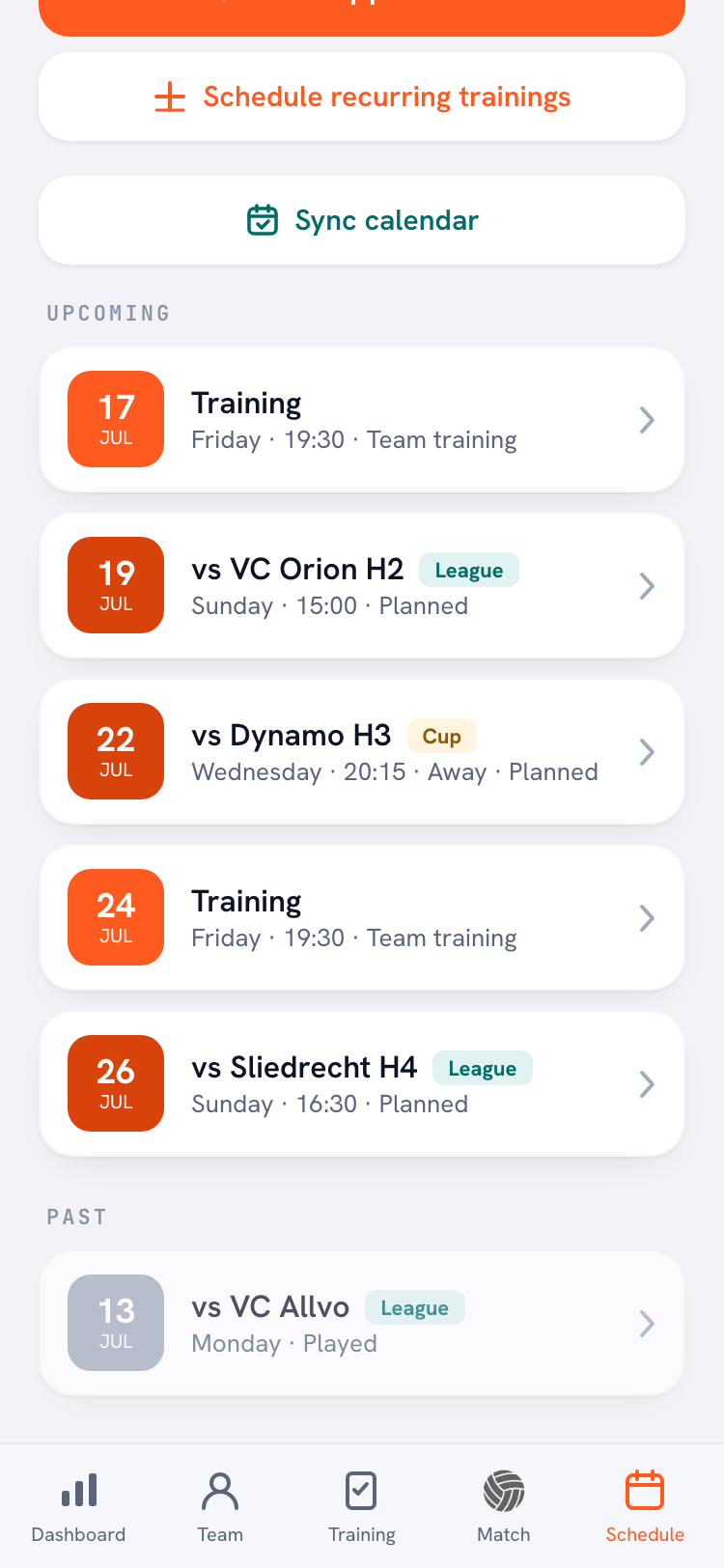
“Usually in one go. We train Tuesdays and Fridays, so you set that up as a recurring session for the whole season. After that, trainings and matches sit in the same schedule, split into upcoming and past, and you can sync that schedule with the calendar on your phone.
“It sounds like admin, but it's the condition for everything else. A player can only sign up for an evening that exists. As long as your sessions live in a group chat, there is nothing to respond to.”
So then you built a sign-up button. Why did that take so long?
“Because the button is the easy part. [laughs] A player opens the session and sees two buttons: I'm coming and Can't make it. That's all. Tap Can't make it and the app asks ‘Why can't you make it?’ with ‘Reason (optional)’ underneath.
“That word optional is the whole design. And there's a note line you can use with any answer, not just when you drop out. People who are coming sometimes have something to say too: I'll be a bit late. That wasn't there at first, and that was simply a mistake on my part.”
What about the player who is always there?
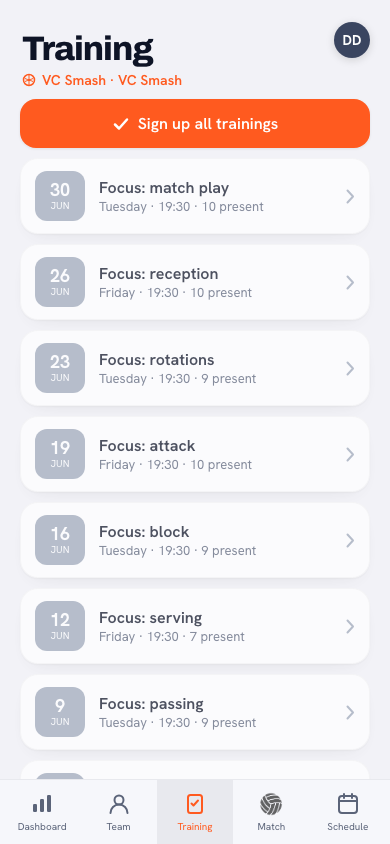
“He shouldn't have to tap twenty times. There's one button at the top: sign up for all sessions. Once at the start of the season, and after that he only has to speak up when he can't make it for once.
“And in that same list, every session already shows how many people are down for it. The player sees that counter just as I do. That matters to me: it isn't a monitoring tool only the coach gets to look at, it's just information about your own Tuesday night.”
Why isn't answering compulsory?
“Because a forced answer isn't information, it's noise. If you make someone commit on Tuesday to a session next week, you get a guess. And a guess sitting in your app is worse than an empty box — because an empty box you can at least see.
“So I made that third state visible instead of tidying it away. Anyone who hasn't answered is simply listed, at the bottom, marked as no reply. That's not an accusation, it's worth a phone call. Usually it's the same two lads, and usually they just turn up.”
What does the team itself see?
“A card called ‘Who is coming?’ with the counter above it: so many of so many present. Everybody is on it, sorted by answer: first who's coming, then who's coming to watch, then who's out, and at the bottom the ones who haven't said anything.
“One thing they don't see: each other's reasons. When someone types why they can't make it, they're typing it for their coach, not for thirteen teammates. You see your own reason, never somebody else's. That's not a technical limit, it's a decision — and it's the one I thought about longest.”
And what do you see as the coach?
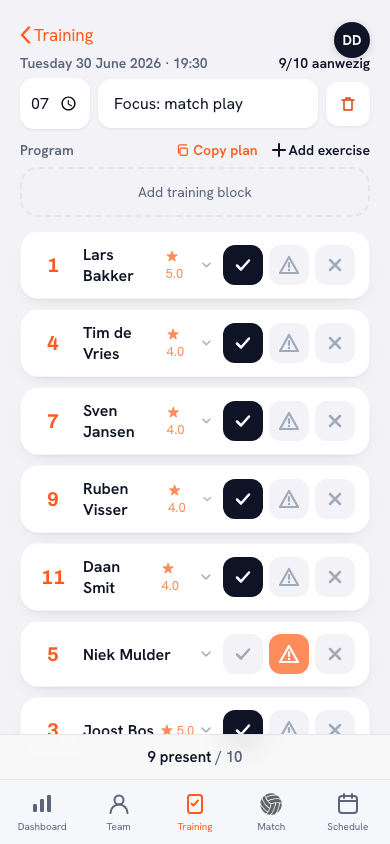
“The same names, but with three buttons per player: present, late, absent. That middle one is the most important and the hardest to guess, so there's a legend above the list. Late still counts as present — he was there, just later.
“And there's an All present button. It sets everyone who hadn't answered yet to present and leaves the rest exactly as it was. Anyone who marked themselves absent stays absent. In the first version that button overwrote everything, which meant one tap wiped the most honest information you had.”
How do you build a session that works for seven and for fourteen?
“By thinking in blocks you can stretch or fold rather than in fixed drills. A block-work section with three lines becomes two lines and an extra serving turn when seven show up. What's fixed is the theme of the evening, not the number of courts.
“And honestly, the gain isn't a clever feature, the gain is the timing. Knowing at four o'clock that you have seven is a completely different evening from discovering at a quarter past seven that you have seven. Same seven players, entirely different session.”
When do you cancel instead of pushing on?
“With my group the line is six. Below six you can't play anything game-like any more, so you end up training something other than what you planned. But that's my line with my squad; a youth team of ten can run a fine technical evening with six. You have to set that yourself.
“In the app, cancelling and deleting are deliberately two different things. Deleting took the whole attendance list with it, ratings included. Cancelling leaves everything standing and only lifts that evening out of your attendance figures, with a line saying it doesn't count. And it's reversible: there's a button to reinstate the session.”
Does the team hear about it too?
“Now it does. For a long time that was the most important missing notification in the whole app: I'd cancel the half seven session at five o'clock, see a green tick on my own screen, and nobody heard a thing. Meanwhile half the team had been told the night before that there was training tomorrow at 19:30. People drive to an empty hall on that.
“Now a message goes out straight away saying the session on that date is cancelled. It's the only notification allowed through the quiet hours. If you hear at ten at night that tomorrow's training is off, that's useful to you. And because the evening doesn't count in the figures, it costs nobody their attendance percentage. That's exactly right: a cancelled session is not an absence.”
Know by Tuesday afternoon who is coming
Put your squad into Koach, plan your sessions and let players sign themselves up or out. You see the count long before you walk into the hall.
Try Koach for free