
“A ten-year-old does not need to know his own attack percentage”
Volleyball coach Dennis Boekhout on measuring young players: what he records, what he deliberately leaves out, and why those are two separate decisions.
At the first youth match of the season there is always a parent on the sideline asking how their daughter is doing. Tracking stats in youth volleyball is tempting: the phone is out anyway, the app is counting anyway. But a number that makes perfect sense for a seventeen-year-old can drive a ten-year-old out of the game.
Dennis Boekhout coaches a youth team himself and built Koach. He explains where he draws the line: on age, and on how much of their own numbers a player ever gets to see.
From what age would you track a young player’s stats?
“That is one question short. There are two in there. What do you record, and what does the child get to see of it? Those are two separate decisions, and I watch coaches take them as one. You can record everything and show almost nothing. That is exactly what I do.”
Fine, the recording first. What do you track with the youngest groups?
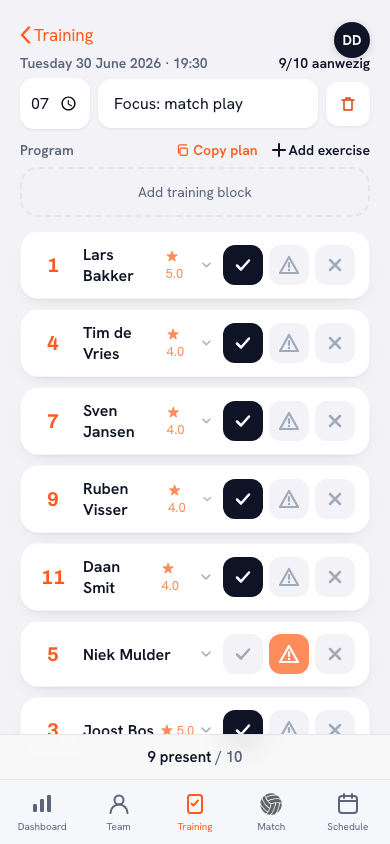
“Attendance. Nothing else. For the youngest category — the app calls it Mini, everyone up to eleven — I tick off who is there, who cancelled and who simply did not turn up. Three buttons per name, done in twenty seconds.
“And do not underestimate that. Half a season in, I know who is there every Thursday, including the rainy ones in November. That tells me more about a ten-year-old than any attack percentage.”
No points, no errors, nothing at all?
“No. With a ten- or eleven-year-old you are measuring the growth spurt, not the player. A kid who grows ten centimetres in February watches his numbers collapse because his timing has gone. That is not a dip, that is a body. On a graph it looks exactly like a dip, though, and that is how a child will read it.
“Besides, I know perfectly well who serves well. I do not need a percentage for that, I am standing right there every week.”
So when do you start counting?
“For us it turns around Youth C, twelve and thirteen. The app works that category out from the date of birth, so I do not have to calculate anything. At that age they start comparing themselves anyway. It happens in the changing room, with or without an app.
“From that point on it actually helps to have something that is accurate. Otherwise the changing room wins, and the changing room is almost always talking about the last match.”
And in matches you do record everything?
“Yes, but not in order to measure. During the rallies I tap in who won the point and how, because that is where my substitution and my time-out come from. The numbers still being there afterwards is a by-product.
“And look at what is left standing: counts. Twelve attack points is not a judgement about a child, it is simply what happened.”
Then the second part. What does a player see of it?
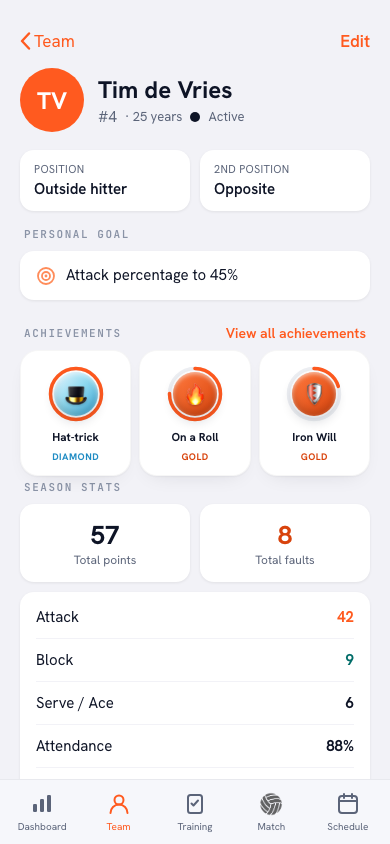
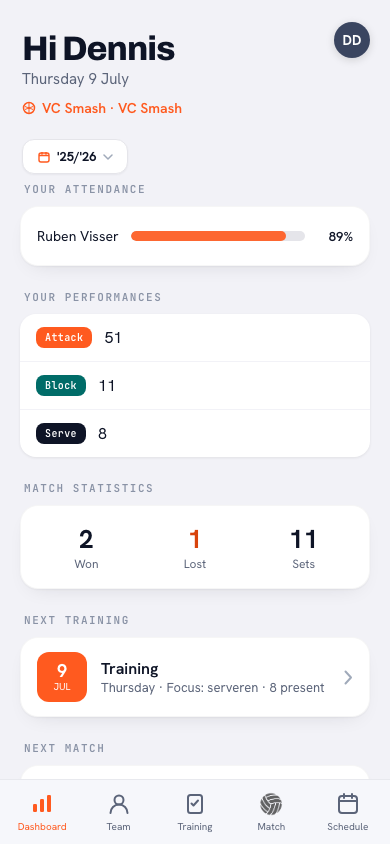
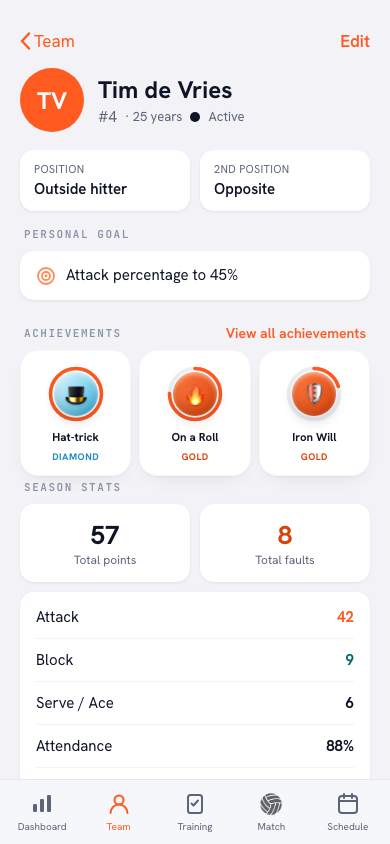
“Less than I do. That is not a setting I switched on, it is how the app is built. On my screen I get his profile: position, age, personal goal, the season figures, the errors. On his screen he gets his own attendance, his own points and the next session.
“The difference is in what disappears. He does not see my effort rating, he does not see my notes, he does not see his team-mates’ ages, and he cannot even open a team-mate’s profile. Comparing is something only I can do.”
Why the effort rating in particular?
“Because a star is a judgement and a point is a count. After a session I tap a name and give stars for effort. That is what I thought of it, on a Thursday evening, possibly after a rough day at work. Something like that does not belong unfiltered on the phone of a thirteen-year-old.
“Points per match I do leave in, graph and all. There is not much to argue about there. That difference between a judgement and a count is really the whole rule.”
And the parents? They ask whether their child is being judged on this.
“I get that question every season, and it is a fair one. A parent can be linked to their child in Koach. What they see then is what is being asked of their child: the next session, the exercise I sent home, the bar duty, whether they are driving. No numbers about their child.
“That is a choice. The moment a parent sees a number, the car ride home is about that number. And the car ride home is where the fun in this sport dies most often.”
And if a twelve-year-old asks for his numbers himself?
“Then I show him. Together, on my phone, with my voice next to it. That is something else entirely than a dashboard sitting in his pocket every evening.
“And there is one number that is genuinely his: his personal goal. It sits at the top of his profile and he can change it himself. With a seventeen-year-old it says something like ‘attack percentage up to 45 per cent’. With a twelve-year-old it usually says ‘make every training session’. That is fine too.”
Is there a switch to turn stats off completely for one player?
“No. There is not, and I am not going to invent one because it sounds good in an interview. What I do not record does not exist — that is my only switch. If I do not score a youth match live, there is nothing there afterwards.
“Is that a gap? Maybe. No coach has ever asked me for it. If it ever arrives, I want to know first what someone actually wants to shield: the recording or the showing. Those same two again.”
One piece of advice for the coach standing in front of ten-year-olds tomorrow?
“Start with attendance and do nothing else for a whole season. [laughs] I mean that. A full season of attendance tells you more than half a season of attack percentages with holes in it, and it costs you twenty seconds per session.
“And if you do start counting after that, ask yourself for every number whether you would show it to the child. If you cannot explain it in one sentence, it should stay with you.”
Measure without piling on pressure
Koach records attendance, effort and stats per player, and shows a player only their own numbers. Set up your squad in ten minutes and decide for yourself how far you go.
Try Koach free