
“Even in a Tuesday-night group, someone wants to know if they are improving”
Coach Dennis Boekhout on the objection he hears most often — there is nothing to measure at our level — and on the three numbers that do hold up.
The objection nearly always arrives in the same shape: our level is too low, there is nothing here to measure. To plenty of coaches, volleyball stats for recreational teams feel like a suit two sizes too big — attack percentages for a side that builds every rally differently, who is that helping? Dennis Boekhout, coach and the builder of Koach, thinks they are half right.
A conversation about the three things that do pay off at that level, about what he would leave alone with a recreational side, and about the switch that is not in the app.
What is the objection you hear most often?
“That the level is too low. Word for word: ‘There is no point for us, we are just messing about.’ I hear it from recreational sides, from Tuesday-night groups, from the coach of a sixth team. And I understand it, because what people picture when they hear the word statistics is a scoring sheet with fifteen columns and somebody who spends the whole evening not looking at the court.”
Do you agree with them?
“Half of it, yes. Attack percentages say very little when the build-up is different every rally. If the pass sits nicely on the setter one time and lands three metres off the court the next, you are not measuring the hitter, you are measuring the accident in front of him. You do not need an app to see that.
“What I do not agree with is the conclusion: so we record nothing. That is a jump from ‘this one number is wrong’ to ‘every number is wrong’. There are three things that hold up at any level, and together they cost you less than two minutes an evening.”
Which three?
“Who was there. Who played. And whether the type of error shifts. That is it. You already half track the first two in your head anyway, and the third one you do a couple of times a season.
“The nice part is that none of the three has anything to do with standard. An attendance percentage means exactly the same for a first team as for a group that turns up on Tuesday to sweat and laugh: this is how often you were there.”
Why start with attendance rather than with the game?
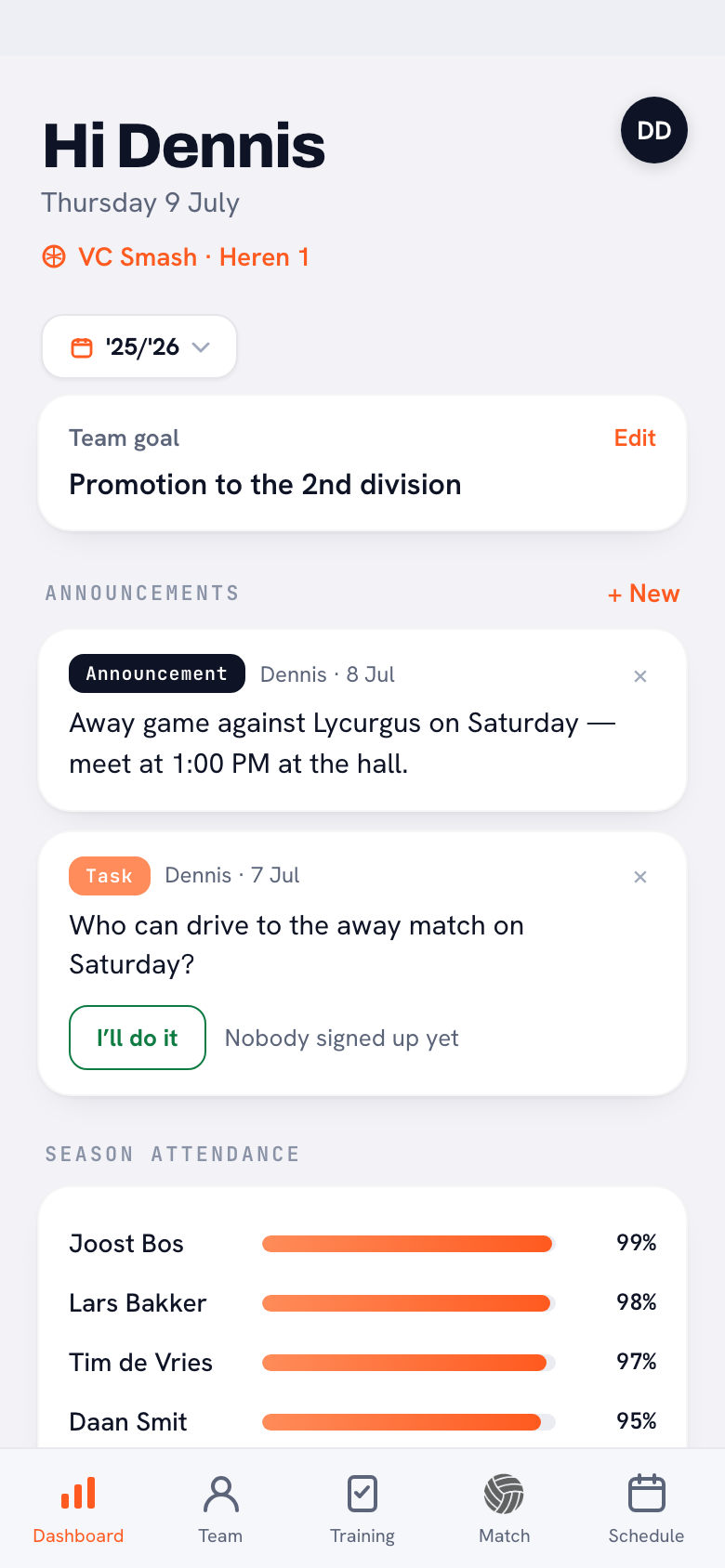
“Because it is the only one you need anyway. You have to know whether you have six players on Saturday. That a season figure falls out of it along the way is a bonus — you are not doing anything extra for it.
“And it gives you the fairest conversation there is. When someone grumbles that he hardly plays, a recreational coach has two options. Give the gut answer, or say: look, you were here eight times out of sixteen. That is not an accusation, that is just the screen. I also tick ‘late’ now and then, and there is often more information in that than in any attack percentage.”
The second one: who played. What do you do with that?
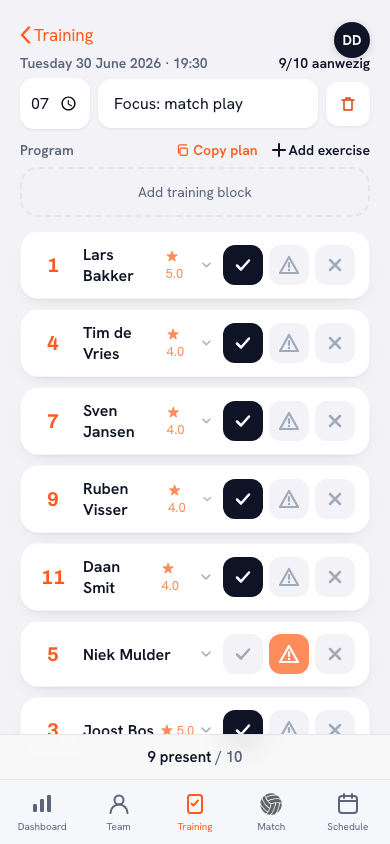
“In a competitive squad you call that playing time. In a recreational side it is something else: it is a check on your own fairness. Everybody says they rotate properly. Almost nobody checks it.
“After a match I can simply see who was in and who was not that day. That is one tap while saving the result. Three months later there is no argument left about who ‘always sits on the bench’, because it is written down. And if it turns out the complainer was right, I know that too, and that is half the value.”
And the third, the type of error. That does take work, surely?
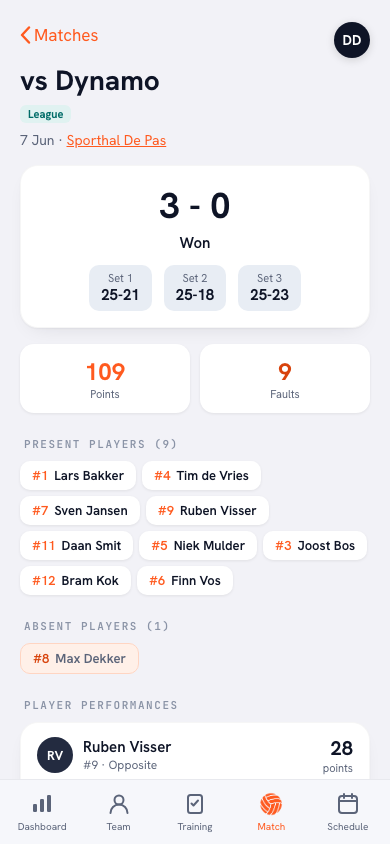
“It does, and it is the only one of the three I would not do every week. The app knows six types: service fault, attack fault, bad pass, too late, net fault and other. To fill those in you have to watch rally by rally, and that is exactly what a recreational side does not need.
“My advice: do one set. Not the whole match, not every week. One set in October and one in February. You do not have to do anything with percentages afterwards, you just look at whether the pile has shifted. If October was mostly service faults and February is mostly net faults, something has changed. That is a training topic, and it is one nobody would have picked on instinct.”
What would you leave alone with a recreational team?
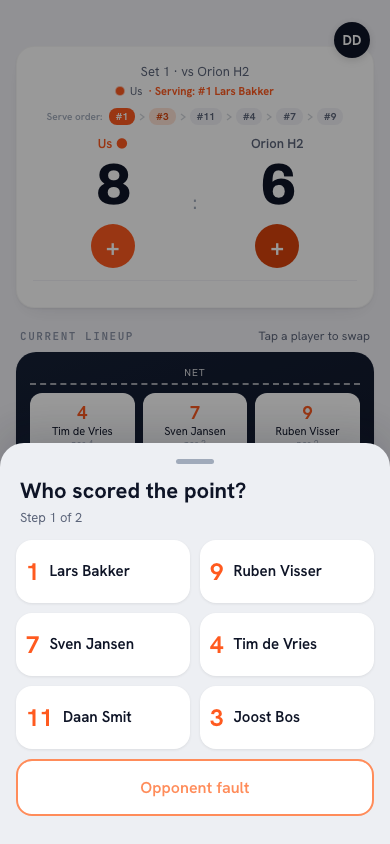
“Scoring rally by rally. That screen was built for a match that matters: you tap who scored, then how. Two taps per rally. On a Tuesday evening you end up looking at your phone all night instead of at your players, and nobody asked for that.
“I would leave the star ratings alone as well. Technique, game awareness, coachability, work ethic, effort — that is five sliders per player per session. In a selected squad that is worth a conversation. In a group that comes along for the fun of hitting a ball, you turn it into appraisal night, and then you are dismantling exactly the mood you were supposed to protect. [laughs] Do not ask me how I know.”
Is there a ‘no statistics’ switch in the app?
“No. And I should just say that plainly: there is no toggle that puts a team into a lighter mode. What you switch off, you switch off by not doing it. Record no points and there is no points list — there is literally nothing there. And as long as you send your players no invitation, nobody else has a screen to look at either.
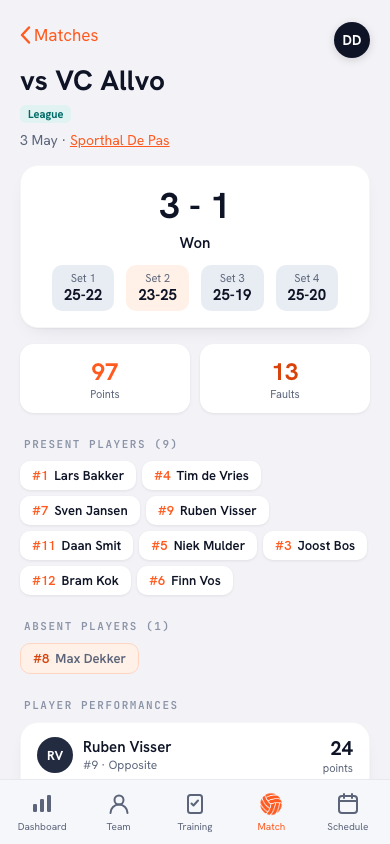
“What does exist is the middle road. You can enter the result afterwards, even days later: type in the set scores, and after that you may fill in points and errors per player. May, not must. Leave those fields empty and you have a match with a result and an attendance list, and that is that. One thing to know: errors you type in afterwards land under ‘Other’ in the error breakdown. You lose the type.”
And the badges? Do they not hand out prizes by themselves?
“Only if there is something to hand out. The performance badges — MVP, Top Attacker, The Wall, Ace Machine — need points. Do not record any and they never appear. Nothing is invented.
“What does keep working are the badges about attendance and character: On a Roll, Iron Will, Day One, Loyal Player. And honestly, at recreational level those are the only ones that mean anything. Nobody in that Tuesday group is going to be top scorer of the year. But somebody is still turning up every week in January, and that is allowed to be noticed.”
Back to the line we started with — that someone there wants to know whether they are improving too.
“Yes, and that is the bit coaches underestimate. People do not take up a sport in order to stay nothing. Even in a Tuesday-night group, someone wants to know if they are improving. It is just that ‘improving’ there means something other than an attack percentage.
“It is: I turn up more often than last year. I no longer hit three into the net in a row. I dare to serve now at 22-22. Those are not statistics, those are sentences. But two of those three you can back up with what you are recording anyway, and that makes them credible instead of kindly meant.”
Where would you start if you took over a group like that tomorrow?
“Eight weeks of attendance and nothing else. No scoring sheet, no ratings, no conversation about data. Just tick off who is there at every session.
“Then look at it once, calmly. If you think: that was useful — fine, expand. If you think: this tells me nothing — also fine, you stop and you have lost eight times thirty seconds. That is a fairer test than my opinion, or anybody else’s.”
Start with who showed up
Put your team into Koach and for eight weeks tick nothing but who turned up. No scoring sheet, no ratings. Then look once and decide for yourself whether it helps.
Try Koach for free